

Day 6
Ghardaia I
The Ibadite pentapolis: charm, mystery and a sense of tradition
Towards the Mozabite pentapolis
We cover another 200 km through the desert, on a road that cuts it in two like a blade; little traffic and a sun that shines without beating down. The coach labours up the climbs that appear now and then, revealing the flat immensity that opens up once we crest the rise. The apparently unchanging landscape leaves the mind free to think, except when it shifts from time to time into rockier formations and expanses of sand, sometimes both contained within the same visual horizon. The eye distracts the mind, but the apparent monotony soon returns to encourage new thoughts. The desert is like the fire in a fireplace: it seems always the same, but in reality it is always different; it is far more magnetic than a television screen. A few bushes, a couple of oil wells and some wild dromedaries grazing freely are the modest haul of the road. A coffee stop, then we set off again and find ourselves before what will be one of the highlights of the entire journey: an oasis, or more precisely a series of oasis towns made famous by their history and by the environment in which their inhabitants live. We arrive at the edge of a depression where the various inhabited nuclei appear with their palm groves: the pentapolis of Ghardaia amazes both for its location and for the specificity of its traditions, inseparably linked to one another. The Mozabites, followers of the Ibadite current of Islam, were pushed into these deserted and inhospitable areas by stricter Sunni communities between 800 and 1,000 years ago. They ended up developing a highly solidaristic society, a necessary element for facing the difficulties presented by the nature of the place, forming communities with precise rules still followed today.

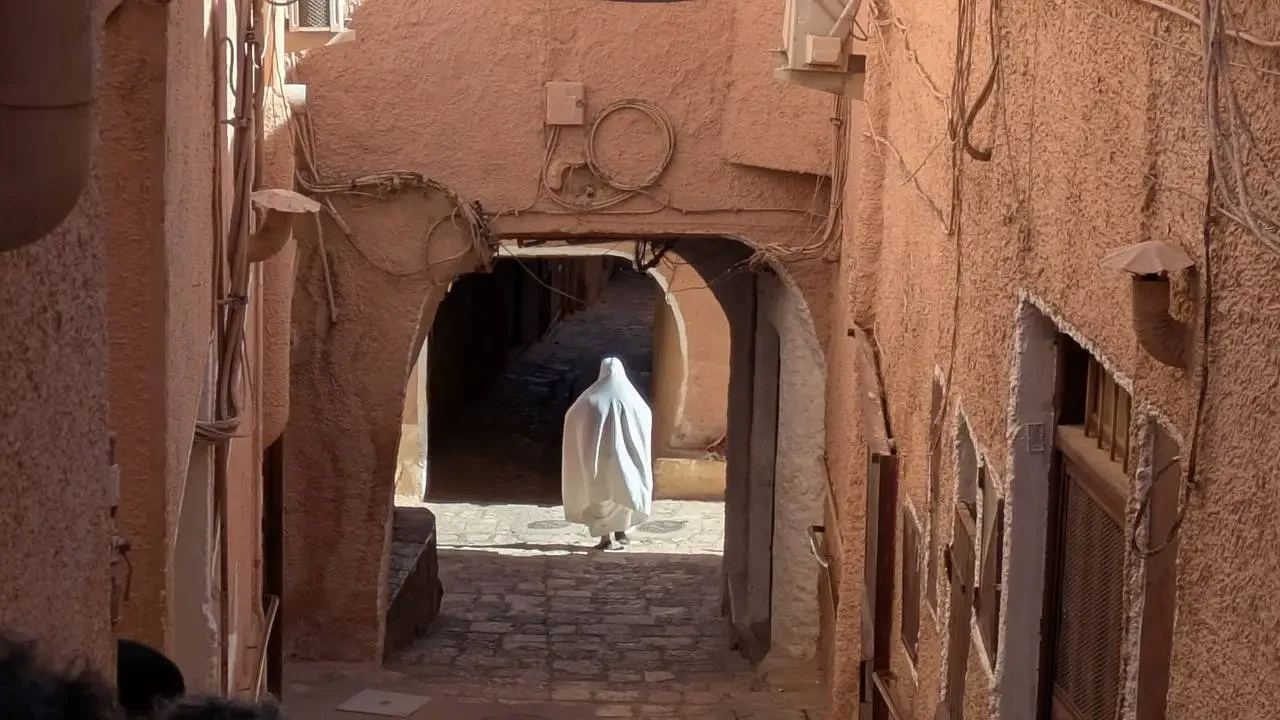
It feels like a leap into the past, and one truly has to leave Western eyes and assumptions at home when seeing women entirely dressed and covered by the haik, the long white veil that leaves barely one eye uncovered, one only. It is an unsettling sight: like ghosts from the past, they timidly move through the narrow lanes of the old city. Of course one cannot expect absolute uniformity in their behaviour. Some dare to look at us, foreigners being few and at least arousing curiosity, and scan us with the only pupil allowed to observe the outside world from its orbit. Others withdraw, passing close to the walls loaded with modesty, as if naked, or even turn back. Others stop and turn towards the wall just at the sight of our coach. In reality we will discover that women are not treated badly; they simply do not belong to active society. At home they rule, outside they simply do not exist. On this subject it is difficult to find a synthesis between our world and theirs.

When we arrive in the town, the density of housing and the narrow streets force us into a ten-minute queue, which seems incredible since we are in fact in the middle of the desert. The first and most important of the five towns is Ghardaia itself, which gives its name to the pentapolis.
Ghardaia, souk and daily life
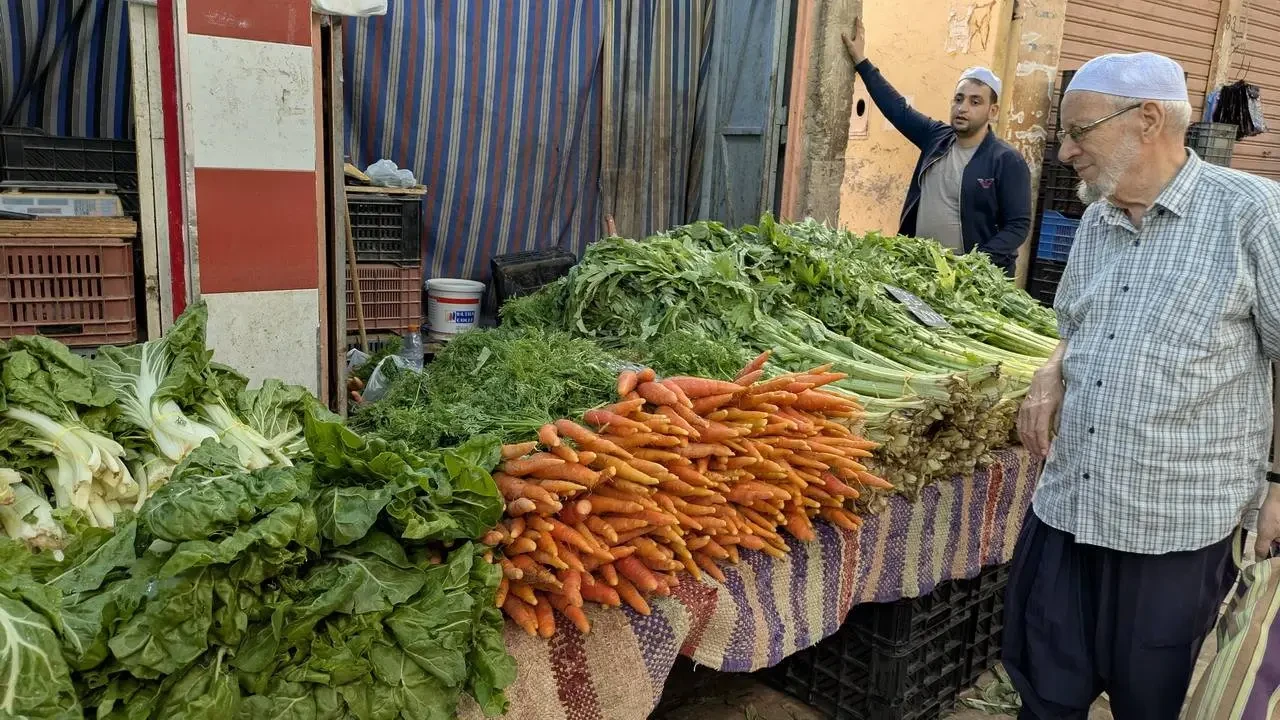
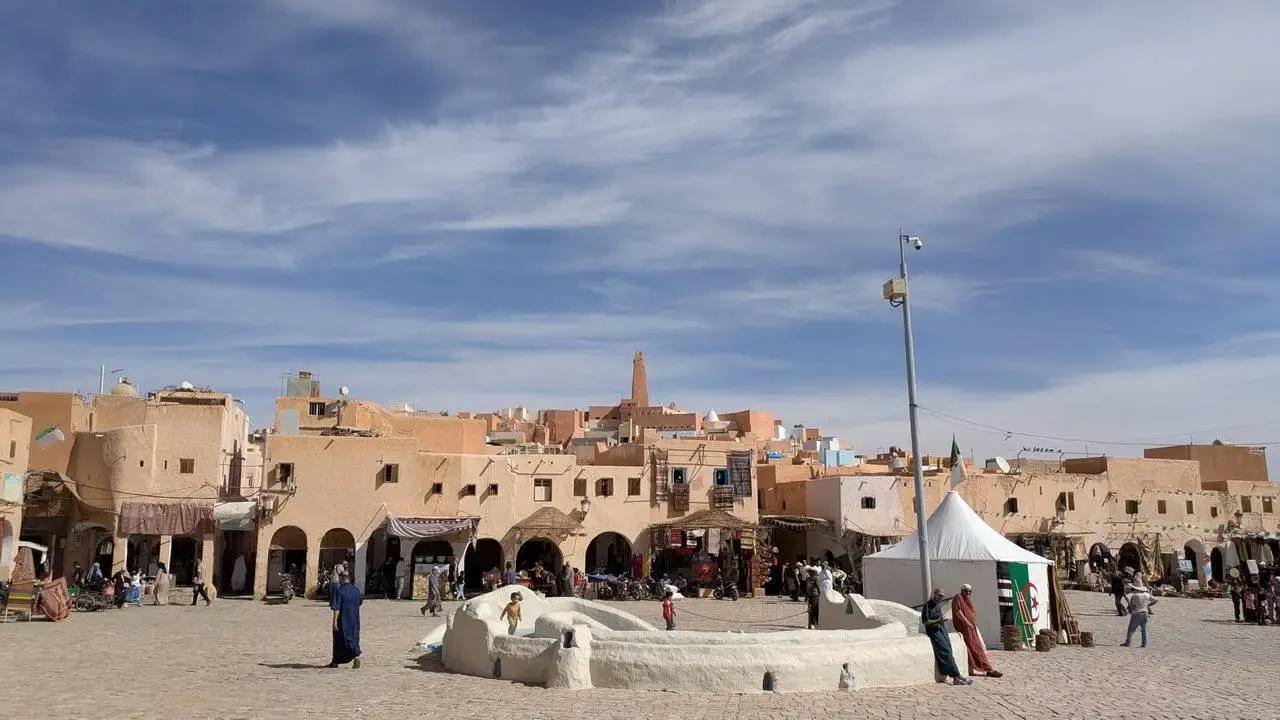
We visit the market area, the souk, dating back a thousand years, where barter took place between citizens and merchants from outside. It is the only area where one may move around alone. We take a walk, making our way among colourful and richly stocked stalls: we see vegetables whose existence we did not know, fish and inviting spices. The shops displaying Berber carpets are splendid, with colours not too bright and geometric designs. The clothing too, sober and not excessive, with Berber decorations, is truly elegant. When we innocently begin to climb the first steps of the stairway, we are politely told that the upper part can be visited only with a guide, which we are scheduled to do shortly.

The local guide speaks good French and represents one of the local families, which counts 5,000 people. Being a guide does not only mean showing visitors the beauties and history of the city; it is also a form of prestige because it allows interaction with foreigners. He worked as a doctor managing the gynaecology ward of the local hospital, retired, and now holds this administrative-political role, in addition to guiding.
The first curiosity to satisfy is obviously how the miracle of water is possible. He tells us that at a depth of 40 metres there is an aquifer and that in the 1930s and 1940s the French carried out explorations to see whether there was oil. At 400 metres deep, however, they discovered that there was indeed gold, but not black gold: white gold, an ocean of water stored in the bowels of the earth. Not wishing to be disappointed or miss anything, at 800 metres they also found oil. Thanks to the discovery of the new aquifer, agriculture received a boost and urban development followed, all in compliance with the strict rules governing the Ibadite society of the pentapolis. Furthermore, the soils here are more fertile because they have been less exploited than those in the north, which favours a much better yield. Many inhabitants normally have two homes: one in town for the winter season and a simpler one for the summer in the palm-grove area, to benefit from the shade created by the trees. Rain is rare, only a few days a year and with little intensity in spring or autumn.
Mozabite society and community rules
The social order of the towns that form Ghardaia is a kind of perfect communism, a society in which, at least as we are told, equality and sharing are non-negotiable principles. The houses are all alike, and those who have more are expected to share with those who have less, so that in theory there should be no poor people, though one does see beggars in the souks, especially black children, perhaps immigrants. Distinguishing narrative from reality is not simple, but life in such a hostile place in past centuries could not do without a deeply rooted foundation of solidarity. An example that still seems current is that of multiple weddings, in which wealthy people also cover the expenses for poorer couples so that in one ceremony everyone can marry and celebrate as if social differences did not exist, sometimes reaching fifty weddings on a single occasion. The assembly of families has a higher value, and therefore greater power, than the mayor or provincial president themselves, and also constitutes the authority of what we might call the judicial power. If, for example, there is a dispute within a couple and the wife expresses her point of view or complaint, the husband is summoned by the council, which has a religious basis because it is represented by the imam and some wise men. They listen to him and, if his arguments are not accepted, ask him to repent. If he does not, he is literally ostracised: if he has a shop, nobody buys from or sells to him, nobody speaks to him and, in short, he is marginalised in a social context where the concept of community is deeply felt and characterises Mozabite existence.
At the highest point, as in the other four towns, stands the mosque with its attached minaret, square in plan in the North African style. The paint on the houses is not smooth; we will discover that it is roughened to leave tiny shaded areas and thus prevent the houses from overheating. The Mozabites are a population of merchants, and their carpets are among the most prized in Algeria. Men often move to other cities in the country, if not abroad, in order to sell them. In terms of clothing, Ghardaia is a case apart even within Algeria: as mentioned, some women wear the white garment, the haik, leaving only one eye free; others wear a classic dress or show off the hijab, whose fabrics convey an image of class at first sight; others still, a few, wear jeans while keeping the face wrapped in a veil. Men wear curious trousers whose crotch drops almost to the ankles, pleated with style but rather unusual to our eyes. Others wear more typical tunics with the classic turban in the Tuareg style. Many dates are grown here too, although the quality is slightly lower than in Biskra. Places to have lunch are rare in the area, so we take the vehicle again and go to a very crowded lunch restaurant with good-quality dishes.


It is time to see the second town too, El Atteuf. Here as well we are handed over to the guide, a characteristic and energetic elderly man who, in his typical trousers and leaning on a stick, takes us to discover what we might call his little kingdom. He acts as host, tells history and anecdotes, and chases away boys and girls who mischievously peek at the foreigners, breaking the moral rule. Until some time ago Ghardaia was divided not only geographically into five towns, but each had professional specialisations: in El Atteuf there were mostly butchers, while Ghardaia stood out for commerce, others for textiles, and so on. Today there are no longer professional distinctions, only tendencies handed down from one generation to another in a context of professional diversification.

For privacy reasons, the windows of the old city may not face one another from house to house, and the doors are also staggered to preserve this concept of reserve. There are niches similar to guard posts carved into the walls of buildings, allowing men or women to withdraw so that a passer-by of the other sex can pass. This rule applies to both sexes, but in principle it is men who must make the first move in hiding their gaze, at least lowering it when crossing a woman. The fact that women are expected to behave and dress differently from what is found in much of the Islamic world should be traced more to rooted and ancestral traditions than to real religious precepts. In the Islamic world, except in countries where fanaticism reigns, it is rare to see such separation combined with de facto segregation, relegating women outside public society. This should not, however, be confused with mistreatment of women, at least not physical mistreatment.
El Atteuf and Beni Isguen
It does not escape notice that in this region there are many black people, the result of past and recent immigration as well as descendants of slaves who arrived in past centuries. We also see many children around: they are at home because they have been granted a week's holiday close to November 1, the revolution holiday. Or rather, the date on which the war of liberation began in 1954.
With our guide we climb the narrow streets leading to the mosque, then descend beside the cemetery and visit the modest white mosque lying in a square at the bottom of this small valley. Inside we meet some ladies and girls who "shamelessly" welcome us by offering cakes, biscuits and tea. Our man does not seem to appreciate the surprise very much; it is hard to understand whether it is a gesture of rebellion, an unplanned welcome or one not authorised. We are favourably impressed and exchange a few words in the limited French they know, but it is a pleasant experience.
The third visit is to Beni Isguen. In truth there is not much difference between the towns, but the beauty lies precisely in seeing daily life and the simple architectures clinging to the climb that leads to the mosque, always located at the highest point. The old entrance gate opens onto the market square, where we watch an auction. Before a few spectators, the seller tries to raise the price of a piece of furniture and some other object of little value. In the past this selling system was common practice, when wood and foodstuffs such as lots of fruit or vegetables were auctioned. The seller stood before potential buyers, who had to look forward without seeing what the others did. A price was proposed, for example 100 for a certain product; someone nodded, the seller increased it, another nodded, and the scene repeated until nobody said yes anymore. At that moment the product was considered sold. Climbing the little streets amid children celebrating the holiday atmosphere, we reach the square where the mosque stands, from which there is a fine view over much of the pentapolis. The sun is now disappearing and so do we, heading to the hotel in a dominant position, and later to the restaurant about fifteen minutes away by coach for a good dinner in a typical setting, where drapes and carpets create a particular atmosphere. We will learn to eat dates with sour yoghurt as an appetiser and discover the refined taste of drinks and soups typical of the area, in which date juice and couscous are harmoniously worked together with a medley of tasty spices.


