Day 11
Shigatse
Shigatse: politics and religion at the Tashilungpo monastery. Shegar: first view of Mount Everest!
Morning in Shigatse
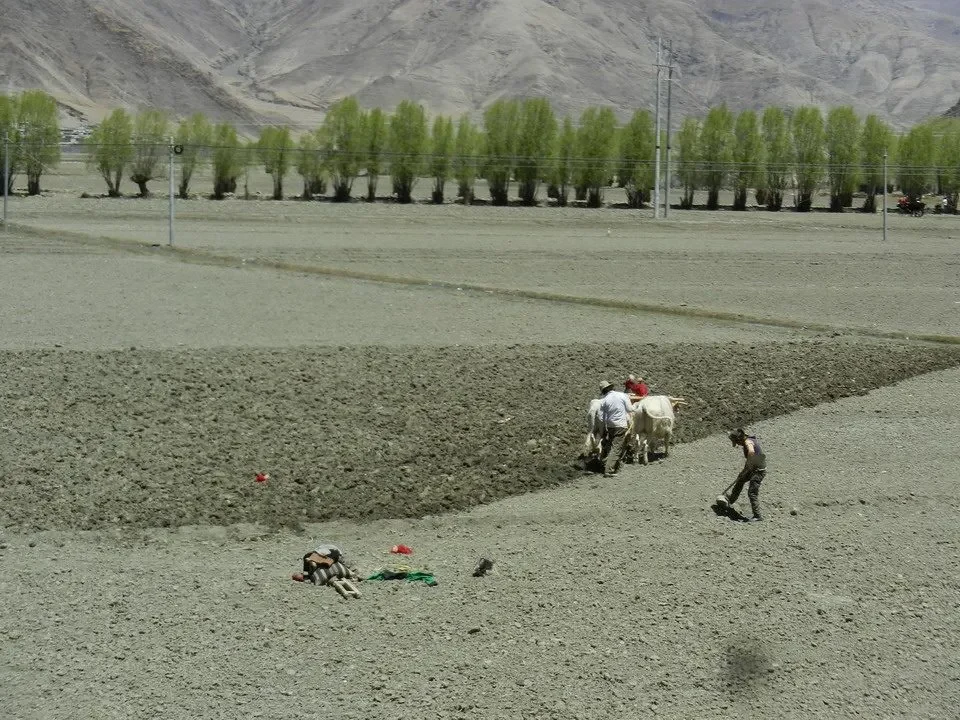
Breakfast in the usual Tibetan style., simple and without the pretensions of luxury that no one here can afford. But the most interesting aspect is the vibrant decor, it feels like stepping back in time, where tradition marked every aspect of daily life. The sky seems to emit its own light, originating from its cobalt hue, while the sun slowly rises on the horizon, warming the day with intense colors without significantly affecting the temperature. The area we are crossing between Gyantse and Shigatse is primarily agricultural, barley cultivation, and there are extensive areas that are being plowed these days. These are private farms where there is a simple form of mechanization, very different from what we saw in Nepal. The willow tree is one of the few plants found on the plateau; it serves as a windbreak along the roads and to protect houses, and it is very resistant to both wind and altitude. It is also used as building material. The domestic structure is normally two-story: on the ground floor there are the animals and the storage area, while upstairs is the living area.
Before entering the city, we head to the local police station where the guide tries to obtain permits to continue, specifically to go towards the western part of Tibet. Another one will be needed to enter Everest National Park. This is pure bureaucracy designed to create difficulties and discourage mass tourism. For those with the necessary documents, it's simply a formality. However, it would be absurd to come all this way and then be sent back to one of the many fixed checkpoints along the route. But issuing only one permit in Lhasa would have diminished the adventure.
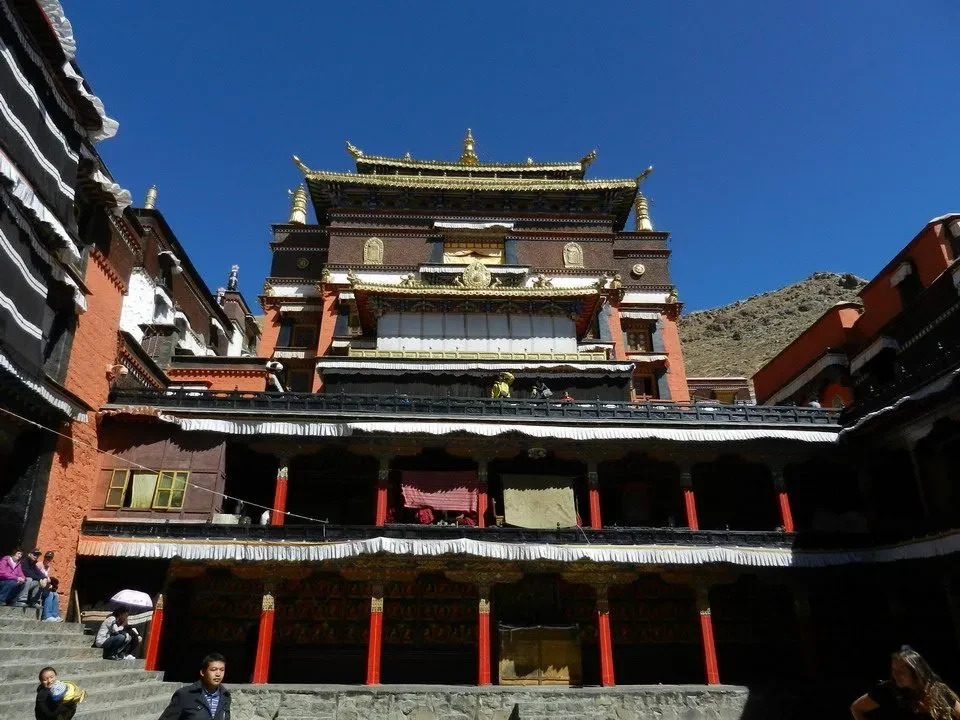
To be honest, the police station in Shigatse is not yet open, or rather, the officer who stamps and signs documents hasn't arrived (even though it's already 9:30), we will return later. In the meantime, let's go visit that mix of pure faith and government-aligned religion, which is the monastery of Tashilongkpo The first is made up of worshippers who pray intensely, and who... Yak butter (In reality, it's a vegetable oil, at least in this case) due to devotion, and which, again out of devotion, leave large sums of money to the monks. On the other hand, there is a religion that has been bent to the will of Beijing. In the past, there were 3600 monks, but now only 800 remain. During the Cultural Revolution, they were scattered, forced to marry, or taken to re-education centers, from which few emerged alive. Currently, to become a monk, one must be authorized by a government agency (which we could define as a new form of theocracy), in exchange for receiving a salary like any other public employee, while donations from believers go into state coffers. This is at least what we have read on several occasions, obviously outside of China. Furthermore, the monastery is particularly significant and "delicate" because it is the chosen seat of the Panchen Lama (the second highest religious figure in Tibetan Buddhism). With a structure that can be briefly described as the vice-president (Panchen Lama) appointing the president (Dalai Lama) and vice versa, we currently have a Panchen Lama appointed by the Dalai Lama many years ago, but kidnapped at a young age and disappeared somewhere hidden in China, and another appointed by the Communist Party, who found among its ranks a particularly zealous and sensitive monk to the issues of the capital and appointed him as head of the highest office, so he will appoint the next Dalai Lama when the current one passes away. It seems that this last one will not be accepted by the faithful, and we will face new oppressions and massacres. Obviously, the current Panchen resides in Beijing and rarely appears in his natural seat of Tashilungkpo. In short, there is a tangle of political and religious intrigues, and we are right in the heart of it. The air that one breathes is that of any monastery, where believers, monks, and the inevitable restoration work circulate. It seems to be seeing a certain opulence that, in reality, does not detract from the aesthetic point of view: recently painted walls...untrashed outdoor curtains, reconstructed stupas that look ancient even though they are only a few years old. It feels like arriving in a religious courtyard where time has never passed and everything functions perfectly, in a virtuous circle worthy of a movie set. It is worth repeating that the true believers who inspire admiration for their attitude are certainly present, sincere and almost innocent. But this is their religion, and within their simple cultural context, they transcend the earthly representations of Buddha. The rest we don't know, but we strongly suspect that in this place, religion does not represent the totality of thoughts. In the chapels, you can find many paintings of the 9th, 10th, and 11th Panchen Lamas. However, there are no portraits of earlier figures, which is strange since they didn't exist before. When the monastery was built, on the site of the oldest chapel, there is a black stone that served as a foundation for an open-air Tibetan cemetery. Inside the complex, we see many sacks of barley donated by pilgrims to sustain the monks, who will use it to make tsampa, an essential Tibetan dish.
Traditions and spirituality
Only the stupa belonging to the fourth Panchen Lama remains in the monastery; the others were taken away during the Cultural Revolution, so the relics of the other Panchen Lamas have been placed in the stupa of the fourth.
The city of Shigatse has now become completely Chinese, stripped of its historical significance and surrounded by forests of palaces that likely encourage the rural population to move into the city, transforming them into workforces.
We left the city and travelled through a desert area with rocky hills. Occasionally, we could see small villages that were surviving thanks to basic forms of agriculture, which with the fee becomes a farm. Seeing them from the outside makes you wonder how they live: small groups of houses of the same color as the earth, surrounded by walls to which are usually attached yak manure drying. Everything around is a yellowish-ochre color without a single blade of grass. Although I understand that April marks the beginning of the season, it remains the fact that the suitable time for cultivation is very limited. The frequent streams flowing down from the northern slope of the Himalayan mountain range provide valuable support to agricultural activities, providing the necessary water resources to grow barley in the terraces and little else.
Your La Pass and Friendship Highway
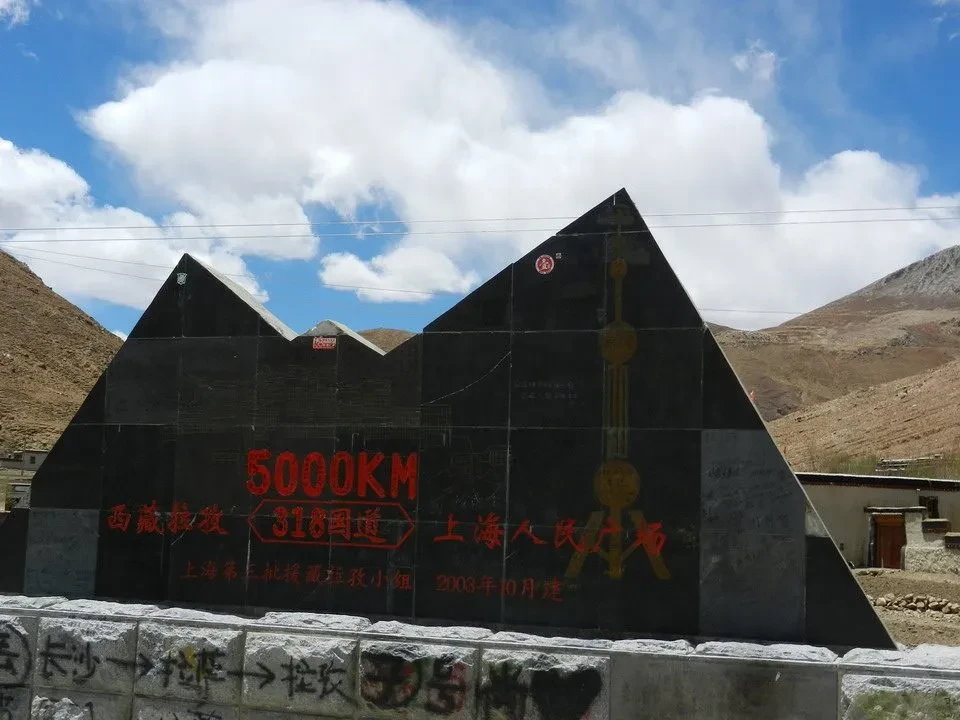
We stop at a rest area near the marker indicating kilometer 5000 from Shanghai A considerable distance, but not enough to escape its imposing presence. It's surprising how the distances are measured starting from Shanghai and not Beijing. Besides a couple of shops selling drinks, there are also some vendors offering stones and religious-themed necklaces to travelers (almost like rosaries). We arrive at the Tsuo La Pass at 4526 meters, a completely desolate area, except for the thousands of prayer flags that overlook the hill. Sheep seem to graze on the land. We leave the Friendship Highway for Sakya, which we reach with a detour of 25 km on unpaved road. The landscape here is also very arid: flocks of sheep and goats are searching for food in the plowed fields, although it seems they don't suffer from hunger. We are told that this year's spring has arrived late, due to the fact that there will be two months of August, according to the lunar calendar which must align with the solar one. Talking to our guide, we tell him that in Italy, we have a new government and we are surprised when, explaining how the Italian government system works, he asks us what "Parliament" means. We should not forget that in China (and certainly not in Tibet), the institutions that govern the state are very different from ours, and Parliament is replaced by a Congress that rarely meets and only upon summons. To make sure we understand correctly, our guide will use a digital translator for the word "parliament". Along the road, there is a lot of agricultural activity, with farmers working in the fields. In this case, most work with oxen, while only some already have tractors. Sakya It is located at an altitude of 4300 meters, while the road we take to reach it stays at around 4000/4100 meters. Its name means "Grey Earth," and many buildings have colors different from the typical Tibetan houses. The monastery It actually belongs to the Sakya school, and is managed by a "dynasty" of monks who have the right to marry and have children in order to pass on the lineage and lead the complex. The simple monks, however, must remain celibate, as do all religious figures in the Buddhist world. The interior is dark., we meet a few pilgrims and are the only tourists present. The interior has a more austere appearance, especially the chapel of the protective deities, which seem to have terrifying appearances, some of which have even been covered. It's unclear whether this is truly a system to instill even more fear or if they are genuinely frightening. However, it seems that they want to represent a symbol of hostility towards ignorance. We walk around on top of the monastery walls. amazing view from above nearby. We notice that the geometry of the buildings, as well as the residences of monks and those who live there. Outside lies what was once a village, which has developed despite its peripheral location. We return to the main road to tackle the ascent towards the passed by Gyatso La,
Alongside the asphalted road, we encounter herds where sheep are increasingly replacing goats. The shepherds who follow them live in tents in conditions of extreme poverty, where cold and strong winds sculpt their faces so much that they appear petrified. Snow is becoming more frequent, with snowdrifts mainly located in the valley floor, covering much of the stream that carves tunnels under the frozen ground to continue its course. The pass is at 5248 meters above sea level; the cold is intense. due to the wind but not particularly annoying. Walking on a flat surface doesn't cause any problems, except when you feel your heart beating strongly after taking just a few steps uphill. When descending, around kilometer 5114 we have the First view of Everest (proudly said Qomolongma in Tibetan, which means "Mother Goddess of the Earth"). It is still quite distant, almost hidden among the other mountains, but its shape cannot give any reason for doubt. Here it is finally before us. We take the first photos, just in case tomorrow the weather doesn't allow it, and we are left speechless at being face to face with the highest mountain in the world. We don't know, but this is only a preview. Tomorrow we will have the privilege of getting to know it much more closely, and time will once again be on our side. We are at 4500 meters and we can now see the first inhabited villages with their corresponding terraces. The Qomolongma Hotel... Shegar It's in classic Chinese style, large but also simple. Not speaking English and ordering a beer (and the rest of what isn't on the standard dinner menu) is an adventure in itself. The room is cold, but you sleep well under the blankets. When you're at altitude, evenings are always the same: after dinner, the cold becomes very uncomfortable, and going to bed represents both a solution to fatigue and a remedy against the cold. Tonight we'll take a walk in this insignificant country, and the only thing that convinces us to stay out despite the wind is a sunset postcard The west is covered in all the shades from yellow to red. We return to our large room, despite the very small bathroom, where we find a temperature of 11 degrees. By placing two blankets on top of us, we will be able to have a restful night's sleep.
As we move further away from Lhasa, the Tibetan people maintain their high level of courtesy, although this may affect efficiency due to the rural nature of the areas we are in. There is not much tourism and people remain isolated for most of the year. Even the waitresses seem unsure whether to fulfill the orders they have received or simply watch as guests approach. The time it takes from asking for something to receiving it can be quite long, but it is important to be patient and tolerant towards people who live in such a different environment. If we were as courteous as they are! It goes without saying that people in Nepal are equally polite, but they also possess an innate sense of friendliness. This is more difficult for the Tibetans, who are accustomed to a stricter and more austere environment, as well as 60 years of oppression. However, once you get to know them, it is impossible not to love their way of being.