

Day 10
Gyantse
Stunning views of the plateau. Gyantse: a crossroads of history, a bastion of Tibetan culture.
Gyantse
Sleeping at an altitude of 3600 meters is no longer a problem. As soon as we need breakfast (at 7 am), we go to try the tsampa for the first time. A friendly waiter accompanies me to the buffet to prepare it correctly. It involves putting some barley flour in a bowl and then adding hot tea with butter, mixing everything together. Afterwards, we head out onto the street to perform the kora of Jokhang, the devotional circuit that pilgrims make repeatedly, always clockwise. Despite being early in the morning the narrow streets of Barkhor The area is already crowded with worshippers heading to the ceremony sites, and while a long queue waits for the opening of the Jokhang, others are bowing before the temple We join the faithful who throng every corner of the kora, turning prayer wheels and chanting mantras aloud, all within an atmosphere made particularly mystical by the crisp morning air and the light of the first sun, which makes the colors of the houses beneath a cobalt sky incredibly evocative. We enter the courtyard of a small monastery where a couple of monks are preparing dozens of butter tea kettles over a rustic fire of enormous logs for breakfast. Not far away is the residential area that also hosts pilgrims arriving from all parts of Tibet and surrounding areas, which is just beginning to wake up. It's a labyrinth in which you can still experience old Lhasa. Miserable dwellings house travelers, while small monasteries appear to be part of a home, and small shops are starting to display their goods. Our Western eyes cannot help but notice the poor hygiene; probably the temperatures prevent the spread of diseases that could decimate the city. In reality, our concept of cleanliness doesn't really align with monasteries and, in general, homes; it's not up to us to be moralists about cleaning products. We come from a civilization where washing has become one of many businesses… Therefore, we don't feel qualified to give lessons.
The ongoing work concerns the entire city center; we are told that it started last year and should be completed by the end of this one. It mainly involves underground pipes, but there are also scaffolding in front of the buildings that, before being used for renovations, seem to be intended to hide the unsightly aspects of a once-poor area. Walking at night really carries the risk of getting lost in some ditch.
At 9 am we have our meeting to depart and will be punctual. We then head south towards the airport, from where we turn southwest towards Gyantse. Along the road For Shigatse, you often encounter spiral staircases painted on the rocks. We are told that they originate from Bön religion and symbolize ascending to paradise. Throughout Tibet, we will also find numerous speed control points, and it is interesting (sometimes even frustrating) to learn about their methods: at the first fixed checkpoint, drivers must get out of their vehicles to receive a form in which the vehicle's details and the time of passage are recorded. If the limit is 60 km/h, and this is usually quite strict despite the roads being in good condition and passing through rural areas (except for a few rare villages), at the next checkpoint, which is for example 60 km away, you cannot pass until one hour has elapsed. It happens that everyone drives at their desired speed before stopping on one side a few kilometers before the checkpoint to wait for the necessary time to avoid a fine. Then, they continue at a faster pace, repeating the stop further along. In this case, electronic devices would certainly lead to better results.
Our guide is originally from a small village located 40 km from Gyantse, where foreigners are not allowed to enter. It seems there are certain "tourist corridors" that are permitted for transit, while the rest of Tibet is prohibited or requires further permits. During demonstrations and unrest, the entire country is closed until further notice. She studied English for a couple of years, but speaks it fluently with very good pronunciation. This makes her different from the Chinese, who even when they know the language, pronounce it in an incomprehensible way.
The road progresses relatively quickly across the plateau before winding along a section that becomes increasingly steep amidst high meadows where the vegetation appears to have just emerged from winter. We are told that there is a lot of snowfall in these mountains, while it also rains at the highest passes in summer. However, we should consider that the concept of heavy snowfall must be relativized to the Tibetan territory, which, being north of the Himalayas, is minimally affected by precipitation. The almost complete absence of tall trees and vegetation generally demonstrates this. The snow melts very quickly, as only sporadic patches of snow remain at the highest sections of the road by the end of April. And it's only around 6000 meters that the snow begins to be consistently present.
Towards Gyantse
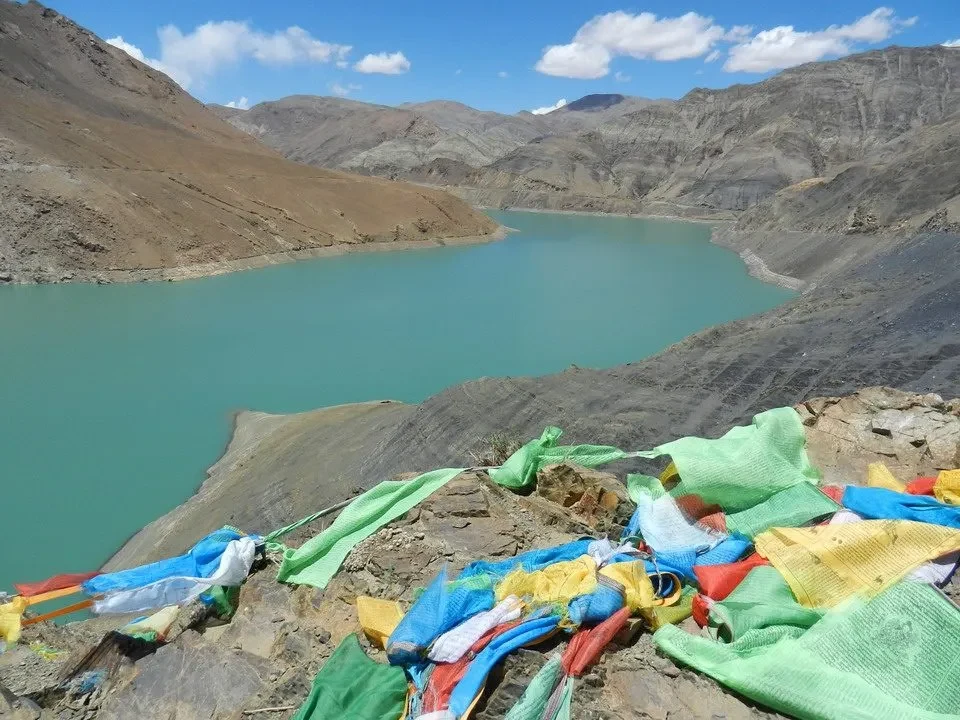
We reach the altitude of 4794 meters. Kampa La Pass, from which we can enjoy a fantastic view. Yamdrok Lake, a holy lake whose shape resembles that of a scorpion.
It is revered as a talisman that supports the spiritual life of Tibet. It is said that if it were to run dry, the country would no longer be habitable. It is the largest lake by size, where "Tso" means "lake" and "drok" derives from nomadic people, while the prefix refers to turquoise. From the very beginning, we realized that Tibetan is a difficult language, but we will try to communicate in English or understand each other through gestures. The peak that forms the backdrop of the lake has an elevation of 7190 meters. There are several local shepherds on the hill who try to attract tourists with photos alongside yaks and decorated dogs.
Tibetan Buddhism has borrowed heavily from the previous Bön religion, with the exception of some practices that are completely opposite, such as the direction of the swastika (which symbolizes a Buddhism without end) and the counter-clockwise path in Kora. Integrating with the previous religion in the 11th century, modern Buddhism also considers many natural places sacred, such as lakes, hills, peaks, etc., which is not found in other schools. We descend from the hill through some villages in the steppe, and it spontaneously occurs to us to ask how one can live in these areas: complete absence of trees or even shrubs, dry land, no notable services within at least 100 km. Here you have to manage with your own experience and what little the nature offers. In this small area, you will find yak droppings, the only accessible means of heating. The manure is left to dry. attached to the walls and therefore piled up once dry, usually above the same walls which define the boundaries of the houses in a well-ventilated area. We learn that the abundance of this "resource" is sufficient to allow people to spend the winter comfortably, and that the ashes are rich in fertilizing substances that can be used in the latrines and consequently as fertilizer in the fields. At 4500 meters, there are already terraces ready to host barley cultivation.
Karo-la Pass
With everything there is to see, it seems like there isn't even enough time for the lunch, which wisely guides us to a restaurant that shines with its simplicity and taste of his dishes. This is a very well-organized self-service area where we take advantage of it generously. We continue until the foot of the Naiqinkangsang snow mountain, one of the sacred mountains of Tibet (a belief originating from an earlier religion). At the summit, you can see the "flag cloud" (the creature of wind and snow) fluttering and shining in the air. So we are at Karo-la Pass (5010 mt.), near Karo-la Glacier With its namesake peak, which reaches approximately 5,600 meters in height. It is known as the "Queen of Ice" on top of the world.
Manlha Water Control Project
As we descend, we encounter another lake, this time artificial, the Manlha Water Control Project It is a dam with a capacity of 20,000 kW. The project provides irrigation for over 43,000 hectares of land, as well as limiting river floods.
Arrival in Gyantse
When it was past 2:30 PM, we arrived in Gyantse, the fourth town in Tibet (after Lhasa, Shigatse and Chamdo), which was also an ancient trading center and a crossroads between the road leading from Lhasa to Nepal on one side and the caravan route arriving from south via Sikkim/India/Bhutan. It still retains much of its original style as it has not been significantly influenced by Chinese culture, although the shops are undoubtedly and visibly Han ethnic. It became an important military and commercial center (particularly for wool and crafts). It gained fame in history in 1904 when a battle was fought to defend against the English invasion. In memory of this event, the Chinese built a monument to commemorate it and awarded the title of "hero city." It is almost outrageous to see them talking about foreign invasion and occupation here. We immediately visited the monastery ( Palkhor Choide) ( Photo2, Photo3, Photo4) with the wonderful stupa (Khunbum) and then the fortress (Dzong) The first one was founded in 1418 and is one of the most important monasteries in the region. In the monasteries and temples, you can find chapels dedicated to the protective spirits; these always have an angry expression, but this is intended as a symbol to scare away evil spirits and against ignorance. These figures should therefore be interpreted as protective deities, regardless of how they appear, indeed they are specifically for defensive purposes.
Lapu once again provides us with a series of information about Buddhist culture that are useful for gaining a better understanding of this fascinating faith. We will never be able to fully understand and unravel its mysteries, which we leave to the experts (there are even talks of a thousand different varieties of Buddha), but we can at least get a general idea, particularly regarding the concept of the cycle of life.
The main focus of the visit to the Dzong (fortress) is mainly on... A panoramic view of the city and the monastery from above.
Traditions and spirituality
Without the means to burn bodies as is done elsewhere, the deceased are carried in procession to a clearing outside the village. Once the ceremony is over, the bodies are broken up so that they can be taken away and eaten by birds. After all, in a land that is frozen for much of the year and lacks wood, this seems to be the only way to give someone a burial. There is an exception for those who died from potentially contagious diseases; they are buried to prevent the spread of epidemics. Open-air cemeteries also exist in the populous Lhasa, where a couple of places are used for this type of burial, and we are told that the birds have plenty to do. It should be noted that Chinese people are cremated, as is their tradition. However, the youngest children are scattered in the sacred waters of some lakes; presumably no one has the courage to break up the body of a small child to feed to the birds. It is difficult to come to terms with certain practices that have been ingrained over millennia, but even in this way, it is necessary to consider extremely different realities, in a world where it is even difficult to die!
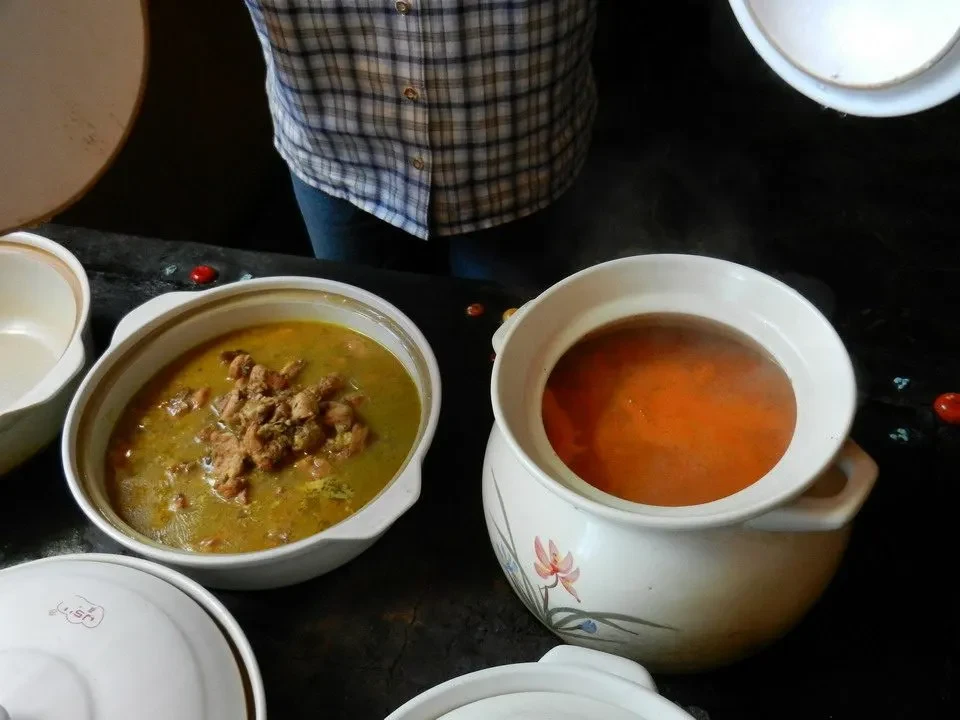
We walk back to the hotel, which is simple but efficient and nice. We have dinner at Tashi with a yak barbecue and a sizzler the same cow surrounded by vegetables.


