Day 4
Trek Annapurna III
The big day: with a climb of 2000 meters, we reach the Annapurna Base Camp under clear skies.
Let's tackle the ascent to Machapuchhre.
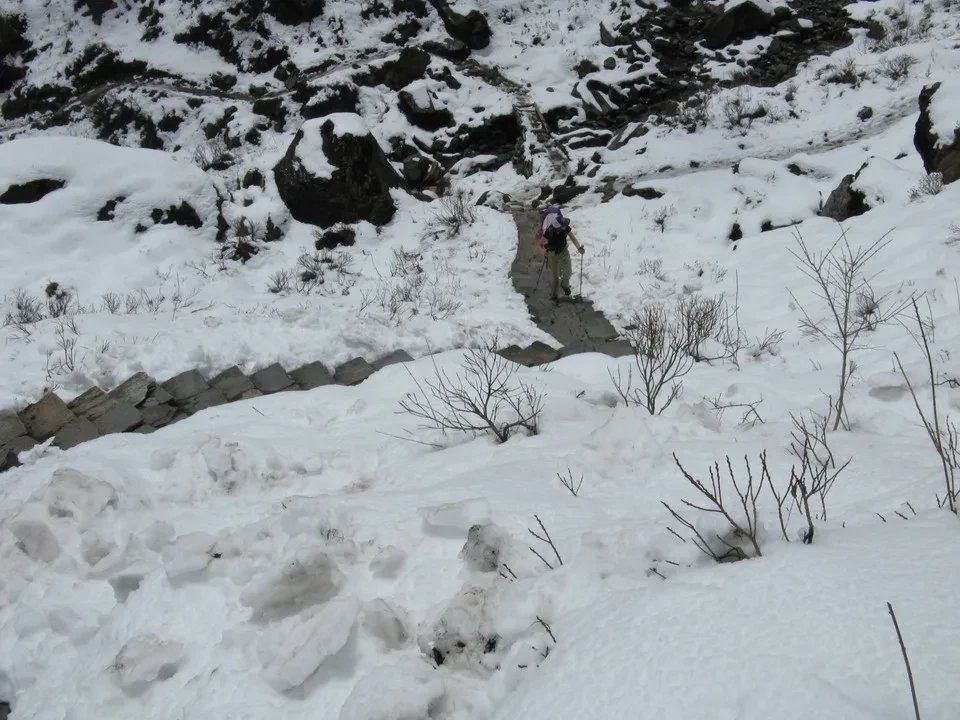
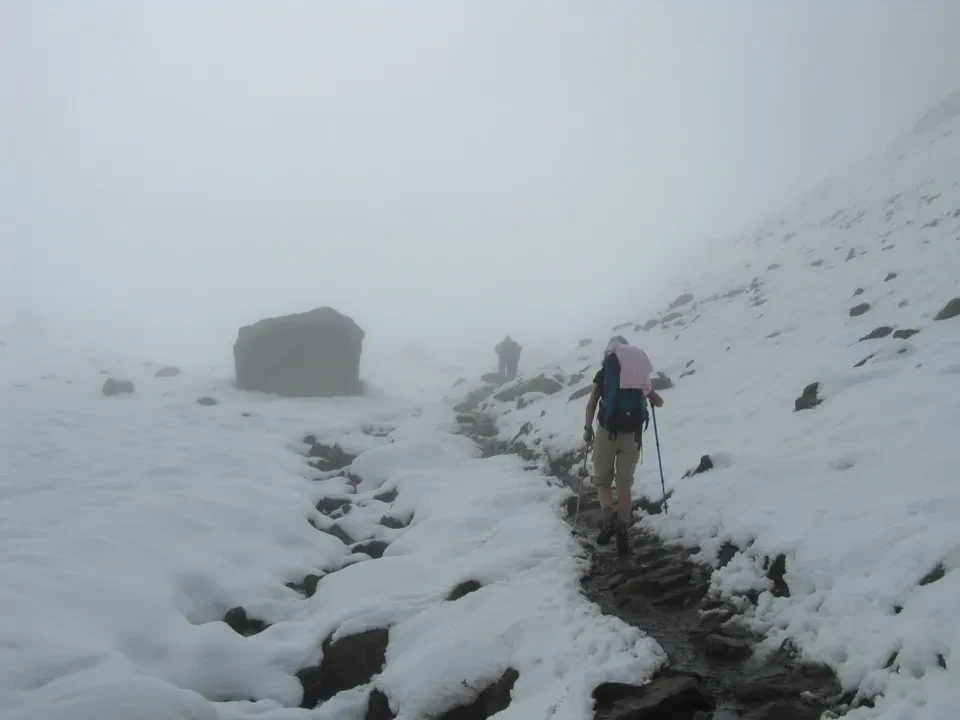
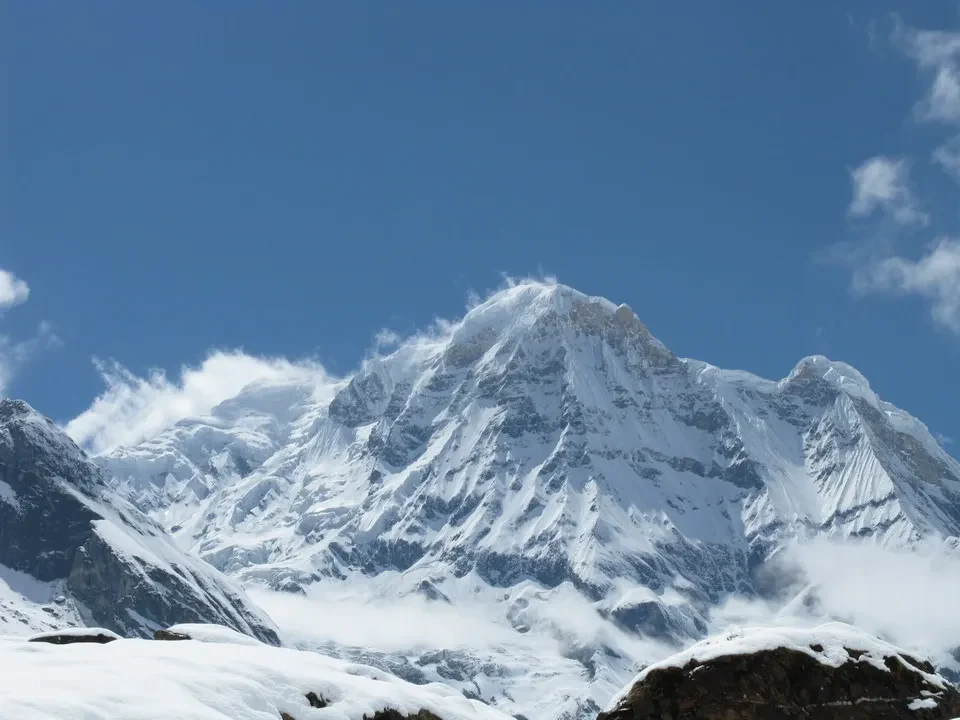
The day begins with great prospects. The sun starts to illuminate the peaks overlooking the corridor leading to the sanctuary, and at 7:10, with our hiking boots on, we begin a historic day for what our experience in the mountains represents. Before departing, we consult with the lodge owner, who reassures us about the risk of avalanches. Feeling reassured, we load up our heavy backpacks and We leave Bamboo. at an altitude of 2300 meters. We first take a bus to the forest. with the path winding and everything dripping with moisture. In one hour and a quarter We arrive in Dobhan., in another hour we are at the Himalaya Hotel to continue on the same route towards Deorali. Shortly before the village, we cross a snow bridge over a stream that flows down from the slopes of Hiun Chuli: the following day, upon our return, we will see it collapsed and we will have to go around it further upstream. After Deorali, the path takes a detour on the eastern side of the river to avoid the landslide-prone section using two very precarious bridges (in certain cases it is still dangerous to cross even on the other side), and at an altitude of 3200 meters, we start encountering snow on the ground. The passages from yesterday and today's sunshine are still melting them. We return to the other side, and the path becomes steeper. As we ascend in altitude, we are forced to walk through the snow, but if our feet are cold (which you don't notice while walking), our spirits begin to dream of the first snowy peaks, a kind gift from a finally clear blue sky. We tackle the ascent to the Machhapuchhre Base Camp (MBC) consisting of a steep staircase. We are now at 3700 meters, and the effort is becoming noticeable. After climbing up and down, we have already gained 1600 meters in altitude. This was our destination for today, but the pleasant weather and uncertain future lead to an ambitious idea. We replenish ourselves with dried fruit while observing for the first time The Annapurna South (7219 meters). The fogs occasionally obscure the horizon, only to reveal it again shortly after with completely new views. Since we have no idea how the situation will develop, we decide to try and reach the last 430 meters to the Annapurna Base Camp (ABC). Staying at the MBC would definitely have been better for acclimatizing and resting, but life is about experiences, and sometimes it's good to let our instincts guide us, even if they are those familiar Western habits. We gather what little strength we have left and We set off on our journey. as the guides indicate, we will take approximately 2 hours, stopping whenever our bodies tell us that we are not able to absorb enough oxygen to continue. We also don't hesitate to photograph and film the beautiful scenery that surrounds us, which is particularly evocative due to the mists that appear forming light clouds of various shapes, before disappearing, leaving the scene to the snow-covered mountains just below. This is a relatively easy stretch, a path with constant ascent where the distance covered is greater than the elevation gain. Even though it's snowy, we can move well through the melting snow. It's hot and the evaporation creates a lot of humidity, which must be quite rare at these altitudes. As we continue some heavy snow drifts flowed like milk in a small basin not far to our left, stopping about 150 meters from the path without putting us at risk. Every now and then The fog surrounds us. and visibility becomes very limited, making breathing even more difficult. Think about those who (although with different timelines than ours) make ascents much higher and technically more challenging: they must be either crazy or heroes, sometimes both. But at this moment, we are filled with unconditional admiration for them. The effort, the altitude, and the weight of the backpack make this final stretch a kind of happy ending to a difficult ordeal. At some point, we see the Base Camp in the distance, consisting of a series of buildings arranged roughly in a square. Above us is Mount Annapurna South. The altimeter indicates that only 150 meters remain, but the distance to cover is still significant. Now there's no turning back, and within an hour we reach the sign that welcomes us to our destination. We are speechless, both from exhaustion and emotion. After 2000 meters of altitude gain We are at Annapurna Base Camp (4130 meters)... our final destination, which just yesterday seemed an unreachable mirage. The good fortune of finding the first day with beautiful weather, combined with our determination, allowed us to achieve this goal. After months of study and preparation, a long journey and local travel, we are finally here, standing still, almost incredulous, while tears of emotion run down our faces. We listen silently to a silence that never stops talking.
Arrival at Trek Annapurna
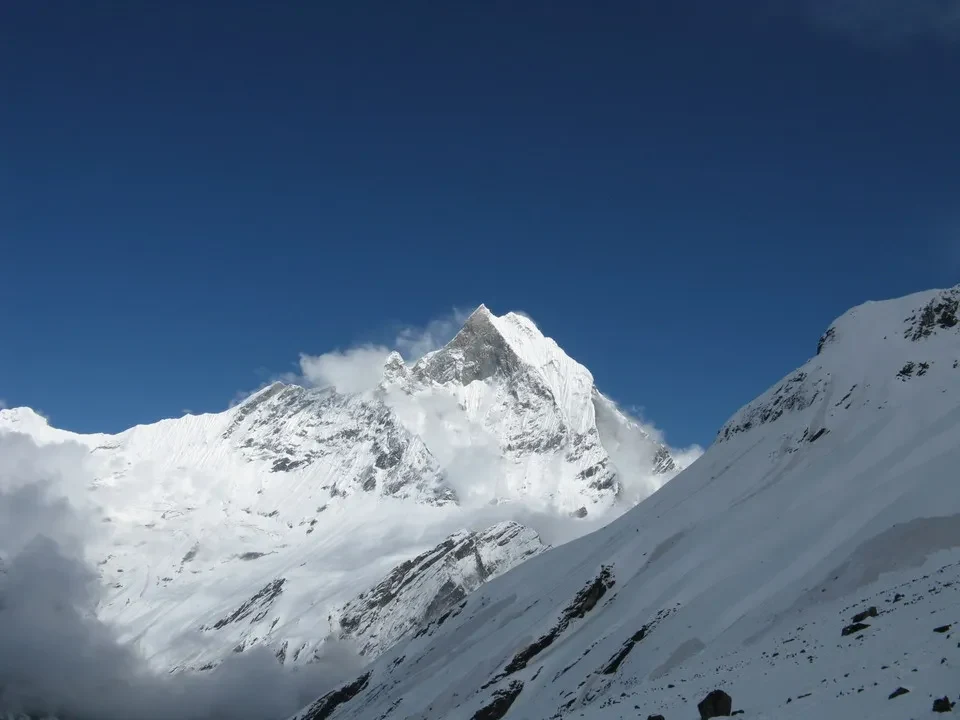
The Annapurna Sanctuary It surrounds us with its peaks ranging from 6500 to 8091 meters in altitude. Below, we can see a depression between Hiunchuli and Machhapuchhre, which represents the corridor through which we climbed. This particular peak now stands prominently in its classic "fish tail" shape, which was previously blocked for us. It is a huge rock and ice formation that twists around itself to take on the form from which it gets its name. Even though we stopped at 6997 meters, it is one of the most important peaks in the region. Besides being a sacred mountain within this syncretic religion that combines Hinduism with Tibetan Buddhism, which has also settled upon the previous Bön religion, Machhapuchhre remains inviolate due to its sanctity. Attempts to climb it were made unsuccessfully about sixty years ago; since then, permits for ascent have not been granted. At this point, only Annapurna I (the eight-thousander in the area) is still hidden by the increasingly thin mists, which are destined to disappear with the arrival of night. In the meantime, let's go and relax. at one of the lodges simple and spartan, with cool rooms not just for the style of furniture (!), but also for the temperature. Let's take a break in the dining hall of the refuge, where the manager is very friendly and helpful. How beautiful is the outdoor environment.; we sit around the table, under which a fire is burning kerosene stove (which we often see carried in containers of at least 20 liters by the porters): this system heats the lower body and allows you to dry wet clothes. With our hearts pounding from the altitude and the excitement of being in that place, we meet a friendly Quebecois. He is 69 years old and has been doing very well so far, along with a porter. He is a person who has traveled around the world and seems to be comfortable wherever he goes. In these parts of the world, you can meet interesting people with whom you can share your experiences, and the conversation flows without interruption until dinner time. From time to time, we go outside to see and experience the magic that surrounds us. It's incredible, but the Nepalese chefs are able to cooking delicious dishes Even with these prices, we also ordered rösti with homemade cheese and fried rice with vegetables. Everything is based on simple criteria, but the cooking with wok pans and the ability to add flavor with spices makes it all very enjoyable, considering that the available ingredients are not many and that everything arrives in baskets carried by the porters who we constantly see going back and forth between the villages. Looking around, I see containers filled with many eggs everywhere; assuming that the prolificness of the local chickens cannot justify such production, we conclude that they are brought in on baskets by the porters with great care. After dinner, all that remains is to find some un unlikely night photo... while the mind travels along the snow-covered ridges that the full moon sufficiently illuminates, making them clearly visible and admired by the human eye. These are moments of an intensity never experienced before, erasing all the fatigue endured so far, instants that will not be forgotten. The silence of the Himalayas speaks to us and welcomes us: now it is finally clear why this place is called a Sanctuary and why the entire area is considered sacred. The name Annapurna means Goddess of Abundance: there could be no other name. As I mentioned to my Canadian friend, the motivations and joy of being here probably give us more satisfaction than some mountain professionals have experienced when climbing the same peaks. Since the nightlife at ABC does not offer any other entertainment, before 8:30 pm we take our place in our sleeping bags for a night that is not easy. Digestion becomes complex, the mattress does not cushion much of the hardness of the underlying ground, and the altitude makes sleep difficult. In a continuous state of drowsiness, we manage to spend the night and get some fragmented hours of sleep. The most difficult thing is breathing: lying down means taking in less oxygen, the cold would require us to hide our heads in our sleeping bags, but this further limits breathing, forcing us to alternate between immersing our faces to warm up and breathing properly.