Day 3
Trek Annapurna II
Still rain in the jungle until Bamboo (via Chomrong). And snow at higher altitudes.
Morning at Trek Annapurna
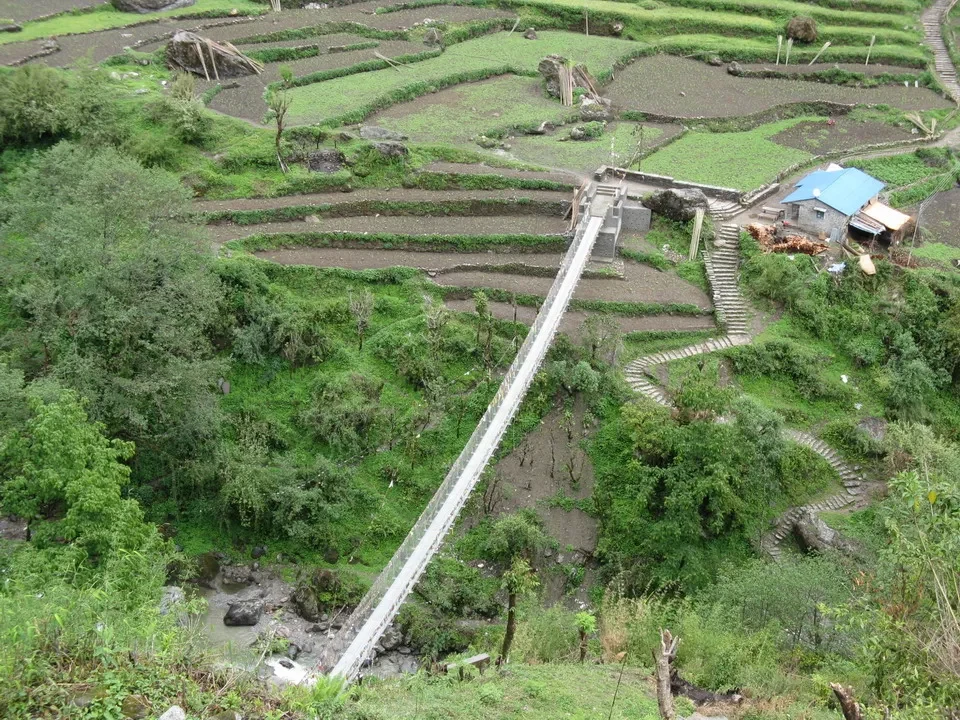
Yesterday evening, after confirming that there were no problems with having breakfast early, we set an alarm for 5:45 so that we could get on the road (or rather, the trail) as early as possible. Unfortunately, during the night, we hear the rain continuing, and when we wake up after a restful sleep, we find that the situation hasn't changed. I go downstairs and talk to the lodge manager with whom we agree to meet again in an hour and a half. There are no problems with falling back asleep; the problem is that when the alarm rings again, the weather hasn't changed. We therefore prepare for a new day in which we will definitely need an umbrella, and our thoughts begin to turn towards pessimism. You think about how the carefully planned trip could end up failing (and it really deserves to be said) due to the rain, that in the area where the valley narrows before opening towards the Sanctuary, they might be able to clear snow as indicated in the guide. And even if we manage to reach ABC with bad weather, the idea of only having to imagine where Annapurna and the surrounding peaks are doesn't make us happy at all. Breakfast will be a temporary boost of confidence consisting of pancakes with jam. We settle the bill, open our umbrellas, and leave at 8:20 Let's get started. for our destination. Along the downhill route, everyone's thoughts focus on what to do in the next few days, as we find it difficult to imagine any sudden changes. We don't have precise forecasts, but what we have leaves little room for optimism. An alternative could be to reach Chhomrong and then descend towards the valley floor, which leads to Ghorepani, and from there head to Poon Hill, another beautiful place with a superb view of the mountains. We would avoid the risk of landslides, but thinking about reaching a scenic viewpoint in this weather seems like we are fooling ourselves. Perhaps it is precisely in these moments that the idea of persevering and continuing towards our goal matures within us, leaving fate as the arbiter of our short-term future. With a shaky descent. We arrive at New Bridge, in an area where the path descends to reach the Modi River, which descends powerfully but not forcefully after days of rain, a clear sign that it snows more heavily at higher altitudes.
Arrival at Trek Annapurna
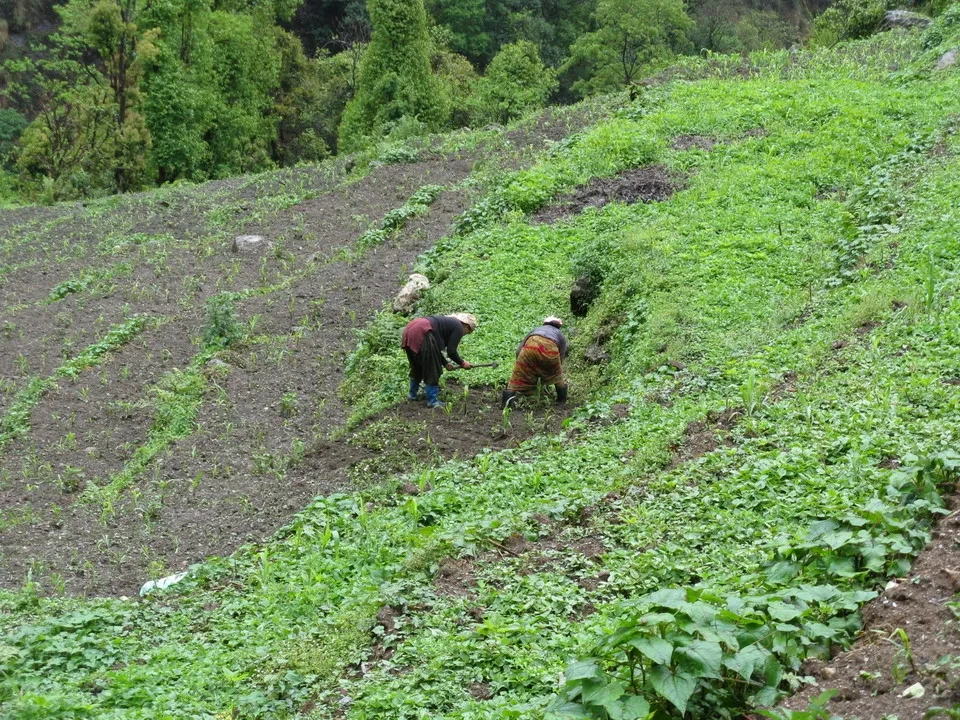
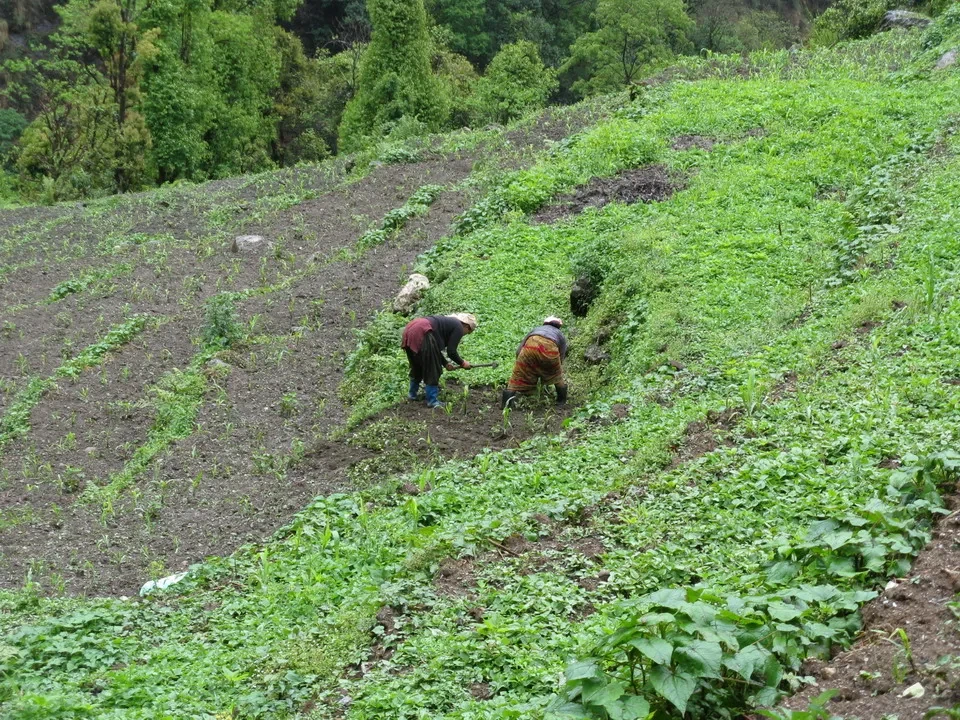
The stream originates in the Annapurna Sanctuary, flowing through the only gorge represented by the valley we are about to traverse uphill. Further downstream, it will join the Kali Gandaki, which collects water west of Annapurna and Dhaulagiri (another eight-thousander in the area). The path crosses through terraced areas. The fields are ready to be plowed. Sometimes they are not cultivated, but used as pastures for buffalo and horses. During the tour, we will not encounter yaks, perhaps only a few calves that Hindu religious tradition prohibits from killing. In smaller areas, goats and sheep graze around the houses. On some of these terraces, farmers use a plow pulled by two oxen: even at a distance, you can see the hard work that is still not mechanized here. The sowing of barley is being prepared, the only grain that grows in this area. It's interesting to note how those who work the land also do so in the rain, probably to take advantage of its greater softness. Meanwhile, we have descended 1315 meters: the low altitude makes us feel even more humidity. Despite the rain, we wear shorts, while breathing becomes difficult even though we are not at a high altitude. The bridge (New Bridge) that will allow us to reach the right slope is in Tibetan style, and as I cross it, looking at where to put my feet on the slippery wooden planks, I use my hand to create a slight scratch by planting a piece of wire that serves as a joint between the two metal cords that support the bridge. We have reached the lowest point and all that remains is to climb back up in the rain, in the humidity, with a leech that we discover has taken residence in my sock and is sucking my blood. It seems like everything is conspiring against us, but we face the ascent towards Chhomrong along a stone staircase that seems never-ending under the weight of our heavy backpacks weighing 12 and 10.5 kg. Birds of prey soar in the sky. From its somber appearance. Chhomrong is the last large village before entering the long "corridor" that leads to the Annapurna Sanctuary: this small town has the junction of the route we could follow if we implemented alternative plan B to our original program. From here on, there are only more villages, mostly seasonal, inhabited mainly during the tourist season to provide logistical support to hikers. However, they have a somewhat organized structure since people stay for several months in spring and autumn. You can find cultivated fields, gardens and chickens roaming among the paths. The porters make trips between villages to deliver supplies and everything necessary for those who live there and pass through. They are like walking trucks, with baskets (woven by hand with bamboo fibers) packed tightly and weighing up to 30/35 kg. A strap connects the men's heads (sometimes women can be seen too) to the top of the container to maintain balance at the expense of the neck. I can't imagine what it's like for the knees and spine under the constant swaying of climbing endless stairs. It's a job just like any other in this area; if you don't work as a porter between villages, you do it for tourists who hire you to carry their backpacks and allow them a more relaxing stay. The agency in Kathmandu strongly recommended hiring a porter for a modest price of $100 per week, including food and accommodation. Although not mandatory, their services are also required at the first ACAP and TIMS checkpoints. Among us, we had agreed that the guide would follow us due to a family problem in Pokhara and would reach us as soon as possible. We didn't want to give up this opportunity out of masochism or for some kind of saving. Rather, we intended to use our brains to find our own way and complete the journey at the times that we considered most suitable. Finding the right paths is easy, and carrying our backpacks independently meant sharing the lives of the locals for a few days. The trek doesn't present any particular difficulties, and being independent seemed like a good choice, considering the tight schedule in which we had to move. At the end of the trek, we will be happy with the decision made and perhaps also with the gesture of humanity towards the unfortunate person who would have had to complete a trek in just over 5 days when guides indicate that it is feasible in 10. However, we were able to complete everything as planned without rushing: only the daily walking hours were longer at the expense of rest.
A relaxing break with rice pudding after the steep climb that starts at... modern bridge over the Chhomrong Khola and we continue our journey towards Sinuwa... to reach which there are still 45 minutes remaining. We purchase the first time boiled water, which allows us to limit the use of plastic and costs much less than bottles (prices range from 50 Rs in Ghandruk to 100 Rs in Sinuwa, 130 Rs at Himalaya Hotel and MBC, up to 150 Rs at ABC depending on the time required for boiling). All prices are however set by the park authority and increase only when there are concrete reasons. We did not find any kind of speculation, either in the pricing or their application. After Chhomrong, charging batteries costs 100 Rs, and the same applies to heating with a stove under the table (when necessary). From this point on, it is not possible to bring meat or eggs due to local religious beliefs. In the areas around the temples, there are signs that invite you not to spit or defecate. Along a path surrounded by flowering rhododendron trees and a steep, stepped climb, maintaining practically the same altitude, we reach Bamboo when it's already 4:30 PM and the sky at least he stopped wasting water. Over two days of walking, we managed to take a break for no more than an hour. If we want to see the positive side, even today, we can say that it was a light rain without strong winds, which allowed us to shelter. Of course, by evening, our clothes in the backpacks are already damp, even though we haven't directly taken any water, and we don't feel any worse. We find a lodge (the Buddha Guesthouse) run by a friendly woman with very generous features, and we spend 300 Rs for an overnight stay. The feeling is that we have reached a crucial point (compared to the entire journey) towards our desired destination, and that we are at the point where we cannot continue. We can't afford to take risks: if it continues to snow at higher altitudes, the possibility of being stranded beyond the critical point due to avalanches is terrifying. On the 27th, we have a flight to Lhasa, and before that, we need to return down, go back to Pokhara, and then take a flight to Kathmandu. The idea that we might be reaching the end becomes more consistent, and not being able to see Annapurna is almost perceived with anguish, after all the effort and commitment to only see clouds beyond our sight. However, the experience was still positive, even without the sun, we saw lush valleys and an unknown way of life with its rural industriousness, although lacking the backdrop of the highest peaks. In the end, we conclude that even if we have to stop here or, at best, reach Base Camp with the clouds obscuring our view of Annapurna, it would still be a positive outcome. But then, the deities of the Sanctuary come to our aid. After assessing what needs to be done while trying to dry our clothes in a cold and damp room, we go out and see the cobalt blue peeking timidly between the clouds, a sight that was unknown until now. At the lodge, we meet a Polish man who is traveling with a completely different spirit than ours: he moves forward without having previously planned the stages, and with plenty of time at his disposal, he prioritizes contemplation over "alpine-style" hiking. There is also a group of Americans, whom we discuss the upcoming days and weather conditions with. I often go outside and can see... more and more blue take control of the sky. Dinner offers us rösti with eggs and meat dumplings, But my thoughts are focused on tomorrow's day: what will the weather be like, how far can we go, and what are the dangers related to avalanches? We discuss this among ourselves and with other diners, sharing the same concerns. We go to sleep in a cool room, but that is completely secondary.