Day 12
Everest Base Camp (E.B.C.)
Rongbuk Monastery and approach to Everest, up to the base camp on the north side.
Everest Base Camp and Cho Oyu
We must not forget that Tibet belongs to China and that, in the end, this is still a communist country, although it is becoming increasingly difficult to notice this unless there is an authoritarian regime. The first of May helps us remember this. Our guide tries to obtain permits to enter Everest National Park, but this is not possible as the office is closed for holidays. The problem is easily solved by purchasing tickets at the first checkpoint, which is located immediately after the diversion from the main road in the village of Chai, shortly after the passport control point. A quick stop and then on to the 80 km that will take us to EBC (Everest Base Camp), entirely unpaved but on a fundamentally good surface. We will read that the government even wanted to pave it, but the opposition from India prevented this. Being able to have the giant Chinese country with the possibility of bringing all kinds of vehicles just a few kilometers from the Nepalese border, and consequently a few hundred from the Indian one, means exposing oneself to great strategic risks. In return, China has equipped it as well as possible. The climb is constant and at times almost imperceptible, passing through the last villages that survive in the most arid conditions at the bottom of the valleys. A source of life is provided by the canals that bring water to the crops; sheep and goats have their noses planted on the bare surface grazing whatever they can find. About halfway there, we enter a valley at the bottom of which climb the highest peak in the world. But the magical moment was when we reached a hilltop located at kilometer 22 of the street leading to Rongbuk, a true viewpoint from which you can see no less than 4 peaks over 8,000 meters high (out of the 14 existing worldwide). From the right (west), you can see the long, snow-covered ridge of the Cho Oyu, right in the middle, like a star. Mount Everest and right next to it is the Lhotse. Further east, you can clearly see the Makalu. In between are several smaller peaks that have contributed to the history of mountaineering, one of which is the Pumori.
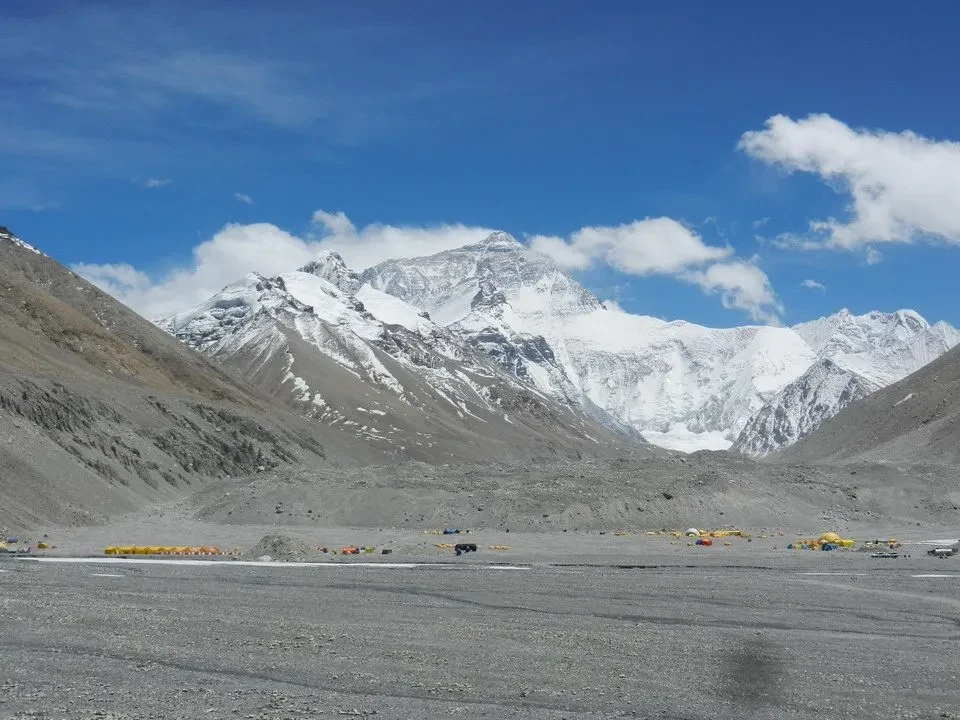
Cho Oyu
We are completely speechless and unable to find words. The price doesn't matter; it's the emotion that allows us to experience this moment as if we were suspended in time, at a very slow pace. Faced with such grandeur, we are simply amazed. The Everest It's now just a few dozen kilometers away, and from there it seems to be watching us, with the inevitable cloud that rises from the eastern ridge and covers the horizon beyond the mountain, once again revealing the sky in front of Lhotse. In Tibet, there are 5 mountains over 8000 meters high, including Makalu, Everest with its neighbor Lhotse, Cho Oyu, and Shisha Pangma (the only one entirely within Tibetan territory), along with 50 peaks that exceed 7000 meters.
Visit to Everest Base Camp
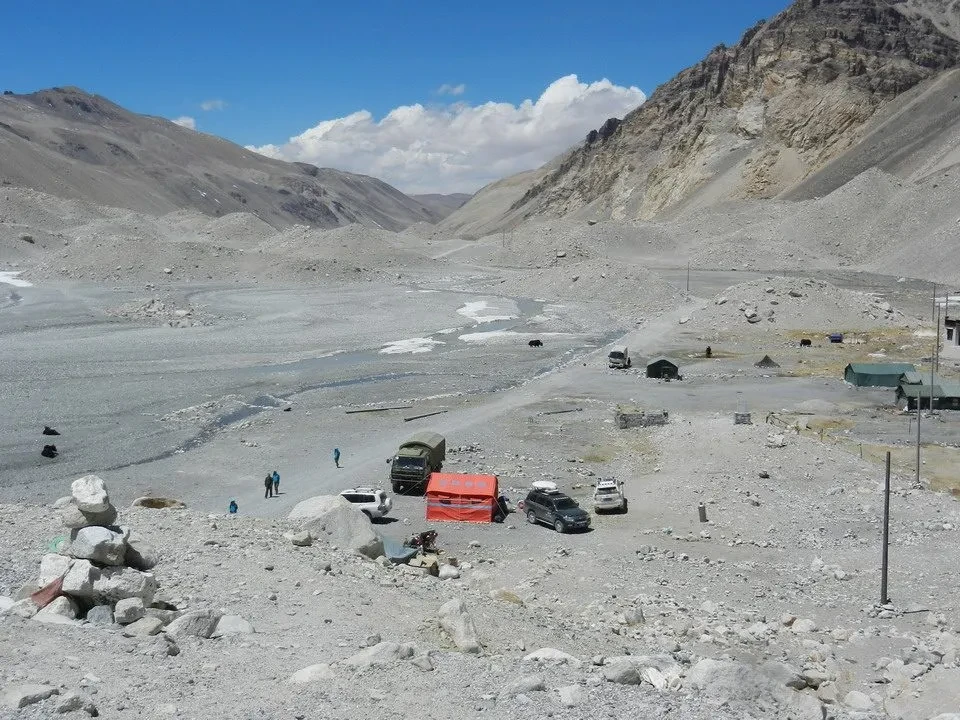
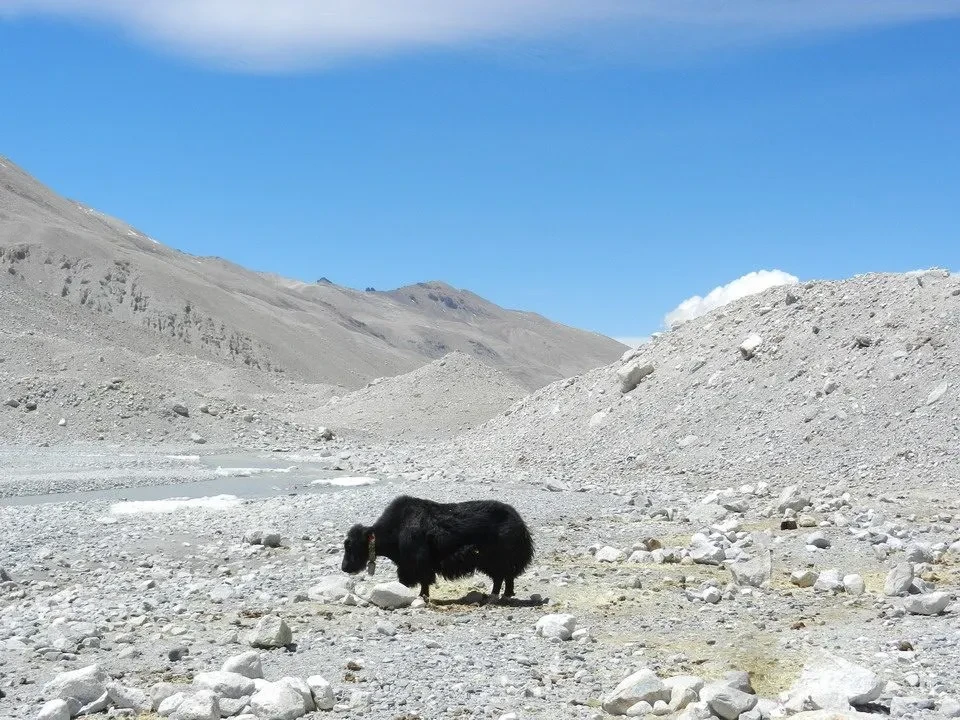
By 1 PM, we arrive at our destination today, the Rongbuk Monastery, where we find a place to stay. small hotel The room is of the basic type that we are now familiar with, but as we will see, it won't be the furnishings but the altitude that makes it difficult to sleep. Lunch in the canteen, where a yak dung stove is located for boiling water. The food is good and appropriate for the altitude. From here, there are still 8 km to reach the actual base camp. We cover the first half with the off-road vehicle until tent camp, where you can find accommodation with various vendors. We continue on our way. for another 4 km on foot (there is also a shuttle service that runs occasionally) and with a drop of 200 meters, which is well distributed over a long distance. We arrive at the meeting point. Beyond which, our permit does not allow us to go. We are at 5200 meters and here you find the inevitable Chinese police checkpoint. Fortunately, this time they do not check if we have all the necessary requirements to be there. Around us, the image of a vast valley that descends from the slopes of the Mother Goddess, with the northern slope of the goddess itself in front, and rocky peaks on either side, as you might find everywhere. The campsite The area where we are located consists of a few tents, likely belonging to military personnel on duty. raising yaks who are sometimes hired as carriers. We, like you, will only see them when we leave this paradise: they are two Chinese girls. We get on a scenic hill where there are countless prayer flags and from the vantage point we can see in the distance the base camp for expeditions. We are standing before Mount Everest; it really exists, and we are here on a beautiful sunny day. We stand in awe once again. After taking the customary photos, I let the wind take over me and my thoughts while the Pyramid looms large. As I contemplate this, my thoughts move from the natural scale to the human one, and I can't help but think that this mountain has witnessed the history of modern mountaineering, tragedies have occurred, and those dozens of tents in front of me risk turning everything into a circus. I wonder if I would like to go further, ascend it, risk my life, but join the select group of those who have "conquered" Everest. The answer that emerges as I remain still, gazing at every detail of this changing grey-to-ochre rock face is that I would like to climb it, provided I am capable. Behind the apparent simplicity of this statement lies a purist argument. Reaching the summit of Mount Everest has now become an excursion that requires only having the money, paying for the organization, and being in good general health. The rest is taken care of by companies dedicated to this purpose, which provide equipped routes, oxygen in sufficient quantities, and all other comforts compatible with the altitude. While some unfortunate individuals may encounter bad weather or undiagnosed illnesses, it's part of the game, but most manage to get away unscathed. A trend that sees the USA as one of the leaders in this sport originating from business, and whose environmental impacts are known. This year marks the 60th anniversary of the first ascent, and the campsites are even more crowded, both from the Nepalese side and this side. As I observe it, I think that climbing it must be a job for professionals, people who dedicate their lives to these feats (and sometimes lose them), but who are able to do so with minimal external support, knowing how to cope on their own and not being attached to a rope controlled by others. Once back in Italy, we discover that "Gnaro" Mondinelli was there and climbed it for the third time. This only reinforces my theory that only the strong deserve it. After these moments that seem to last forever, and which have the value of eternity, we begin our descent. Together with Lapu, who ascended by shuttle but is descending with us, we have a long chat about domestic habits, exchanging information at the top of the world. As we walk, we also see empty spray cans (like those for insecticides) used for oxygen, discarded without any care. Do they belong to someone who went to base camp or to some Everest conqueror?
We head to Rongbuk to visit the place. monastery, the highest in the world. Strangely, monks and nuns live together here, while there were previously two separate structures. This is because the Cultural Revolution destroyed both monasteries, but only one was rebuilt. To conclude, let's take the classic photo of the place: the monastery stupa with Everest in the background. The sacredness of nature combined with that of the spirit in a single image.
The fact that there are few visitors is also due to the recent reopening of the base camp. The reason for the closure of the EBC seems to be related to the demonstrations in 2008/2009 by foreigners in favor of Tibet, which were followed by images with the Tibetan flag, until the base camp became a venue for demanding greater autonomy for the region. In response, the Chinese government closed it for an entire year, apparently making an exception for mountaineering expeditions and visitors from China. Fortunately, on April 1st of this year, access was restored to the base camp. Another long period of closure occurred in 2008 coinciding with the passing of the Olympic torch, which was hoisted on top of the world. A symbol of peace and fraternity was used to provide another demonstration of power mixed with arrogance by the Dragon.
We're having dinner now and then we return to the small hotel where we see a large group of motorcyclists who have arrived from Nepal (Americans and Australians), complete with truck following. Let's enjoy the authentic and delicious... delicious local cuisine separated by periods of outdoor activity capture the sunset The wind is strong and the setting sun has cooled the air. We get into bed at 8:30 PM; there's nothing more to do. And here begins the nightmare that will force us to stay awake until the next morning. Even though we don't have any acclimatization problems, we can't fall asleep. If we were somewhere else, it would be enough to go downstairs and spend time reading or watching TV. But here, it's not possible: there is no light (the generator is turned on at 8 PM and switched off around 10:30 PM), and the clock on the table shows a temperature of 6° in the room, which discourages us from getting out of bed. It's more difficult to breathe while lying down than when standing up, so we have to lift our heads occasionally to get more oxygen.