Day 15
Kathmandu
Pashupatinath Hindu Temple and Bodnath Buddhist Stupa: two religions, two aspects of life, a common spirit.
Traditions and spirituality
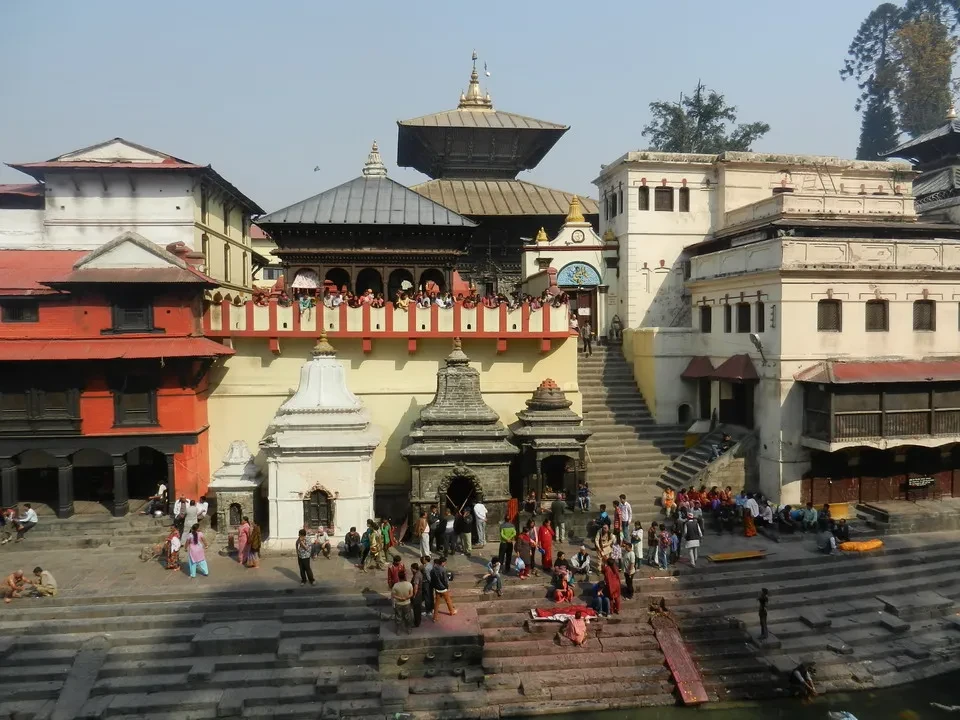
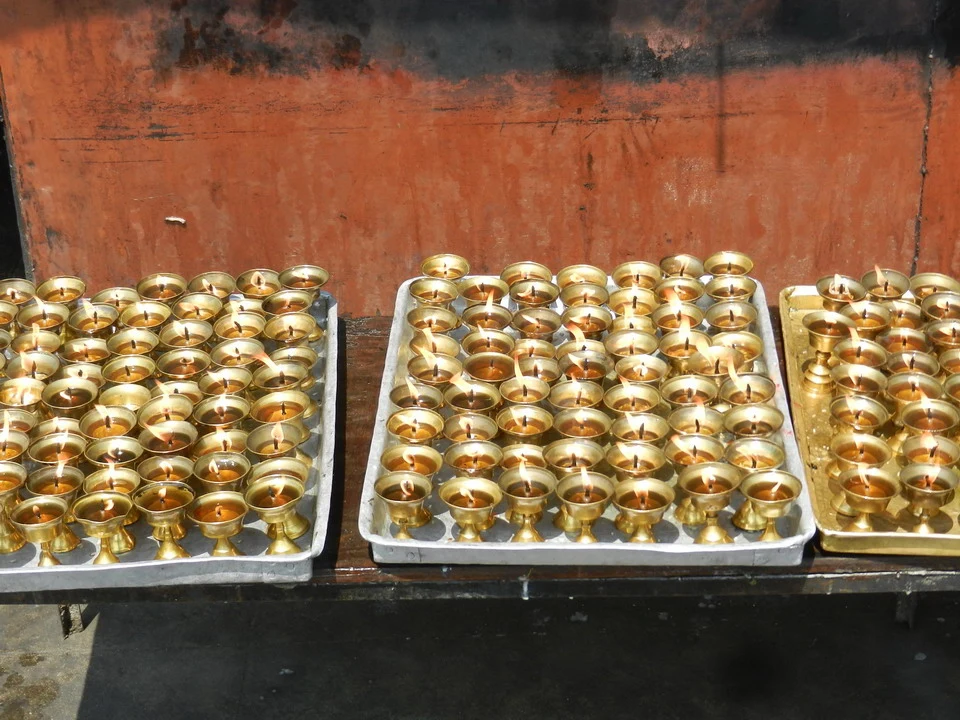
The last day of this unforgettable trip sees us visiting another part of Kathmandu. Since, apart from Durbar Square, the capital doesn't have many major monuments, we had decided to see it "in stages" during our breaks between activities. Today, we dedicate the day to visiting the... Hindu temple of Pashupatinath and also Buddhist stupa of Bodnath. After negotiating the taxi fare, we head directly from our base camp in Thamel to the temple, which isn't really the ideal place for breakfast. Pashupatinath is one of the most sacred places for Hindus and is where many cremations take place due to the Bagmati River (a small, oily pool where the bottom is completely obscured by dirt) comes immediately after the Ganges in terms of sacredness. The exterior presents a serene appearance, with... flower crown sellers due to the very pleasant colors. To our surprise, we find ourselves paying an exorbitant amount (around 550 Rs) for entry, which doesn't even allow access to the actual temple, which is reserved for followers of Hinduism. Even though it's only early morning, we can already see... the buildings are on fire and some funeral services are underway We ask if it is possible to take photos, and a guide tells us that there is no problem. We find that in the past, greater respect was required of those who found themselves in this place for burying a relative, but apparently, paying the ticket also gives you the right to immortalize the show. We still try to be respectful, while the impromptu guide tells us some aspects of the ritual: the body is brought to this place with vehicles similar to ambulances, wrapped in colorful orange and yellow cloths. Then we are transferred to one of the areas where the wood has already been prepared. The ritual involves carrying the body around the pyre three times (which, for those who can afford it, is made of sandalwood, considered a more noble type of wood), on which there are some dry leaves, placing the body and sprinkling it with substances as if it were a blessing. At this point, there is a brief commemoration before proceeding to light the straw and the body, starting from the mouth. The fire immediately envelops the corpse, and we are assured that the pyre can also burn the bones. This allows us to witness a series of cremations, some just beginning, others where nothing remains but ashes. These will then be scattered in the sacred river, in order to begin a new cycle. The entire process takes about 4 hours, with 50/60 cremations taking place each day, because it is a sacred river, many arrive from nearby cities or someone asks to die here. The Bagmati flows with its oil-like color at the foot of the areas, from that point on it will also virtually be the tomb of the citizens of Kathmandu and not only. In the middle of the river, which more properly can be defined as a sludge, some children try to retrieve coins thrown on the bottom, without obviously seeing them. Perhaps what strikes us most is the total lack of hygiene, but this is a cultural fact that locals could easily agree with. There are about ten areas, those in front of the temple are however reserved for the royal family. This was at least until a few years ago; now, with the change in regime, we don't know who they are reserved for. Some areas are covered with canopies to allow the ritual even during periods of bad weather, especially during the monsoon season. We see heartbreaking scenes, such as one where a barber cut my son's hair right now brought it down to zero. This condition must be maintained for a month along with the white garment, which is a symbol of mourning in this religion. The sadhu are not cremated but buried, as they are wise; the same applies to children. The smoke that rises has a pungent smell because it is not only wood that is being burned. Around us, we can see cows grazing, completing the Hindu symbolism. cows, while the sadhu They travel in search of someone to photograph them in exchange for a tip, the essentials that allow them to survive. They realize how fleeting life can be, how it is merely a passage, like Buddhist mandalas, created with sand and destined to disappear with a gust of wind. How different from the Western style, where every moment should be captured as if it were the last and used to its fullest extent, here every moment is simply a small segment of eternity, therefore negligible. The transition from life to death is indeed a sad moment, but it means nothing more than reincarnation and not being too attached to life results in a less tragic relationship with death. With all these thoughts in mind, we leave behind the smoke of those who have passed into another life that rises towards the sky and proceed along the park on the hill overlooking the temple. We ask for directions to reach Bodhnath and manage to cover the 1500 meters of urban stretch without getting lost. We change religion but the spirit remains the same. Perhaps Buddhism fascinates us more because it inspires a mystical instinct or simply because it reminds us of the mountains of Tibet rather than its variety of colors. Unfortunately, we barely know the minimum essentials of these religions and it is difficult for us to discern their most intrinsic aspects. However, we do not exclude that this could be a stroke of luck: a simple approach to religion brings one closer to the divine than a complex theological elaboration. The human aspect of these populations always makes us think that a belief is valid more by virtue of the people who practice it than its opposite. Bodhnath has something special: located on the eastern outskirts of Kathmandu, where most of the Tibetan diaspora fled in recent decades due to Chinese repression, it is an island of tantric Buddhism in the Hindu sea. It is worth remembering that among the pilgrims there are also many Hindus, in the name of a coexistence that is not only based on the good intentions of moralists. The atmosphere is sublime, and you can hear the melody of "om mani padme hum" in every corner, which after a while seems almost to become a chant, but in reality it is the essential combination for reflection, which transports you to another dimension (without using any drugs) and makes the surrounding monuments even more meaningful. The hemispherical dome of the stupa from which colored stripes descend to represent the lotus flower and all the symbolism associated with it. the monks with their classic purple robes, chanting mantras in the monasteries, where the candles are shining They are burning yak butter. It feels like being in paradise, and in some ways it really is.
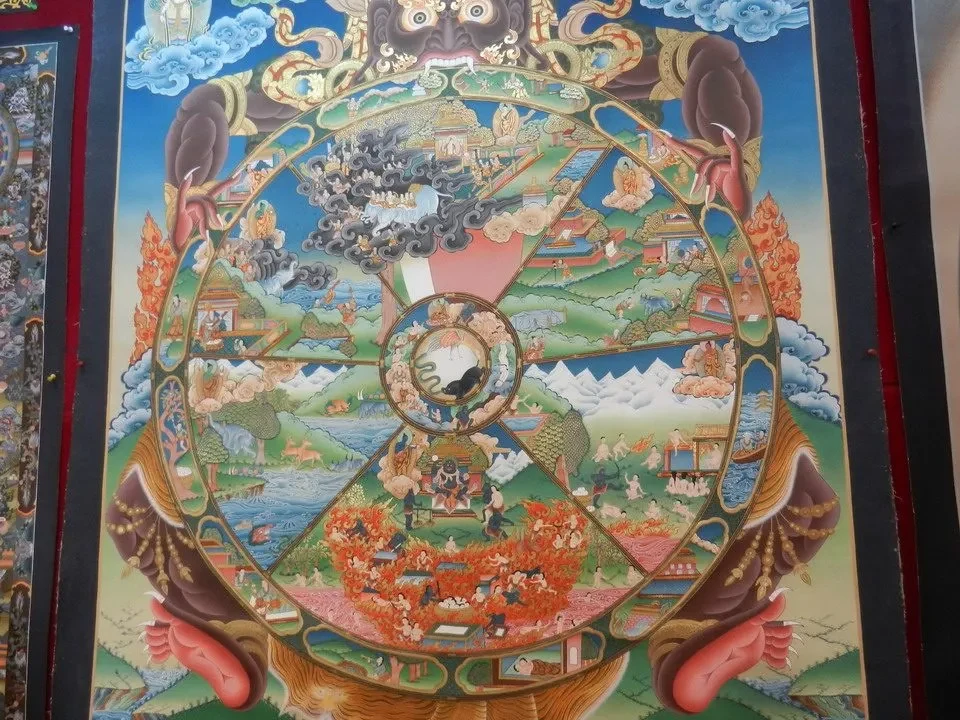
Before leaving Bodhnath, let's go buy a Tanga(religious painting that, in our case, depicts the stupa as seen from above). This is a good opportunity to learn the basics of the techniques, as well as the methods of work. It requires skill, patience and incredible experience, but the result is exceptional in terms of detail.
With a taxi, we return to Thamel where we dedicate ourselves to shopping and there are plenty of things to buy, even for people like us, who are not particularly inclined to these activities. Besides the mountain equipment at particularly convenient prices, you can find many varieties of tea, spices, books and local crafts (items made with yak wool). Now all that's left is to wait until 6 pm, when they will come to pick us up for our final journey to the airport (it's the third in two weeks), but not before we are presented with a katakh (a scarf with good wishes). Despite the slight delay, we have plenty of time, but we still manage to spend another quarter of an hour in traffic when a jam keeps us stopped for several minutes. The cars block each other in what is like a road domino effect, causing chaos in the traffic. For the first time, we would prefer to be at the airport: everyone honking their horns, the police using their whistles more to relieve stress than to resolve the situation, an example of chaos never seen before. In the end, with the policy of small steps, the driver manages to navigate a series of narrow, unpaved side streets that lead us to the road leading to the airport. We are still in time, but we don't have much time to waste. We hand over the remaining rupees to the brave driver who has challenged the traffic, and he gives us a final, enthusiastic Namasté. In fact, I will receive another one from the control officer that I mentioned at the beginning of the story.
Flight to Kathmandu
And at this point, the great journey is finally over; we just need to wait for the flight to Doha. The world around us seems to stop, but our minds continue to race, and in an instant, it feels like we are reliving all the wonderful scenes experienced during these two intense weeks of travel. As always, emotions mix: on one hand, the pleasure that everything has gone well, with reaching the objectives of Annapurna Base Camp and Everest in the not-so-easy Tibet; on the other hand, the nostalgia of leaving such beautiful people. This feeling hits us immediately; it is rare to experience this kind of nostalgia before leaving a country. This time, it's exactly like that: we return, but we must promise ourselves that we will come back, so that we can have a reason to do so. Because once we return to our daily lives, externally we will be as we were before, but internally, a part of us will remain forever among the mountains and with the people of the Himalayas. It will be up to us to occasionally visit them, to find ourselves again!
This report by Sara'
P.S. DESPITE THIS NOT BEING THE MAIN REASON FOR OUR TRIP AND AS A CONSEQUENCE OF THE POINTS OUTLINED ABOVE, WE HAD TO PERSONALLY WITNESS THE OPPRESSION EXPERIENCED BY THE TIBETAN PEOPLE. IF THIS REPORT WILL HELP RAISE AWARENESS ABOUT THE CAUSE OF TIBET, THEN THAT IS THE ULTIMATE GOAL.
Three Wonderful Countries
REFLECTIONS ON THREE WONDERFUL CULTURES:
Nepalese, Tibetan, and Mongolian character: The first group are perhaps the most Latin-influenced, and also the friendliest. With the second group, we see the difficulty of coping with everyday life, of overcoming a benign landscape but at the same time an inhospitable environment, in terms of terrain, temperatures, and altitude. The difficulty of obtaining daily meals combined with Chinese oppression can only make their character more reserved. However, their cheerfulness still emerges in their desire to sing and be open to others. The Mongols are a people who live much further north and must coexist with an even more hostile nature. Although they possess a fundamental asset such as freedom, they are forced to be nomadic in order to survive. This leads to a more reserved attitude, which unites them with the Tibetans in their religious expression. Perhaps less tantric, therefore also here more restrained compared to the beliefs in the deities that populate the Tibetan Olympus, so much so that it makes one doubt whether this type of Buddhism can be considered a monotheistic religion. Nepal and Tibet share instead the harsh but beautiful mountains of the Himalayas. The southern Nepalese side is wetter, snowier, and greener at its lower levels; the northern Tibetan side has drier characteristics with the plateau extending at their feet. A unique dimension that centuries have shaped the way of life of these people.
Lonely Planet
LONELY PLANET:
It doesn't contain any revolutionary messages, but even a half-page in the report on the country's history, which clearly discusses occupation rather than liberation, is enough to make this publication banned. To be honest and out of journalistic duty, it also mentions how before 1950, the Tibetan population lived under a semi-slave system, with the Lamas also holding temporal power, meaning that theocracy forced the population into poverty while high-ranking religious figures were actually landowners who controlled everything.