Day 13
Varanasi
Varanasi, the holy city. A spirit that transcends religion.
Morning in Varanasi
We depart at 7 after a quick breakfast in the beautiful hotel in Khajuraho, where everything has been designed to ensure fresh ventilation throughout the year. The sky is slightly cloudy, which will help us avoid the heat during the long transfer to Varanasi. In fact, we had planned to travel by plane, but a few weeks before departure, IndiGo decided to cancel the flight. We may spend (perhaps) a little more time, but we will have more contact with the places and people we encounter along the way. We cross the rugged outskirts of Khajuraho again, arrive at the entrance to the Panna reserve where we stayed yesterday, and continue on beautiful hills. teak forests until we find the highway. The traffic, in addition to its usual chaotic nature, requires attention because it is the first day of the week, i.e., the day after Sunday's craziness. In short, in just the first 100 km, we will see no less than 4 accidents, some of which we fear have left passengers without a chance: a bus hit the traffic barrier The truck overturned near a bridge over the river, falling onto one side. Two cars also encroached into the opposite lane and were barely recognizable as such. The scenery offers fascinating features., even though there was some fog, when the road goes through a wide hilly ridge After four hours of walking, we stopped at what would be a roadside cafe, but it was only locals where we felt comfortable. We had a light lunch and before leaving, we discovered nearby, almost invisible, the kiosk of a cigarette seller and a barber shop next door. They didn't have customers and chatted quietly; the first one crushed a leaf until it became powder and mixed it with a white substance that many claim is similar to the white paint used for dyeing. The resulting mixture was a paste that was put in the mouth and chewed on one side, at least producing some energy effects. At some point, it was spat out wherever we were. A similar mixture, which many kept in their mouths until it turned a deep red color and their lips resembled those of someone who had just applied lipstick, should also exist. However, the resulting aesthetic effect is not exactly the same as that of the ladies.
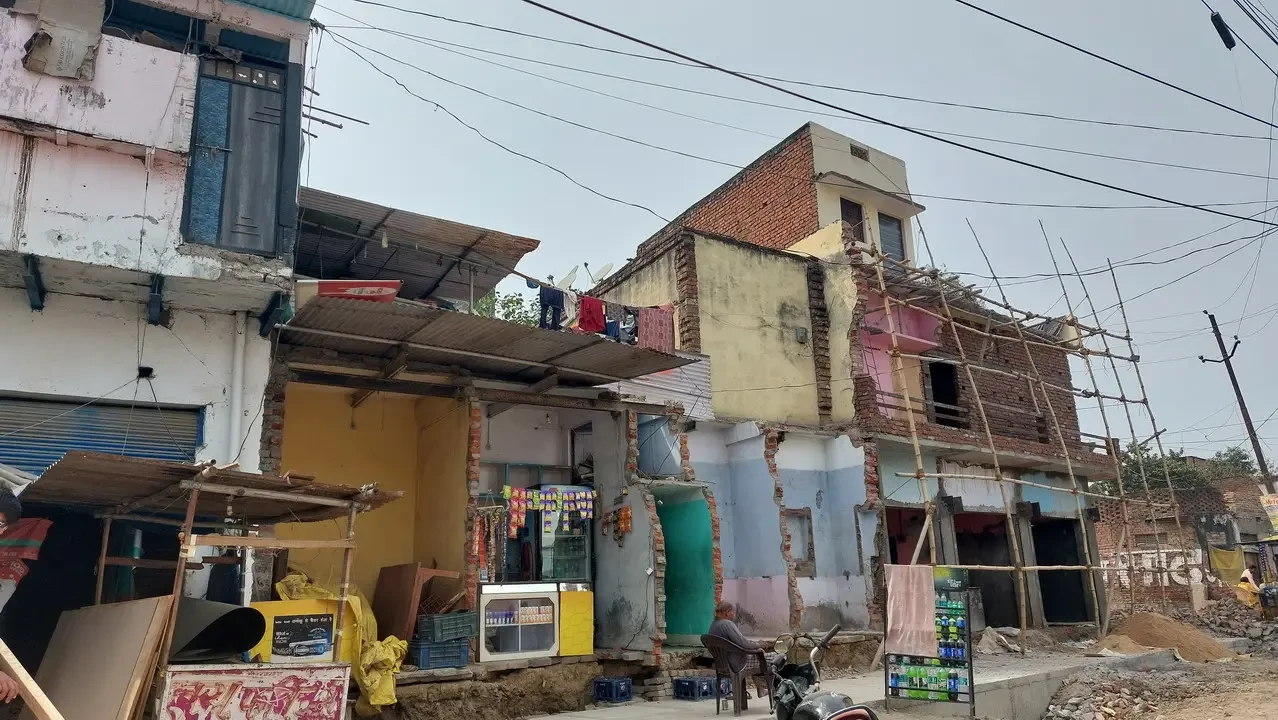
Shortly after 2 PM, we arrived in Varanasi, or rather, its outskirts. the road is being widened and the adjacent houses demolished to make way for rapid development. Sometimes completely, other times only part of the room or even just the back wall remains. It seems there was an earthquake.: rubble everywhere along the edges, houses literally cut in half and people recovering bricks or metal using every imaginable means: from excavators to pneumatic hammers and above all their own hands. Modernity advances and with it its needs, but the small property owners are paying the price, for whom we hope have at least received a fair compensation.
Let's take a fairly extensive tour and cross through the northern bridge crossing the Ganges It offers a first view of the city from above. Once we venture into the urban fabric, we find traffic and queues everywhere; arriving at the hotel feels like reaching a long-awaited destination. It is located in an area primarily dedicated to hotels, and the climate is much more peaceful.
Evening in Varanasi
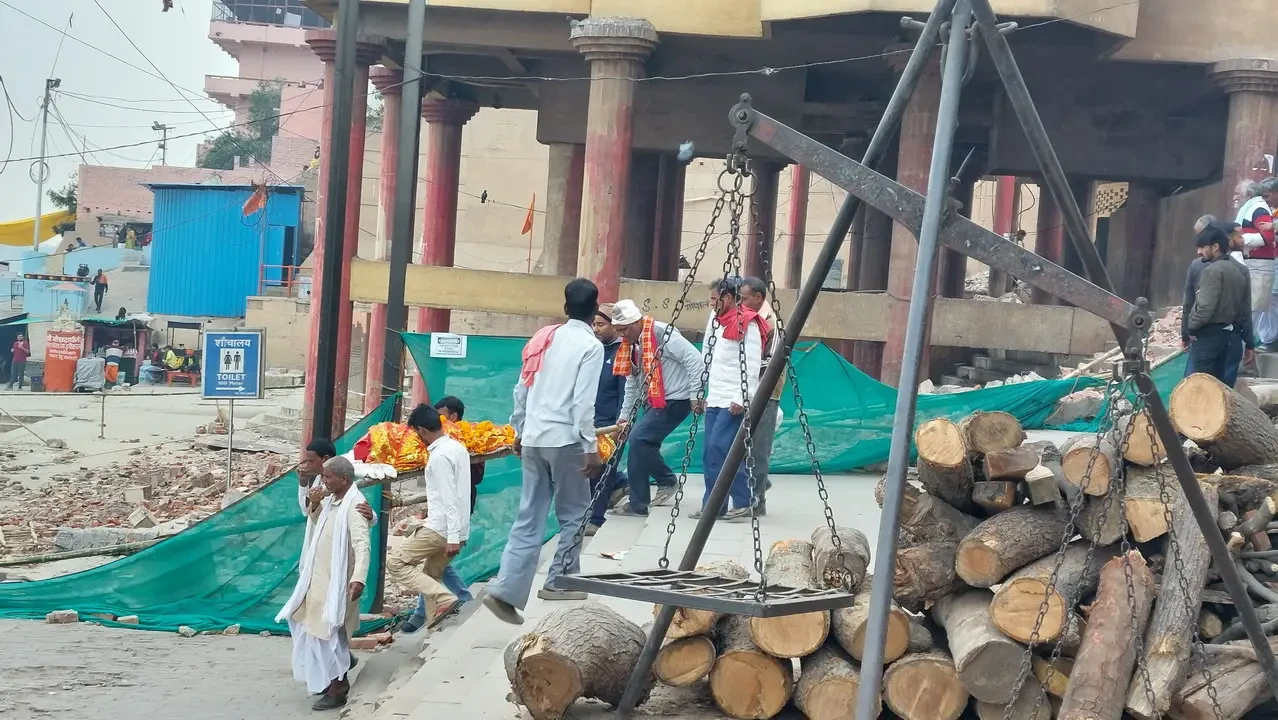
From here, we'll take a tuk-tuk to the city center. on the banks of the Ganges, starting the walk from the Assi Ghat, the southernmost one, and ascending to the one where the evening Ganga Aarti takes place. We see large quantities of wood at one of these ghats. a scale to determine the agreed-upon amount for cremation; meanwhile, the arrival is expected. a funeral procession (only men were present), where the coffin is carried down the steps towards the Ganges riverbank, where the wood is neatly piled with dry grass inside, and then placed, and the group of people begins to walk around, throwing colored dust on it. The ceremony lasts about twenty minutes. At some point, the onlookers move away, and one of the present lights the fire under the pyre, which gradually begins to envelop everything. Higher up you find three more braziers made of iron that allow the ashes to fall through, are full of wood and burn what remains of the bodies, especially the most robust bones. At the end everything is thrown into the Ganges, whose slow and apparently clear waters flow northwards.
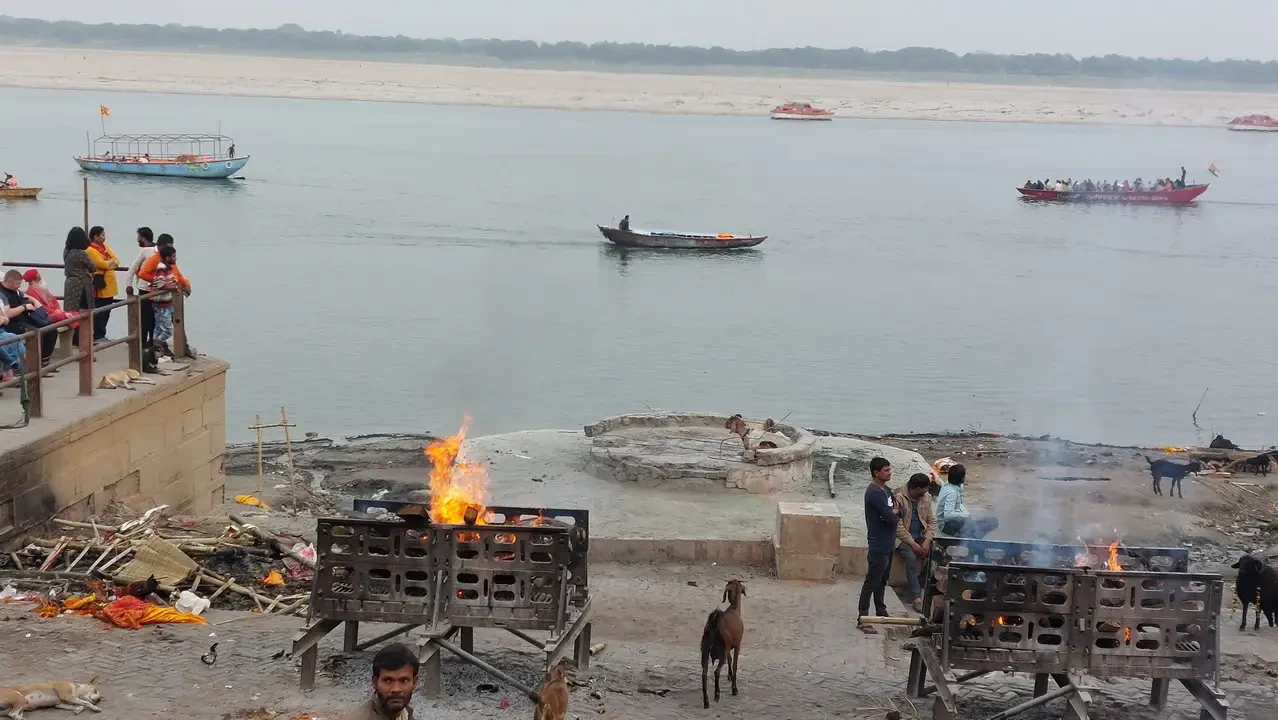
Local wildlife
Here, the concept of life and death is presented differently by Europeans and Indians. Observing reality with our own eyes would be distorting; it's important to acknowledge their greater detachment from these two elements: if one isn't overly attached to life, separating oneself becomes less painful. The same funeral ritual is observed respectfully by tourists, without anyone of the family speaking or feeling even slightly disturbed. In fact, dying here in Varanasi is particularly easy because religion dictates that this way the cycle of death and rebirth (samsara) is interrupted, which forms the basis of our faith. Resurrection is the foundation of our belief, just as Hindus want to avoid it.
Dashashwamedh Ghat and the Ganga Aarti ceremony.
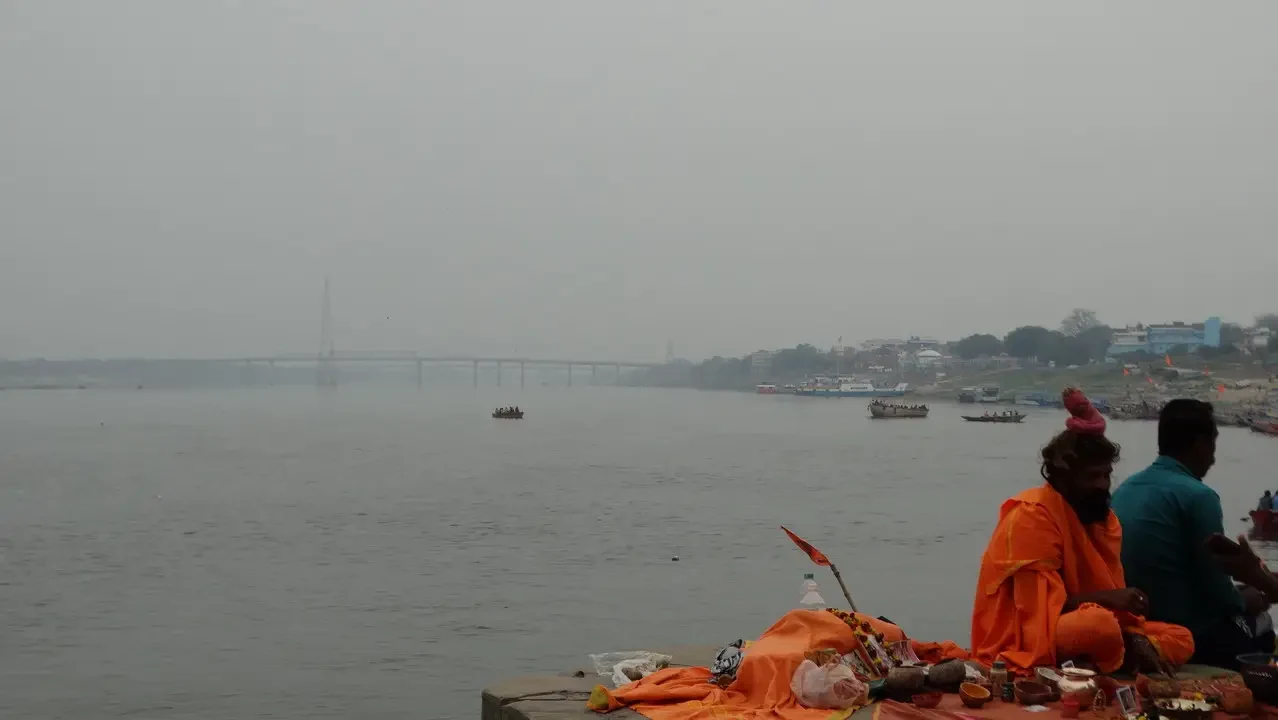
Continuing along the steps, the names of the areas change every 30/50 meters. Altars can be found throughout, while a light mist in certain spots makes the Ganges and the sky appear to be the same color. The orange-clad sadhu They are sitting cross-legged, thin, with their unkempt hair. Some young Westerners try to imitate the sadhus in their clothing and hairstyle, although we could more easily relate them to hippies. The ghats stretch out, always different in style, with people praying, others... they swim in the river ... or in the shallow pools suitable for older people, where some are walking and others are trying to sell something. We finally arrive at the Dashashwamedh Ghat, a place where every evening at sunset, the celebration takes place. Ganga Aarti... with which we pay homage to the great and sacred river. There are already quite a few people here, and some of the seating areas are reserved for those who have booked in advance and paid. We take our places on the steps, and a few minutes after 6 pm, the celebrants perform the ritual. There are thousands of people arranged in all sorts of ways, many Indian tourists, although it would be more appropriate to call them pilgrims; it is absolutely impossible to talk about a tourist trap event. Alongside a middle-class group, there are faithful from every social class, who arrive by incredibly packed trains, eat at the street food stalls, and return with a modest budget. There is even one giant screen which allows you to better follow the events taking place along the river. The participation is high and meaningful; for many of them, being in Varanasi, the holy city, represents the culmination of a dream. Some young people they pass with a tray inside which is located the powder to apply to the center of the forehead, the so-called third eye. Everything follows a pre-planned schedule that repeats daily, always with many people and always with intensity. Even though I don't understand what is being said and am not a follower of this religion, I cannot remain indifferent to what is happening around me. Spirituality prevails, and the aura present above us seems to come from a higher dimension. Without judgment and without prejudice.
As we approach 19:00, we decide to head towards the city to avoid the crowds once the ceremony ends and everyone starts leaving. We find a tuk-tuk, and within half an hour, we arrive at the hotel. From here, it's just a short walk (a few hundred meters) to a restaurant that was recommended to us.
A characteristic of holy cities is the presence of beggars and dirt; those that we would call "mentally ill." However, these are gentle people who ask for a few coins to survive. The starting point is simply different, and we will not be able to understand whether this disarming simplicity has a subjective or objective origin. In other words, did I end up there out of necessity, or is it a personal sense of detachment from earthly life, indifference, or abandonment even towards my own body? I would have had an answer in every other place, but not in India!
Everything in a peaceful setting; you never feel like you're in danger, even in the face of so much poverty and so many people.