Day 3
Jaisalmer
The flight from Delhi to Jaisalmer and visiting the golden city.
Flight to Jaisalmer
The flight to Jaisalmer, originally scheduled with Spice Jet in the afternoon, was cancelled several weeks before, and we had to book another one with. IndiGo Departing at 12:30, essentially under the same conditions. After breakfast, the driver comes to pick us up from the hotel and takes us to Terminal 1 (the one for domestic flights). There is some traffic, but we have time; security checks at the transit point are strict with a large police presence; soldiers are seated behind a reinforced shield so they can protect themselves in case of an attack. It feels like living in a situation where fighting could erupt at any moment.
Flight on time. We find Kahn (the driver, guide, expert, and eventually also a friend) waiting for us in Jaisalmer, and we depart for the city after taking a few photos at... Interesting layover... whose building appears to be little more than a house planted in the middle of the desert. In reality, the runway is divided between civilian and military sectors; we see enormous helicopters parked in the latter, while the civilian sector is undergoing renovation. A good lunch and we meet the local guide who will introduce us to the wonders of this caravan site on the southern Silk Road, founded to provide services to those traveling east or west. Its merchants became wealthy until the middle of the last century by selling opium, other spices and semi-precious stones from the area; silver was imported here, which is not found naturally but there were many skilled artisans who worked with it. Silk, camel wool and textiles in general are among the main activities that are still very popular today; they are produced in nearby villages by Muslim and Romani populations (who are defined by their character rather than being an ethnic group), where the desert offers no other economic activities besides simple pastoral farming, sometimes by nomadic tribes; among the main products are patchwork, pashmina and kashmir, some of which are woven with golden thread. Finally, but not least, is the stone carving, which creates valuable handcrafted objects.
Basically, Jaisalmer is located in an oasis, where water was found and wells were dug in ancient times; however, this is no longer sustainable with the current population, which is why a 250 km aqueduct, known as the Indira Gandhi Canal, has been built. Water, on the other hand, creates problems in the upper part of the fort: urbanization and the resulting increase in consumption have caused sewage to flow into the sandy ground (the rock upon which the fort stands is essentially sand), leading to landslides; a section of the walls has already collapsed and been rebuilt, but the merchants within the fort have been asked to leave it to avoid further damage, and if houses collapse, the responsibility will lie with the residents. To set an example, the Maharaja himself has already moved to a haveli located lower down. Currently, the current nobleman is 25 years old and took over from his father several years ago, of course, through inheritance; Jaisalmer was one of the 55 present in India before the arrival of the British, who allowed them to continue to rule formally under the crown and as social mediators; they no longer exercise political power but remain prominent figures because they hold considerable financial and real estate wealth. Therefore, they have a certain influence on local decisions, but together they can form a political force that further complicates the already complex Indian scene.
The water is pumped into a large tank located at the top of the fort once a week. From there, the population has the right to draw water through pipes/aqueduct for two hours every three days.
Given the short distance to the border, the military presence seems justified; the situation doesn't appear particularly tense, but there have already been three wars and countless skirmishes between India and Pakistan, which requires a high level of vigilance. Its location, being both strategically important and relatively isolated, also includes military schools that can utilize the vast desert areas for necessary training exercises.
Located just over 100 km from the Pakistani border, Jaisalmer experienced a crisis after Partition, but has since recovered thanks to the strong military presence for the reasons mentioned above, due to the discovery of cultural and adventure tourism in the desert (although the season is quite short), and finally as an energy hub following the installation of numerous wind farms.
Mandir Palace
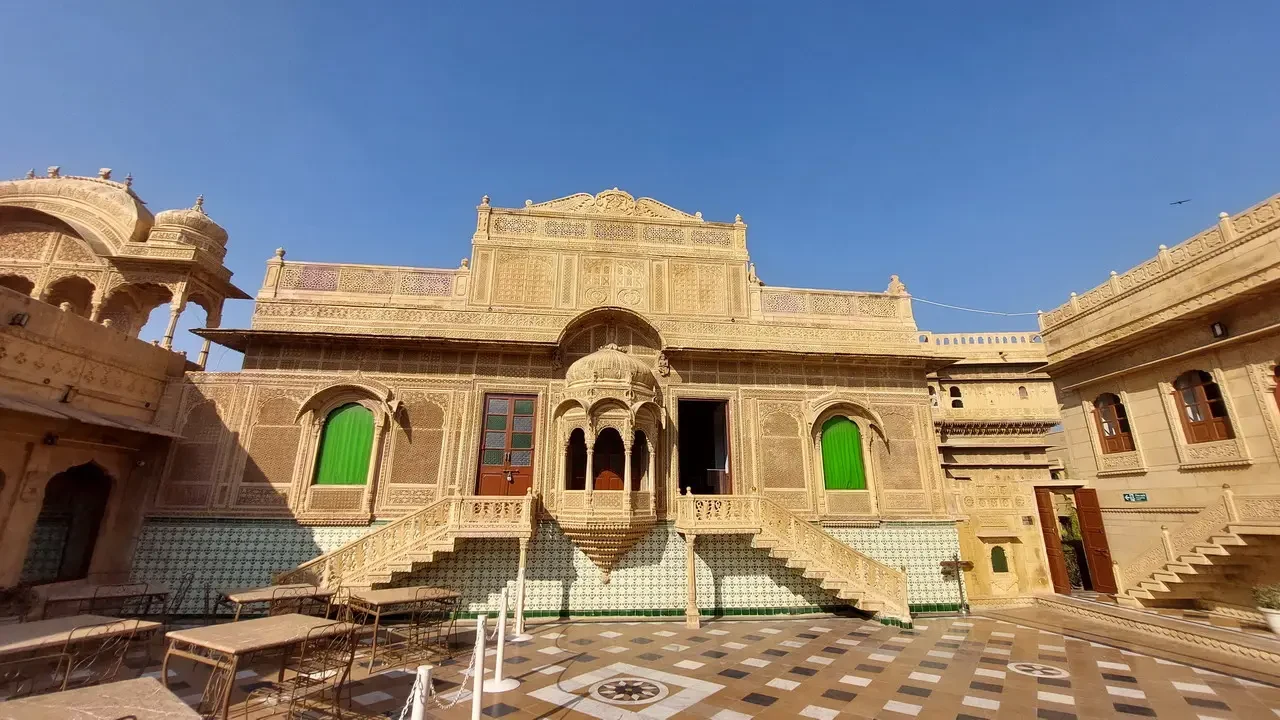
Let's start the visit with the Mandir Palace, which was the Prime Minister's palace, where we had our first visual contact with the typical local sandstone. It has the unique characteristic of being easily sculpted and excavated, but at the same time it retains a hardness that preserves it over time. The decorations I am constantly creating works of art, one after another, with beautifully carved facades that create stunning and durable architecture. This happened during a time when skilled labor was relatively inexpensive and the appreciation for fine craftsmanship was at its peak. The competition between wealthy Rajput families and merchants to excel in art is also evident here. The luxurious interiors not only provide an idea of how nobles lived centuries ago, but also showcase exquisite details that complement the exterior architecture. This stone is currently being shipped throughout India; it seems like two trains depart each day to deliver it to various destinations and workshops. The sandstone used for the walls becomes even more beautiful when the sun sets and its rays heat the walls horizontally, which is why Jaisalmer has been named the "City of Gold." Some religious paintings prompt the guide to tell stories about Ganesh (the son of Shiva with an elephant head) and Ravana, set in Sri Lanka. The building was constructed by two brothers, and from the outside, the carvings seem to replicate the same images; however, a closer look reveals subtle differences that do not affect the overall harmony. The metal railings feature the same patterns as the sandstone and are painted with similar colors, making it difficult to notice any differences until you get close.
We stepped out and walked through the streets of the city center, which were bustling with people, colors, traffic, fresh cow manure, and the smell of sewage from the two side canals. We also saw a curious series of green chili peppers skewered with a small lemon in the middle, all hanging from a string at the entrance of a door or window; these are amulets to ward off negativity that the lemon is intended to absorb during the week; on Saturday, everything is thrown into the street and trampled by vehicles, which in this way crush the evil eye. Afterwards, a new one with weekly validity is placed.
Kothari Patwa Haveli
We are now at Kothari Patwa Haveli, a series of five parallel palaces built by a Jain merchant for his children: it is the apotheosis of refined craftsmanship, like an intricate embroidery. the interiors feature mirrored surfaces., I courtyards I also have decorations and you can see all sorts of tools that allow you to get to know the daily life of the time. The haveli had narrow, high stairs so that anyone arriving was forced to proceed slowly and make noise, so that the hosts were prepared for the imminent visit. There are also iron rings used as rudimentary bells. the contrast between so much beauty and the cows The sight of animals wandering freely and feeding on garbage is quite jarring. Looking down, it feels like you're seeing hell, while above there's the architectural paradise. On the other side of the street, an oddly shaped square opens up, surrounded by tall buildings: when Indira Gandhi visited, she didn't appreciate that such a valuable asset was only visible from the road under the buildings, so she ordered the demolition of the adjacent building so that visitors could move back about thirty meters and have a wider and more pleasant view; both the demolition and the relocation of the residents in the building seem to have been financed by the Indian Prime Minister.
Sunset in Jaisalmer
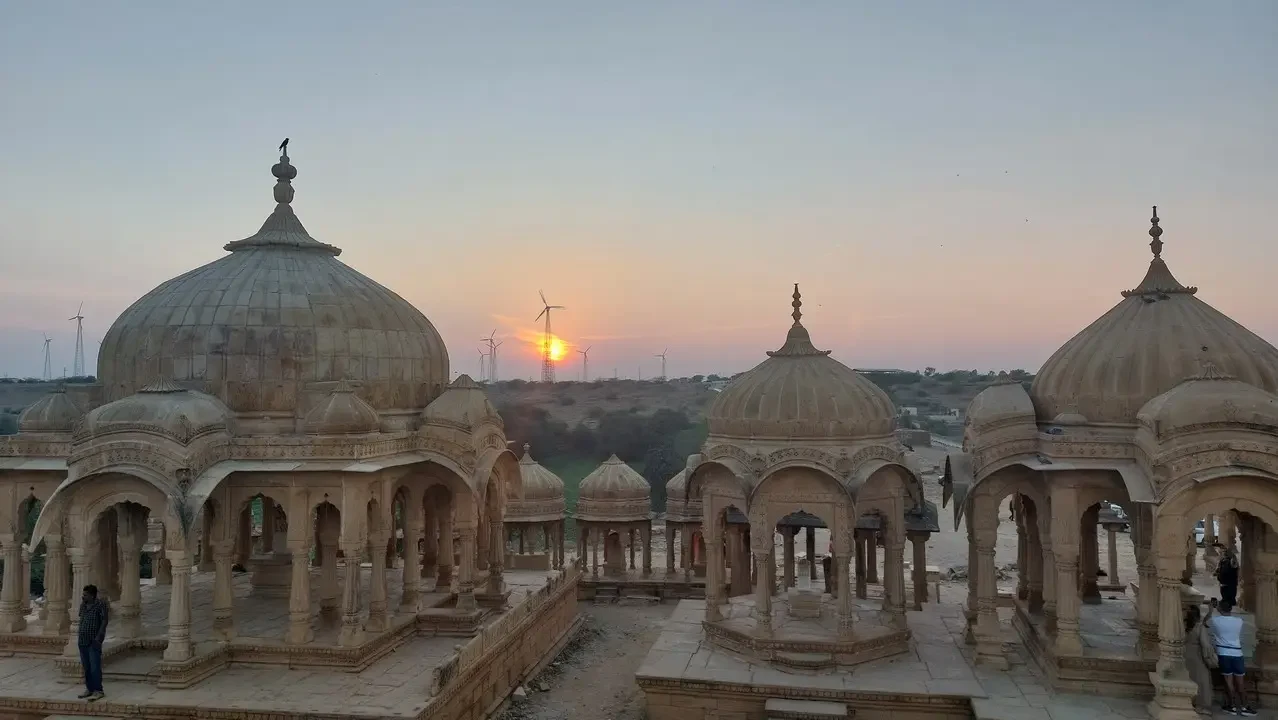
Let's go to enjoy the sunset at the memorial sites of Bada Bagh; since Indian tradition dictates that bodies should be cremated, the concept of a cemetery would essentially disappear. The Maharaja, nobles, and wealthy individuals have tried to perpetuate their memory through beautiful and valuable monuments architecturally located, typically outside urban centers. This is dedicated to the Rajput families of the ruling dynasties in Jaisalmer, and the structures are proportioned according to the importance of the person they were dedicated to. Cremation took place on-site, followed by burying the ashes with a memorial stele, and the bones were then placed in the sacred river, the Ganges. It's a shame that the setting sun is obscured by a row of tall wind turbines, preventing beautiful photos, but this is the price we pay for green energy. In terms of greenery, this desert allows for very lush vegetation thanks to a small dam created several centuries ago and the hills that protect it from winds.
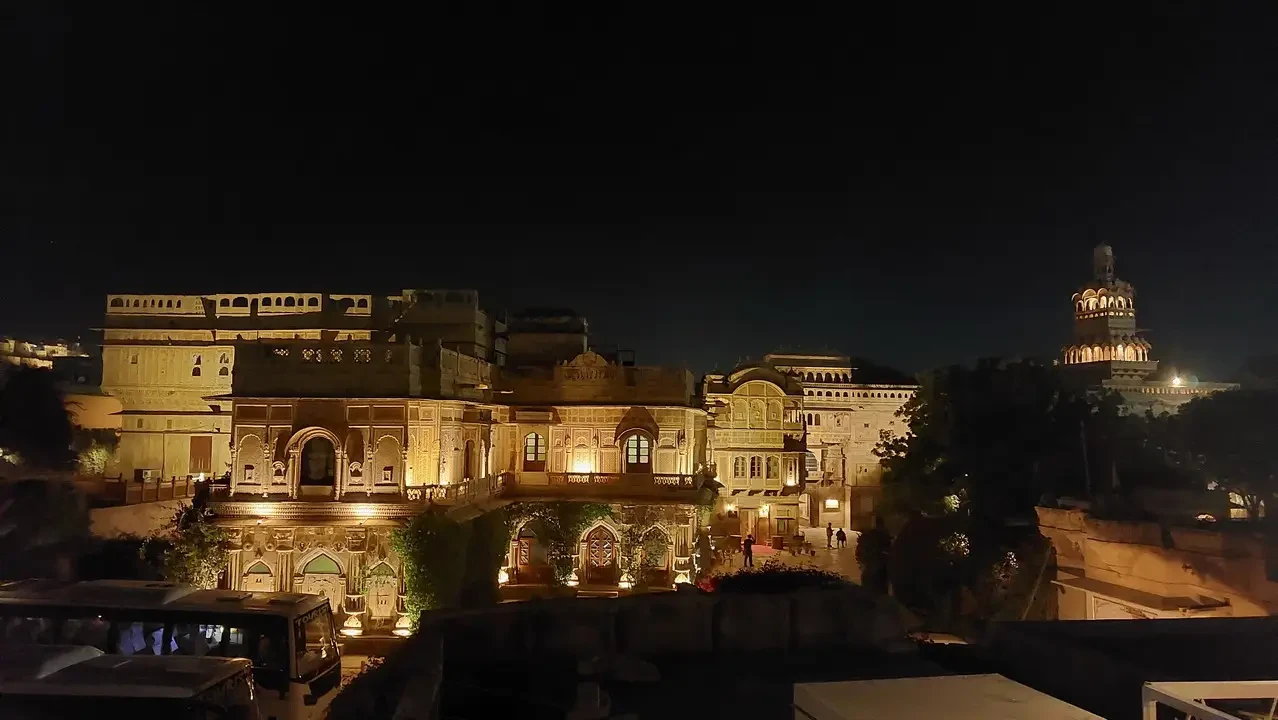
Around 7 pm, we find ourselves at a scenic viewpoint to admire the illuminated city and under a bright sky. Dinner on the terrace of a restaurant with great view and traditional houses sparkling like golden ornaments. We try the korma ram puri for the first time.