Day 11
From Puno to Cusco
History and nature without end, entering the heart of the Inca civilization.
From Puno to Cusco along the Andean highlands.
With sadness we must say goodbye to the friends at Posada Kusillos: today we also leave early, and shortly after 6 am, we enjoy a wonderful breakfast at the table. It's a shame that we couldn't spend more time with them, sharing their simplicity and learning more about the Andean customs they so nobly represent. But when planning a trip, it is difficult to create spaces to stop, especially where and when. So, with a lump in our throat, we wish them a Merry Christmas and return to the bus terminal in Puno, this time aiming for heading south towards Cusco. A few weeks ago, we booked our seats on a tourist bus from Inka Express, which operates the route from Puno to Cusco; it's a well-equipped vehicle with excellent drivers and hostesses who occasionally offer drinks. There are five stops along the way at various historical or cultural points of interest, although one is actually a restaurant that primarily caters to gastronomic interests.
Departure at 6:30 AM with the first stop to visit the Pukara Museum, located in an area of special geological significance due to the presence of pink stone. Two large boards trace a chronological parallel between South American and contemporary civilizations in Europe or Asia, with details that are far from negligible. The explanation of a misunderstanding is also interesting, which even Peruvians fall into: Inca is the ruler, the term means power, as it was for the pharaoh in ancient Egypt. The civilization and language are called Quechua, just like those found in Southeast Asia and Bolivia, which are called Aymara. A stele recalls the transposition of yin and yang in a local version, i.e., the never absolute dichotomy between good and evil. It is curious to see images depicting the catfish, common to Persian and Egyptian civilizations, which combines water and fire, where the cat takes on a diabolical meaning that we also find in our ancient culture. In China it is represented by the dragon.
Abra La Raya, Raqchi and the temple of Viracocha
The Abra La Raya pass, at an altitude of 4470 meters. Represents the highest point reached during the day and also has political significance, marking the border between the provinces of Puno and Cusco, as well as being a beautiful scenic viewpoint. In the background, you can see the glaciers of the Vilcanota Range, while below us is the typical mountain green that gently slopes north towards Cusco. It's also the point where the eastern Andes, of volcanic origin, meet with the western ones; from the nearby and more precisely from the slopes of Mount Apu, which means "God," Chimboya at 5500 meters, the Vilcanota River originates, which later takes the name Urubamba, running for almost 800 km and passing near Machu Picchu, before entering the Amazon River. From here, it will still have more than 6000 km to reach the Atlantic.
As we descend, we find ourselves surrounded by green meadows dotted with eucalyptus trees. It seems that these trees were imported from Australia, particularly Tasmania, where there is a species well-suited to this climate. This operation became necessary at the beginning of the last century to reduce landslides in the Andes, but the plant absorbs a lot of energy from the earth, and it is believed that within a couple of decades, its negative consequences will be seen. For now, it provides good wood for local carpenters. The vast expanses of grass are grazing areas for herds of cows, but we also see many sheep mixed with camelids in the Andes: as a result, this area produces some of the best cheeses in Peru. Further down, some villages are dedicated to raising guinea pigs, known as "cuy," a prized dish in Peruvian cuisine. The next stop is at a restaurant where we can enjoy an excellent buffet.
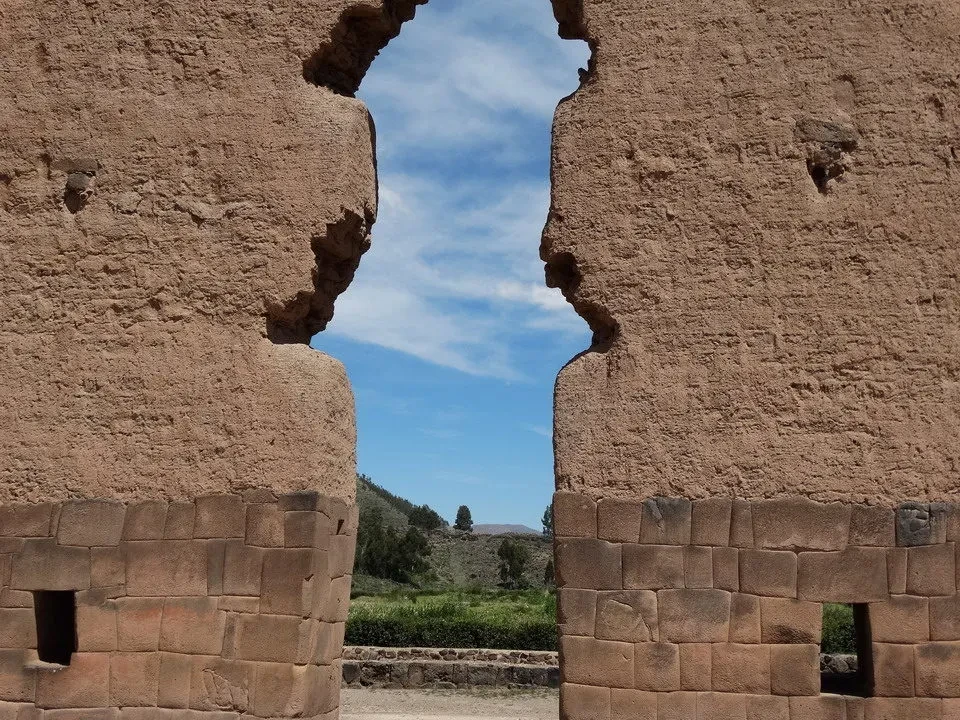
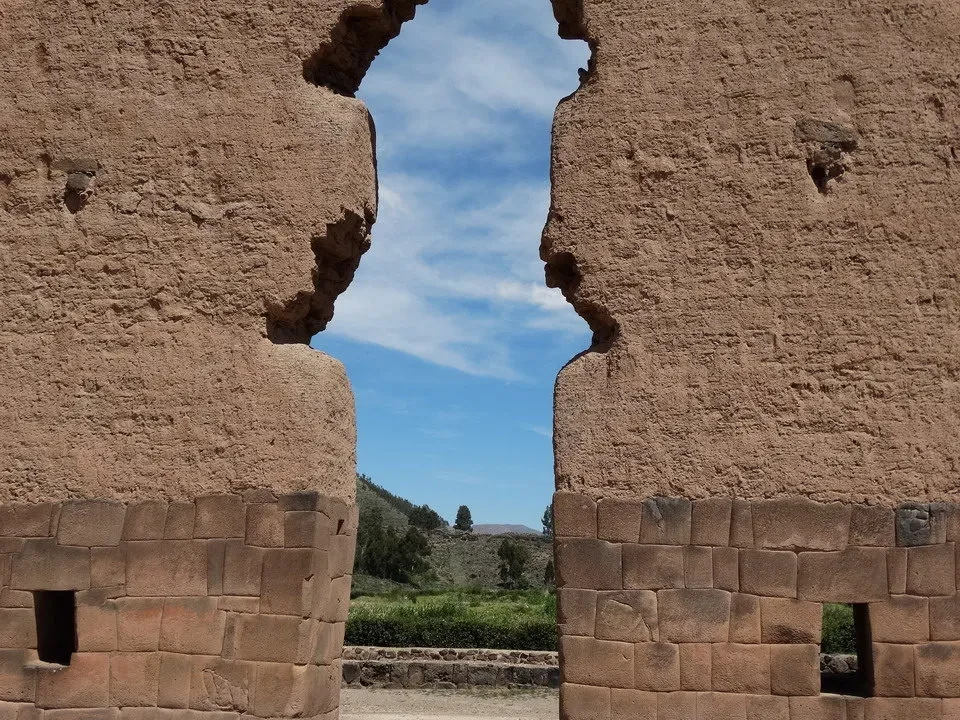
In the next stop, we have the opportunity to immerse ourselves in Inca culture by visiting Raqchi, the Temple of Viracocha... the only one dedicated to the supreme authority, to which worship normally did not allow the erection of temples, the creator god above Pachamama. The exception is due to its proximity to the regions that were inhabited by the Aymara, whom the Quechua intended to annex: the temple was meant to serve to convince the populations living around Lake Titicaca to join the Inca empire and its religion. This happened for a short time due to the Spanish invasion of 1532. In the Inca religion there is a supreme creator god, Viracocha, under whom are the sun, the moon and the stars. On the third level are thunder, lightning, the rainbow and other natural elements.
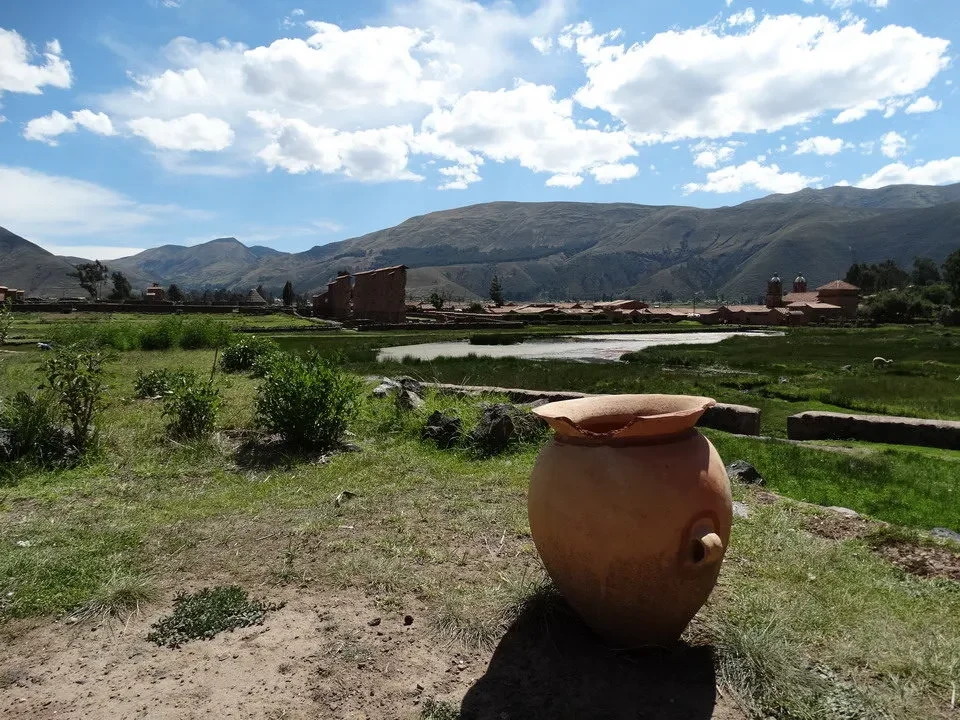
The temple was built in 1410, Machu Picchu is from 1420, at this location to convert the Aymara people once conquered, who lived on the plateau up to Bolivia and Lake Titicaca, which represents the lowest point of the basin. After the conquest, only 20% of the artifacts were saved while Machu Picchu, which was discovered later, remained at 80%. The walls are built with an inward inclination so that they support each other; at the same time, the windows take a trapezoidal shape for the same reasons. Walking along the main street of the complex, we learn that it was designed so that the sun passes through it entirely during the June winter solstice. We begin to see the typical stone blocks perfectly aligned on top of each other, as if they were made of rubber, with adobe walls still in good condition. It is impossible to walk these streets without trying to imagine what happened half a millennium ago; everything remains even more mysterious because, although it is not a very ancient civilization, little has come down to us. Without a real writing system and not particularly concerned about cultural aspects, many of their knowledge have been irrevocably lost by the Spanish conquerors.
Andahuaylillas and evening in the capital of the Incas
The sky is dotted with white clouds, they seem to be trying to emulate the alpacas that graze nearby. There are also water-starved crops, which would lead to their demise if not for irrigation. We are at an altitude of 3600 meters and will descend to 3100 in a very green valley where maize is cultivated, but even this crop is suffering from the drought. We see only a few irrigation systems, despite the Urubamba River carrying a significant amount of water, and it's clear that we are not crossing impoverished areas unable to afford irrigation systems to combat the thirst of agriculture. Perhaps they simply haven't yet adapted to the changing seasons due to climate change. Where there are no crops, there is resilient vegetation, particularly agave and gorse. As we approach Machu Picchu, the anticipation about the weather in the coming days increases: this will be a key factor in the success of the expedition.
Finally, when we were just a few dozen kilometers from Cusco, we visited the church of Andahuaylillas, known as the "Sistine Chapel" of South America, a Jesuit monastery complex that was later transferred to the Dominicans after they were expelled from Peru. It is the only church where taking photos is strictly prohibited, presumably to protect the invaluable treasures contained within, given the abundance of gold and silver artifacts found there. The shimmering effect is truly remarkable, especially considering that we are in a small rural village where one would expect at most a simple church. In reality, the temple dates back to the early years of Spanish rule, and its construction seems to have been intended to instill fear in the indigenous people, who were amazed by its grandeur and opulence. Although the decorations made of precious metals were added later, and the materials came from mines seized from the natives.
We have now arrived in Cusco: the arrival in this city of the Incas was delayed by half an hour due to frequent road closures necessary to bypass bridge maintenance work on the main highway. As always, the hotel we chose is just a short walk from the center, which is very convenient given the limited time available in this city. For dinner, we take advantage of a restaurant located on Plaza de Armas, known for its grills. The square is beautifully illuminated with monuments surrounding it, making it even more beautiful. Cusco It has a charm that is evident even in the evening. A walk through the center brings to mind all the history that passed right here, in what was once the capital of the Inca Empire, now a city transformed by its economic miracle linked to tourism. The famous Inca treasure really exists and is contained within the tourist legacy they left for future generations.