Day 5
Trekking Colca Canyon I
Descent into the Colca Canyon, in the realm of the condors.
Towards the Colca Valley, through high plateaus and Cruz del Condor.
As promised, the alarm will wake us up at 2:30 AM. For today and tomorrow, we have booked a trek in the Colca Canyon and the program is quite intense. A minibus picks us up with a dozen other white-skinned adventurers to head towards the canyon. Thanks to the usual early morning sunrise and a landscape that becomes increasingly magical, we don't have any trouble keeping our eyes open. Once we leave the city, as traffic begins to get heavy, we immediately enter a dry area. The road is beautiful, wide, and in good condition. The curves and turns are also well-designed, unlike the typical Andean roads we are used to imagining.
The landscape is continuously desert-like, with no vegetation growing. At some point, a brightly lit facility appears: it's a cement quarry, created by the abundant volcanic ash that has settled in the region, and this explains why so many trucks are moving at a snail's pace. Between one slope and another, there are high plateaus where the road runs straight as an arrow. We reach an elevation of over 4700 meters, although the plateaus are around 3500 meters. At this altitude, there are still tall trees, but they are almost exclusively eucalyptus; the rest consists of cacti and plants similar to Indian figs. A volcano, Sabancaya, is erupting: we're told that it has been doing so almost continuously for over two years, creating a noticeable seismic activity.
We finally reach a plateau that will take us to Chivay in three hours from Arequipa; afterwards, we stop for breakfast at a well-organized place where we are served bread, butter and jam with excellent coca mate. This is an infusion: each of us takes some coca leaves and puts them at the bottom of the cup to which we add boiling water. After a few minutes, the liquid turns yellowish and can be drunk. It's useful for restoring energy when you're at high altitude, and we discover in this first opportunity that coca is not as harmful as people think, at least if taken in this form. But about this topic, we will return later with more details. The place is located in a sort of mini-farm where chickens, ducks and some turkeys roam. All around are fields of the typical low white corn, purple potatoes and other crops that we partially don't know. Overall, the terraces appear very orderly; water works wonders, we already saw it yesterday in Arequipa.
Chivay is the heart of the Colca region, where you can purchase tickets to access the canyon park. We continue our ascent on a steep road to reach the Cruz del Condor, a place whose name alone evokes much of the magic of our journey. It's said that this season isn't ideal because the females are nesting and the males are watching over them. In reality, after a moment, two enormous birds glide close to our heads, as if they were coming to see us. With a walk in the surrounding area, we spot more of them further down in the canyon, which is about 1500 meters deep at this point. These are the largest birds in the world with an wingspan at about three meters, they seem small down there, and often it's not even worth photographing them. We discover that the condor is a very particular and long-lived animal; it lives up to 75 years; the male forms a pair with only one female, and when he becomes widowed, it apparently ends by committing suicide. A kind of extreme love that turns out to be unique among living species. The birds live in nooks along the steep rocky walls and feed exclusively on dead animals that they identify thanks to their powerful eyesight. In no case do they kill living animals to eat.
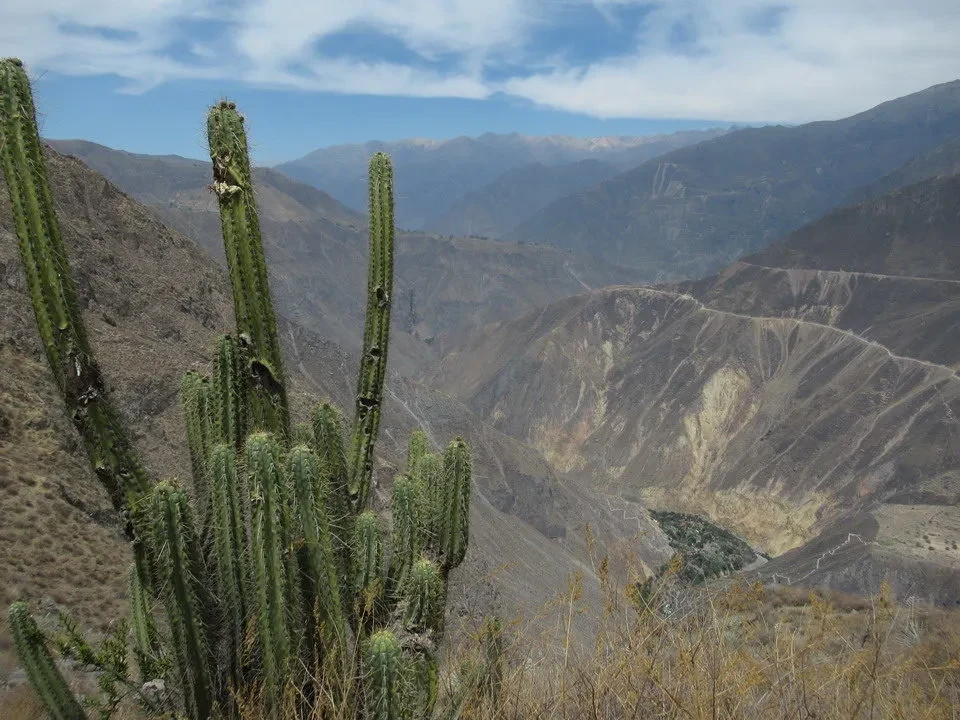
Descent into the Colca and arrival at the Sangalle oasis.
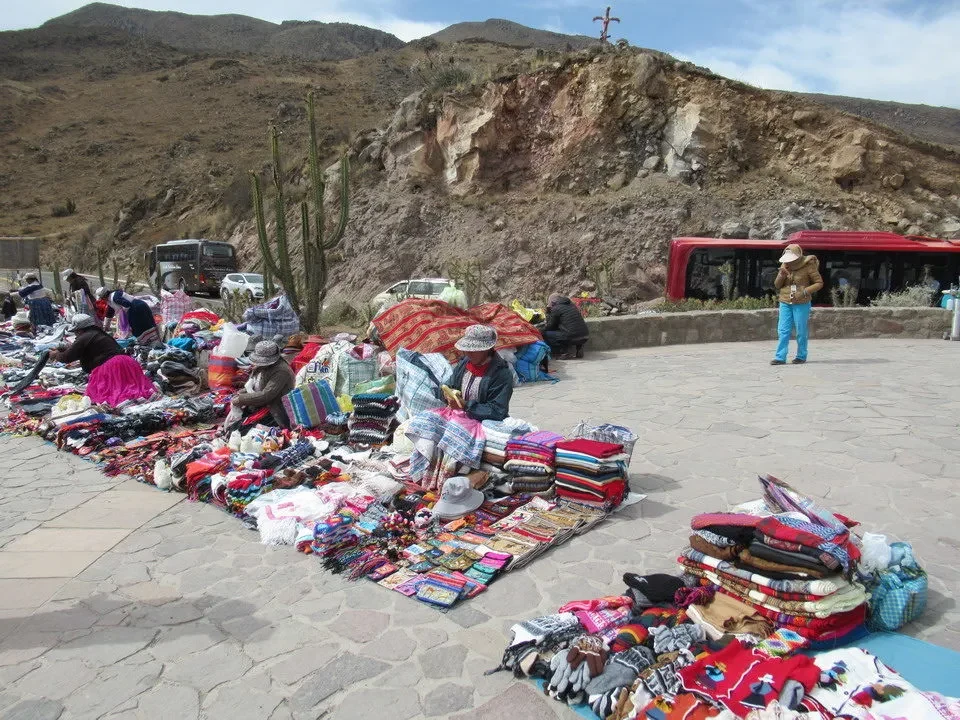
On the parking area, some local women. they sell their crafts multicolori. Another short ride with the minibus and we finally arrive at the starting point of the trek, just before Cabanaconde. Here, we are taken over by a young but excellent and friendly guide who will accompany us for two days. But then, just before we start walking, other birds take flight in the sky, near the rocks. The male condors are circling to survey the area so that no one disturbs the females while they incubate their eggs. We are so captivated by watching them and taking pictures that we wouldn't even be able to move. Their gliding flight, without flapping their wings, supported solely by the air currents of the canyon, creates a nearly miraculous figure. As if gravity didn't exist in this agile and elegant flight; an image of freedom that we also enjoy today.
The canyon It is the second deepest canyon in the world, and the name Colca signifies the union between the Cabana and Collagua cultures. The sky is slightly overcast, but it's pleasant; it's 10 am, and as the hours pass, the sun will take over. Today’s trip was special; I had never undertaken an excursion where you first descend and then climb. In this case, we need to consider that we are at 3350 meters, we need to descend approximately 1200 meters, and tomorrow we need to have the strength to climb back up. It's not like our mountains, where if you're tired, you stop and go down; here, once at the bottom, you must climb back up without hesitation. In reality, we will discover that there are mules with guides who can carry the hiker and take them up when needed. Of course, these services come at a cost, but in this situation, money wouldn't be the first concern.
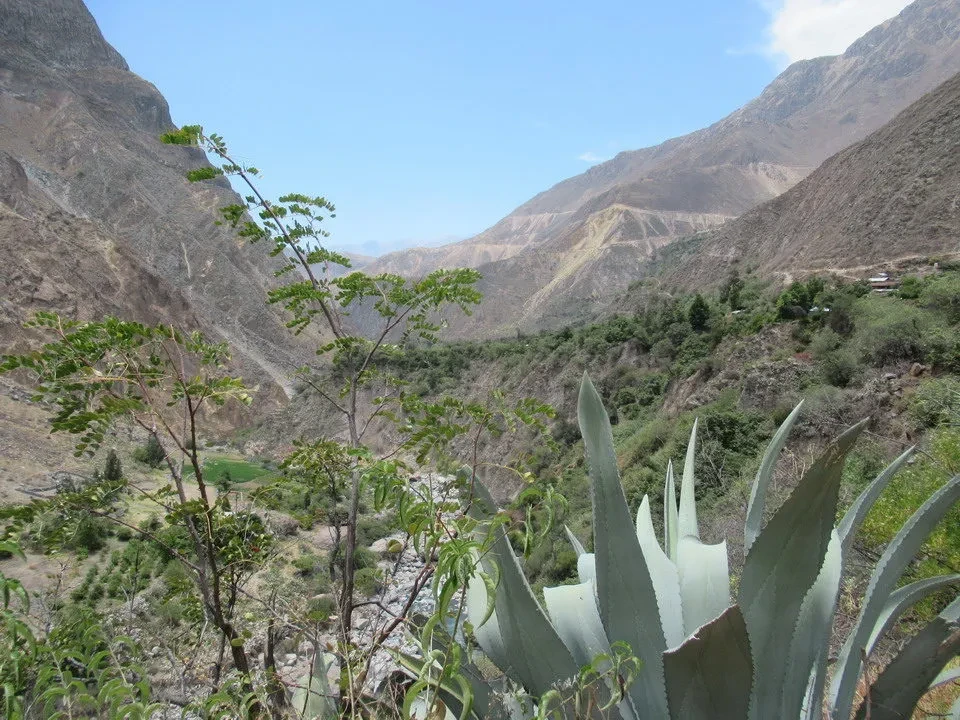
The path is wide.... also to allow passage for donkeys carrying materials. It is important to remember that the path can only be reached on foot or with the help of animals, as there are no roads. On the north side, we see a dirt track running at a higher elevation parallel to the canyon, but goods must be transported solely by people or animals. The sparse vegetation consists mainly of drought-resistant plants, large agaves, and Indian figs. It takes us an hour and a half to reach the suspension bridge that crosses the Colca River, and we then walk another half hour on the other side to reach a small house where a simple lunch was prepared: quinoa and potato soup, and a dish containing rice, a piece of unidentified meat, and vegetables with avocado.
Around 2 PM, we continued with significant climbs to finally reach the Sangalle oasis, where we will spend the night tonight, and take advantage of the opportunity to enjoy a well-deserved swim in the pool. In fact, the canyon floor is rich in thermal waters, so even the simple lodges here can have their own pools; there are five in total. The scenery is incredible: both sides of the canyon are dry, with vegetation consisting mainly of drought-resistant plants and a lot of dust due to the infrequent rainfall. It rains about fifteen times a year, but this year has been particularly dry, as evidenced by the withered agaves longing for rain and the very dusty paths that pose a risk of slipping. In contrast, the bottom features lush green oases, and some lodges even have English-style gardens.
Along the route, our guide teaches us to recognize berries and herbs that could be useful: the first is "muna," a herb similar to mint but with a slightly more bitter taste, which we drink as an infusion (what we call "tea"), while in South America it's called "mate." It's used as an energy booster and seems to have various medicinal properties. We then learn about cochinilla, a medicinal plant for the stomach and other digestive problems. Its berries are covered in white powder that, when crushed with our fingers, releases a bright red liquid that the ancient Incas used to paint their faces. To really immerse ourselves in the scene, we also paint our faces with this color; it certainly has the advantage of being easily removed with just one wash when we no longer want to scare enemies. There's also a plant whose leaves are rubbed, which emit a rather pungent odor and, when applied to the skin, serve as a repellent against the frequent mosquitoes that infest the area. Finally, our guide tells us about eucalyptus and its properties, which we already know in our latitudes.
At the lower part of the canyon, many wild fig trees grow, almost forming a forest. The afternoon descent necessary to overcome the steep slopes from the northern side still allows us to gain an elevation of 500 meters, even though we have reached the bottom. Shortly before reaching Sangalle, the path passes in front of a patch of green: this is where the thermal water flows at 38 degrees from the rock. Some of it is channeled for the benefit of the village, while the rest flows towards the stream and its warmth allows for the proliferation of very lush vegetation. The locals call this point "the place of bad luck" or negative energy. Despite its view, the sharp bend plunges into the void and has fatally attracted several people who have fallen, either due to distraction or deliberate action. Unfortunately, the next morning we will learn about a tragedy that occurred just overnight, although not at this specific location: a 43-year-old Spanish hiker reached the bottom of the canyon exhausted, likely also due to the altitude; he was given oxygen, rested, and when the owners of the local restaurant went to look for him because he hadn't shown up for dinner, they found him dead in the bed. A sad end for those who simply wanted to enjoy this wonderful corner of the world. It may not help much, but it is comforting to think that if one must die, it will be less tragic after having experienced the Colca Valley.
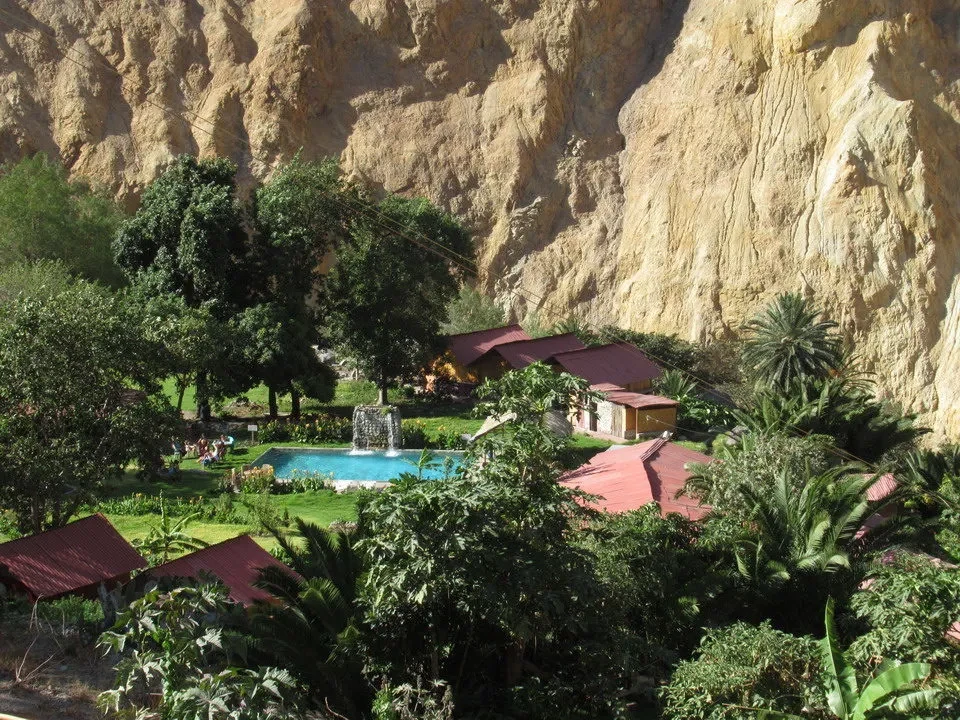
The Sangalle Oasis presents lush nature dotted with palm trees, in stark contrast with the steep slopes that overlook it. The walls vary from yellow, of sulfurous origin linked to volcanic eruptions, to the classic vertical rectangular shapes similar to basalt organ pipes Elsewhere, we find crumbly grey rocks, similar to concrete, which are also the result of numerous volcanic eruptions in the area. Once we reach our base camp, we take a few minutes to relax. swimming pool, before the sun sets around 17:30 behind the high surrounding walls. We are at an altitude of approximately 2200 meters, which is certainly not a significant height in this area, but when the star disappears, the water becomes noticeably cold. Shortly afterwards, we hear a loud noise followed by some movement, as if something had fallen nearby in the village: it's a small earthquake, fortunately short and of low intensity, to which the inhabitants are accustomed.
Dinner is essentially the same as lunch, even though we are in a different location. The same soup, while for the main course we have pasta. But we are certainly not here to appreciate the delights of the local cuisine. The trekkers are mostly young people, predominantly women, from Europe and America. In any case, this is not the ideal destination for those with communication or training issues. The room where we sleep is small and very basic. We did not expect anything special, and it's perfectly adequate for one night. It's almost 9 pm, but the area does not offer many alternatives, and we had a wake-up call at 2:30 am, so it's easy to fall asleep. This is also because tomorrow morning, the meeting is scheduled for 5 am. During the night, various types of birds sing, keeping us company: it's not cold, and we can rest well.