

Day 10
From Rio Dulce to Antigua
Transfer day, without any major issues.
Morning at Casa Perico
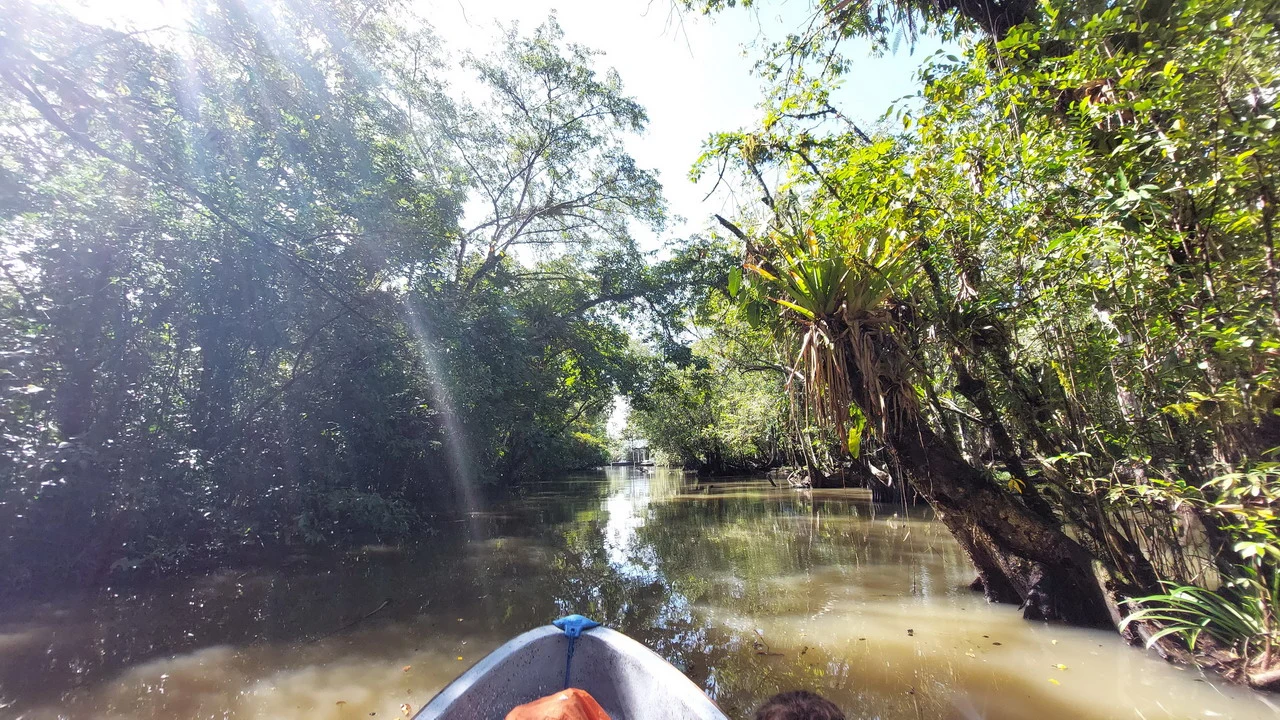
In the night, the rain falls softly and heavily, as is typical in tropical regions, allowing us to finally sleep soundly. The only disturbance comes during the most intense moments when the drumming sound echoes on the roofs made of palm leaves. This experience makes us feel even more immersed in the jungle, although we are not that far from what we might cautiously describe as civilization. Breakfast consists of a couple of pastries purchased yesterday and a hot coffee; we enjoy an hour of peace while walking along the walkways connecting various parts of the site. The rain is starting to stop and the sun begins to peek through the vines. sparkling on the water The view was obscured by the rain. At 10:00 AM a boat arrives to pick us up and at 10:30 we were back on solid ground, ready for the shuttle to Antigua. Rio Dulce had nothing interesting to say: a small town with a central road and a series of shops catering to the locals, it was busy and dirty. We were expecting a theoretical journey of seven hours, which started an hour and a half later than scheduled and ended almost four hours late. We knew that this would be the longest and most tiring leg, and so it was. The bus from Flores arrived when it could, unloaded its passengers, gave the driver time to rest – usually two drivers make the entire journey – and then departed. It was full of people like us, except that they were mostly younger. After just under an hour's drive, we found ourselves stuck in a long queue of trucks moving at an extremely slow pace. At some point, the cars and pickups started to overtake, taking advantage of the fact that there were so few vehicles coming in the opposite direction – although not insignificant. We ended up with the right lane blocked and the left lane used for continuous overtaking, forcing the cars to stop on the sidewalk when they arrived. vehicles from the opposite direction Everything proceeds with reasonable chaos until we reach the intersection with the CA9 road, which on the left leads to Puerto Barrios and Honduras, and on the right towards Guatemala City and Antigua. Unfortunately, the queue continues in our direction; at this point, the driver manages to navigate around the intersection in reverse, ending up appropriately reversed on the CA9. The harsh reality is that this road is much busier, leading to a chaotic situation where vehicles attempting to overtake frequently seek refuge on the narrow platform, creating further competition among themselves. We can no longer understand anything; fortunately, the drivers remain calm – it would only take one argument to escalate the situation. Even the police pickups struggle to move despite flashing lights and sirens. The moment is not particularly peaceful, but we continue to climb into the queue of heavy vehicles. Google Maps indicated about twenty kilometers; we are now just a few kilometers away from completing the red line on the smartphone app: we don't even know if the congestion is due to an accident or the infamous blockages... which we had heard about recently. Just three days ago, spontaneous protests arose that prevented some from reaching Tikal – the day before our visit – while several shuttle transfers literally turned into journeys of hope; we have news of a woman who took 21 hours to reach her destination. However, we soon discover the cause of what is happening: five kilometers after the crossroads, two trucks collided and are still occupying part of the road – one has its cab destroyed, the other was carrying machinery and is now with its cargo moved. With unwanted cynicism, we all let out a sigh of relief when we find that it's not a protest; for the drivers, of course, things were not going well. From this point on, the roles are reversed: while we slowly travel in our lane, there is an endless queue of trucks trying to pass us. We appreciate the spirit of collaboration between the drivers and their ability to manage the situation; the forced reduction in speed avoids further accidents. Passing alongside the long line of trucks parked in the opposite direction, we see a huge quantity of refrigerated containers for transporting Chiquita, Dole and some Del Monte bananas. Talking about dozens of vehicles is still a cautious estimate.
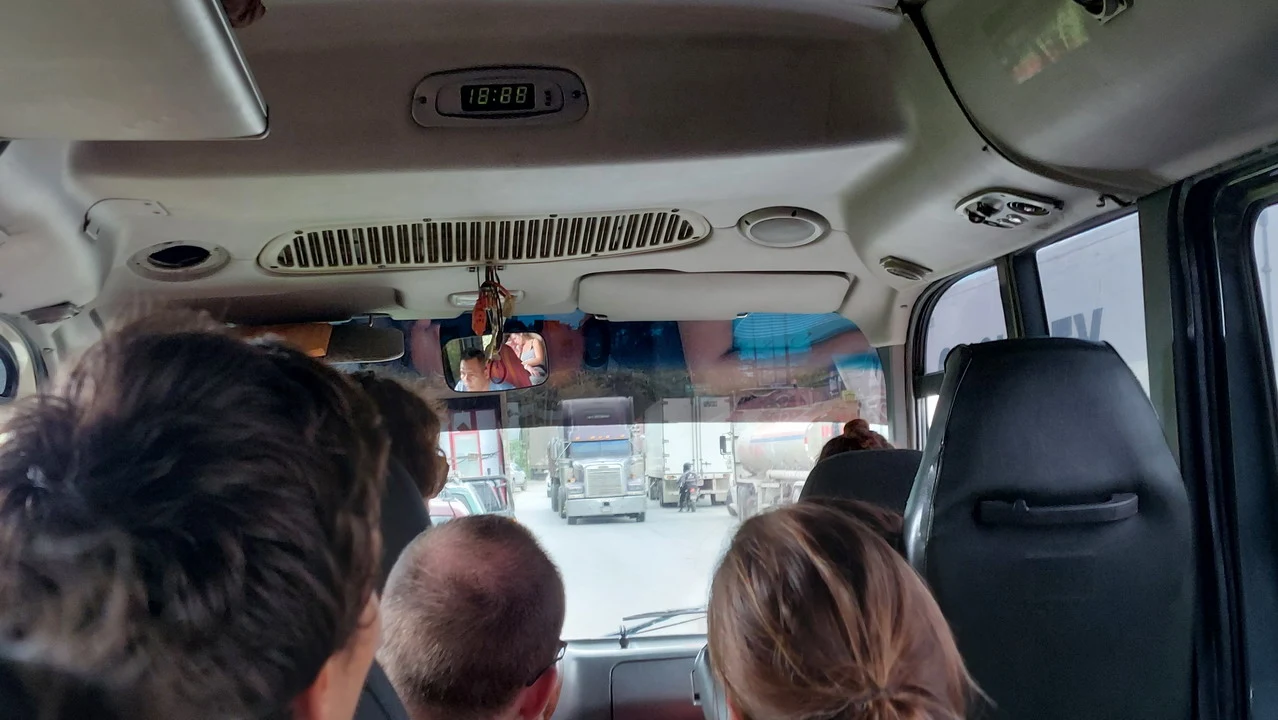
Reflections from the window: gas stations, bananas and tires.
During our long journey, we also had the opportunity to reflect on gas stations: as widely seen in the previous days, gas stations are extremely frequent – sometimes literally one after another – and many of them boast an opulence that is sometimes even greater than those in Western countries. Texaco, Puma, and others compete with each other through large spaces, enormous canopies, and stadium-like lighting. Clearly, the margins are high, despite the price of gasoline hovering around one euro per liter. It's surprising to see a corresponding price of 3.5 euros indicated on the signs, but we immediately remember how fuels are measured in gallons – and the calculations make sense. It is clear that the State does not charge too much in taxes, but considering salaries and prices, we wonder how there can be so many motorized vehicles around. Regarding units of measurement: distances and weights are used in the decimal system, temperatures in Celsius; only for liquids are gallons used. A separate discussion should be made about electrical outlets, which are exactly the same as those used in the USA.
Along the route, the landscape is almost exclusively hilly – rarely any plains – but never monotonous. The crops are mainly bananas or fruit trees, in a very green setting. It's interesting to see the bark of the rubber trees cut diagonally to extract the latex, almost as in Canada with maple syrup. Packed inside the minibus, time seems to stand still, even though the hours pass relentlessly and it gets dark. Two breaks to allow passengers and the driver to rest, a stop to let anyone needing to disembark in Guatemala City, and then on to the final downhill stretch to Antigua. It's late, but precisely because of that, our appetite isn't lacking; we go to the restaurant where we had lunch on the day of departure for Flores, and for a light dinner, we eat fish — moorish fish and white fish – simple but well-prepared and delicious. Although it's 10 PM, all the shops are closed, while bars and restaurants try to get rid of their last guests; only the nightclubs seem to be operating at full capacity on this bright Saturday night. It’s time to return to the hotel where we stayed a few days ago, where we find our suitcases waiting for us; we confirm and purchase the tickets for tomorrow's transfers.


