Day 6
Antigua
The city of colors, surrounded by volcanoes.
From Copán to Antigua
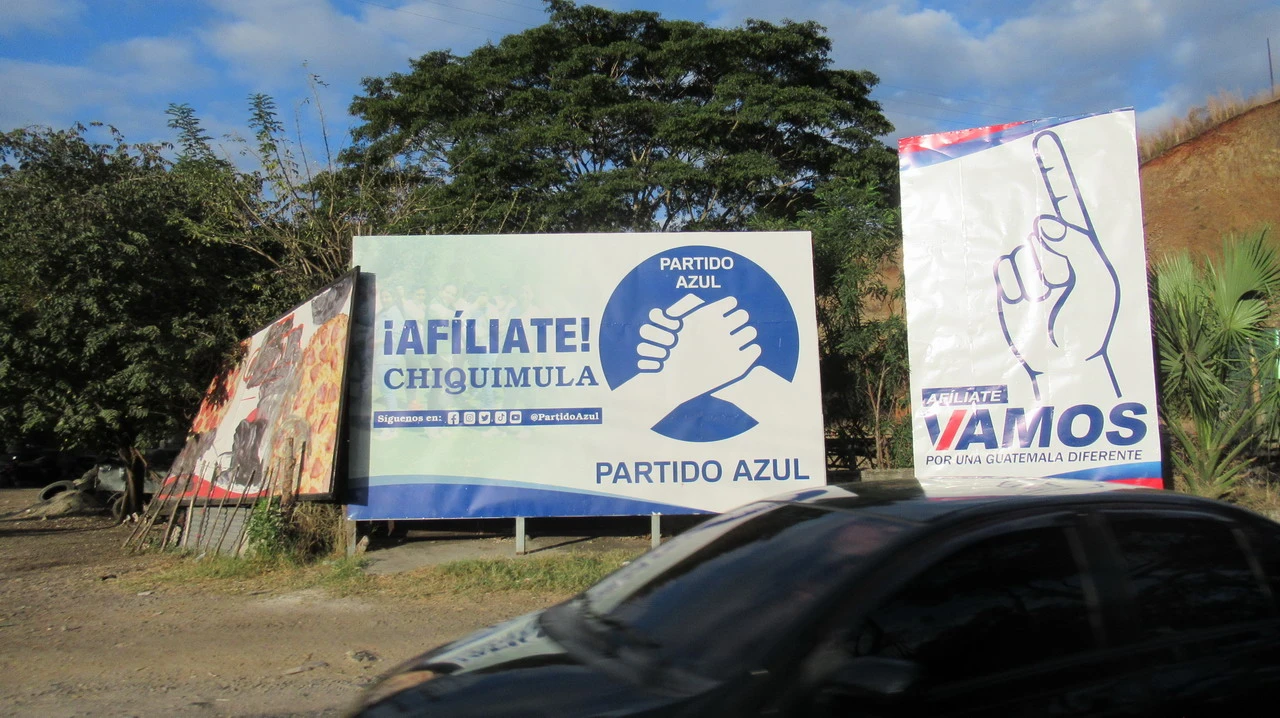
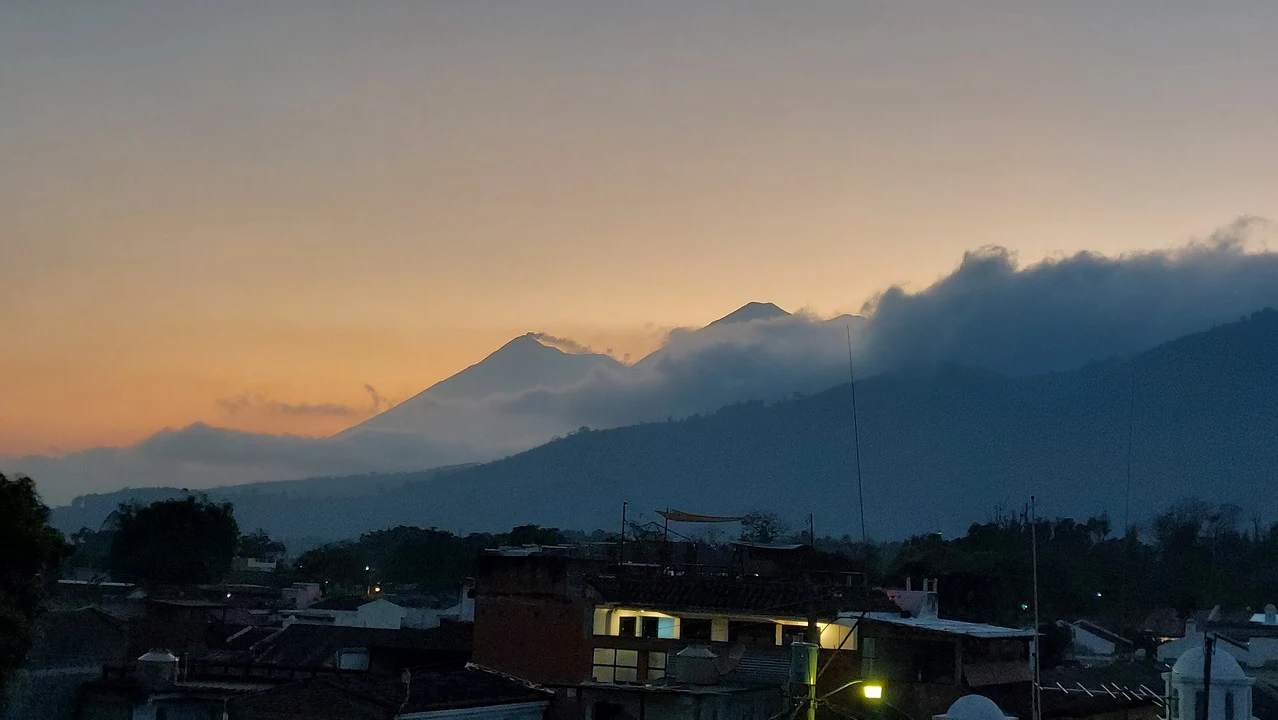
Shortly after 4:30, the sound of roosters woke us up before our alarm even went off, although we were scheduled to leave at 6:00. A Toyota Hiace was waiting for us, and in no time we were at the border, already crossed yesterday, with shared facilities between Honduras and Guatemala: crossing from one country to the other only required changing lanes; the flags, very similar to each other, made it seem like one continuous area. The border zones are well patrolled by military personnel, who work alongside regular police forces. We were told that these were sensitive areas, and this was done in an attempt to combat drug trafficking and illegal immigrants heading towards Mexico and finally the United States. On one of the countless checkpoints along the road to Copán, we had already been stopped and we even found an American soldier from Texas supporting the local militias. These types of checks, besides being very frequent, normally require a large number of armed personnel – around twenty – in anti-guerrilla formation. We head north towards the fork that, continuing in the same direction, leads to Puerto Barrios on the Caribbean Sea or to Tikal; to the left, we go south and therefore to Guatemala City. We stop for about ten minutes along the way: further ahead there was an accident, and when we pass by, we see a body wrapped in a black bag, being taken away to the morgue. A couple of stops to have breakfast and take some fresh air; we also use this opportunity to look around in the early morning hours, and it's interesting to observe the comings and goings in the villages that stretch along the road. Life starts again as every day, with stalls selling various goods. fresh tortillas cooked on the spot, smelly buses going back and forth, people everywhere, and constant traffic. We see a man leaning against a pickup truck with a gun on his belt; we are told this is the norm in Guatemala, where you can buy weapons without any problems – something that is not admitted in Honduras. Fortunately, there are no other delays, except for crossing through Guatemala City, and by 12:30 pm we are at Antigua, where we take our seats in a hotel that smells of history – perhaps it was once a place for religious people, and today it stands between the ancient and the old. It is located in an excellent position, near the center, and the terrace offers a spectacular view of the three volcanoes surrounding the city: Agua, though now extinct but its form still looms over the settlement, Acatenango and Fuego, which lives up to its name and continuously emits smoke and lava. The location where Antigua is situated isn't ideal, so much that the city was completely destroyed by an earthquake in 1773 when it was the capital of the Spanish Central American empire – hence the headquarters were moved to Guatemala City. Currently, the houses have been rebuilt, but they can only have one floor at most, as seismic activity is a recurring risk. This gives the settlement a harmonious structure, although quite geometric due to the streets that intersect at right angles and the cobblestone pavement. The walls of the houses are painted with pastel shades They further enhance the vibrancy of the environment. The only drawback is the excessive tourism associated with its well-deserved fame, which means that every visitor to Central America passes through here, or stays for at least a week to attend one of the many Spanish language schools. In fact, spending a few days here would not be a bad idea: there are plenty of activities nearby, the food is good, and the atmosphere is pleasant despite the high levels of smog caused by traffic. The intensity of tourism has led tour operators to develop clever strategies, and it's worth carefully considering what to do – not just to avoid being scammed, but also to avoid tours that lack substance. A walk along its streets can last an entire afternoon without getting bored or repeating the same things. The orderly urban layout prevents visitors from getting lost; if you do get lost, you can always orient yourself by looking at the position of the three volcanoes that dominate on both sides, one of which looms directly overhead. Except for a few exceptions, the houses are well-maintained, while in the corners you find several dilapidated churches due to earthquakes, in a clear state of abandonment; only the Iglesia de la Merced and the Cathedral; this part was actually modified after an earthquake and now the consecrated area is only represented by the bottom of the old building, oriented longitudinally and with a single nave. You enter through a side door and find yourself in the middle of the church; exiting on the other side, you reach a small square from which, if desired, you can access the ruins of the old Cathedral, of which only the crumbling perimeter walls and columns remain, allowing you to walk through them after purchasing a ticket.
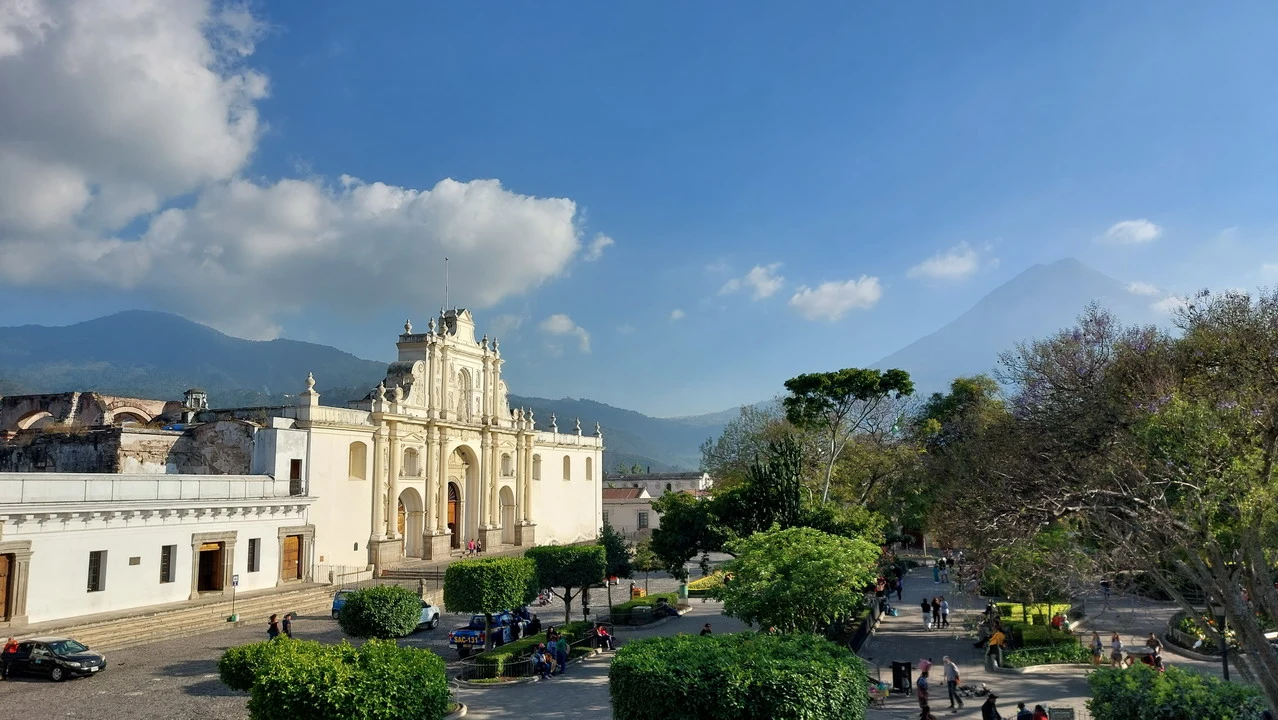
The ruined churches and the weight of conquest.
The first impression I get from seeing these religious buildings in a state of disrepair... due to the various earthquakes that followed – particularly destructive was the one already mentioned in 1773 – it prompts reflection on how nature, and in this case, I don't want to refer to supernatural entities, has somehow sought revenge for the destruction of Maya culture and religion. The Spanish had used the Bible to conquer and kill, building churches with the spoils they acquired, but the superior power of nature had reduced everything they had built to rubble: the skeletons of the churches seem to testify to the futility and short life of a faith manipulated and subservient to a tyrannical power. This story doesn't begin or end here, but the moral lesson that can be drawn from walls that still betray once-rich ornaments is that religions are often used for secular purposes. Burned books, destroyed cities, and their inhabitants burned at the stake or reduced to slavery in order to convert to a new God who, as we see before us, does not seem to have shared the actions of his followers.
The Plaza Mayor, besides the Cathedral, also features two other buildings with beautiful arches: the City Hall and the Real Palace of the Captains General — the former Spanish command in Central America. In addition to a beautiful, tree-filled garden where the purple of a jacaranda stands out, there is also a fountain in the square. A truly attractive corner, further enhanced by the setting sun, is the Union Tank, the stone sink with the palm motif on the adjacent square and the San Pedro church just a short distance away. We return to Plaza Mayor to go up to the first floor of the Town Hall, from where you have a wonderful view of the square itself and the buildings surrounding it: the bright colors of the facades, the green of the square, the volcano in the background, and the clear sky create a simply remarkable picture. A look at other churches in a state of decay, weathered and with weeds growing on the walls; after visiting the interior of the church de la Merced, as the sun sets, we go to admire the city from the mirador located on Cerro de la Cruz, which overlooks Agua volcano. Descending, the church of La Merced As soon as I visited it, it seemed to shine and appear covered in gold, while the more distant volcanoes – Acatenango and Fuego – stood out against the orange sky. The second one emitted a column of smoke that immediately descended and disappeared along its western slopes. There are 25 volcanoes in Guatemala, of which only three are active: Fuego, Pacaya, and Santa María near Quetzaltenango.
We arrived on February 14th and discovered that this day is particularly special, with hearts drawn or hanging everywhere; couples go out for a romantic dinner in a cheerful and light atmosphere. In the restaurant, a singer entertains the customers with romantic songs, which are a staple of the Latin repertoire.
The Honduran driver and Central America that is changing.
During the long journey to Antigua, we had extensive conversations with the Honduran driver. He also agrees that the strict policies implemented by the leader of El Salvador regarding crime should be viewed positively and serve as an example for neighboring countries, which are facing similar problems. Despite many difficulties, it seems something is happening in his country too: the new president Xiomara Castro – the first woman to govern Honduras, elected last year – is trying to change things in what was known as the Banana Republic. A similar situation exists in Guatemala, while Nicaragua under Ortega is a different world altogether: a dictatorship where thinking differently from what the Sandinista leader says is forbidden. The driver lived for twenty years in the United States working in the construction industry, but he never fully integrated and doesn't speak English very well. He finds American society too cold and distant, so when he could, he returned. When asked about Bukele’s popularity in Washington, he said that he is accepted or at least tolerated, given his high level of support at home – an interesting opinion, but one that raises some concerns, especially if El Salvador were to become too close to China. Regarding Covid, he can only confirm the economic difficulties faced by the entire population due to the almost non-existent state aid; subsequently, most people got vaccinated and gradually returned to normal life.