The sacred caves of Dambulla
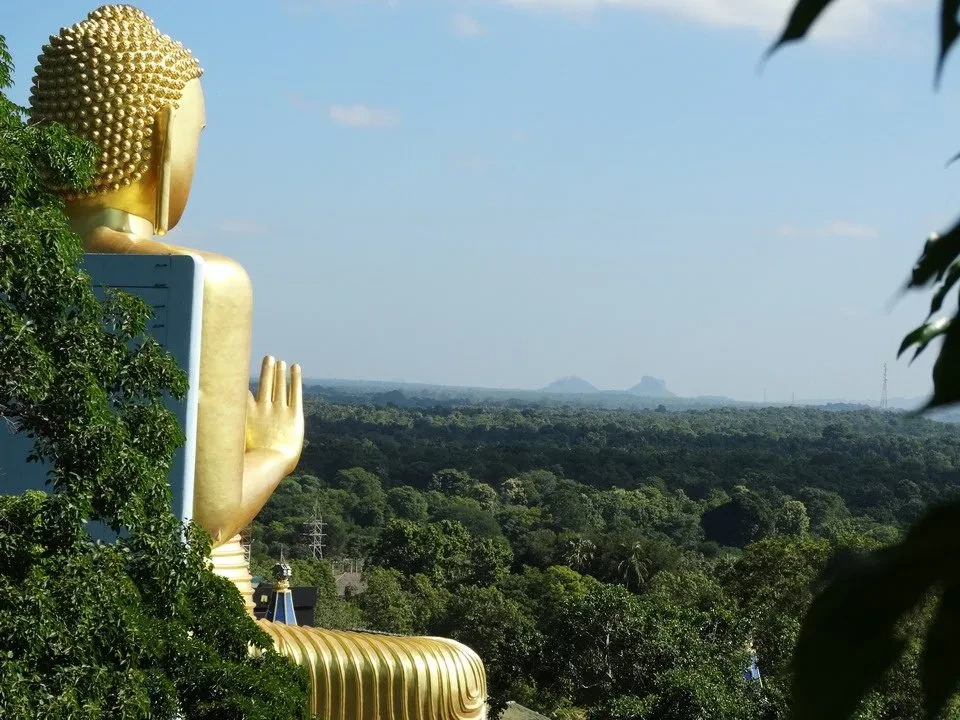
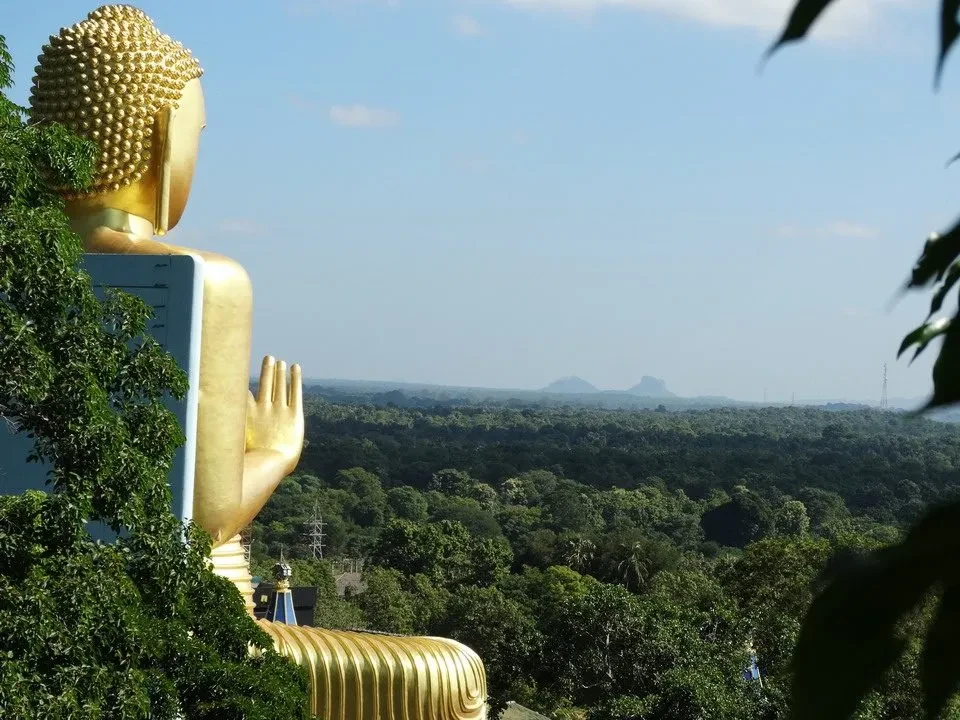
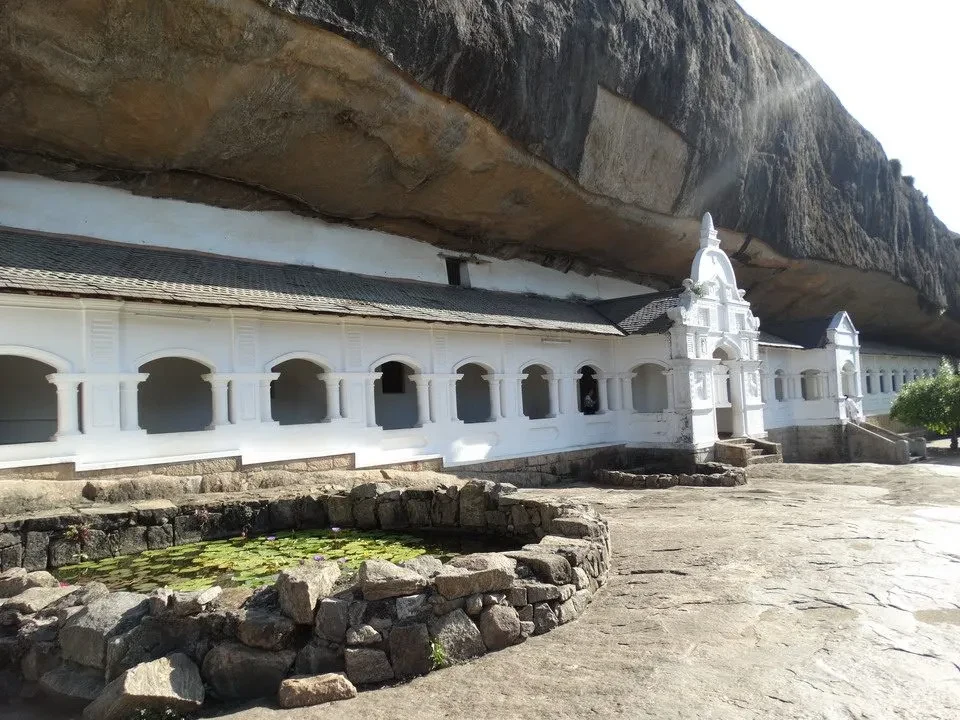
It's not uncommon to visit temples or religious complexes with very different architectures, as well as to see ancient rock carvings located inside caves where prehistoric people displayed primitive forms of art. However, it is rare to come across true masterpieces like those found in the royal caves of Dambulla, which are specifically defined as "rock temples". These are five temples located within a large cave which was divided into five separate rooms. The origin of the story here also stems from conflicts with the Tamils; in fact, a Sinhalese king took refuge there for fourteen years, and after escaping danger, he had the cave temples built as a gesture of gratitude. A good time to visit is early in the morning when there are few people and the sun isn't too harsh. We climb the long staircase – they’re always there – to reach a terrace near which the caves are located, from where you can enjoy a wonderful view of the surrounding plains, all the way to the impressive rock of Sigiriya... just a few kilometers away. Inside each cave, you'll find a treasure of Buddhist art and religion: enormous Sleeping Buddha, walls painted with stories drawn from Sinhalese religious mythology, portraits or sculptures of deities of the local Pantheon... where Hindu and Buddhist deities are once again prominently featured, happily mixed and integrated together. Vibrant colors, excellent maintenance, a representation that is both beautiful and unexpected. This experience is all the more enjoyable after visiting the large temple at the base of the long staircase leading to the caves, where create a giant statue of the Buddha definitely redundant and kitsch. While one would expect a peaceful environment to facilitate prayer, the imposing monument overlooks the tiny humans passing beneath it, while naive sculptures create a questionable modern-religious atmosphere.

Leaving Dambulla, we also say goodbye to the cultural triangle, with its hot and dry climate, savanna vegetation, and flat terrain, as we head south towards the hilly region.
Exploring spices, batik, and the Aluvihara temple.
About halfway between Dambulla and Kandy, we stopped briefly at Matale to visit the spice gardens. batik factory and the Aluvihare Temple.
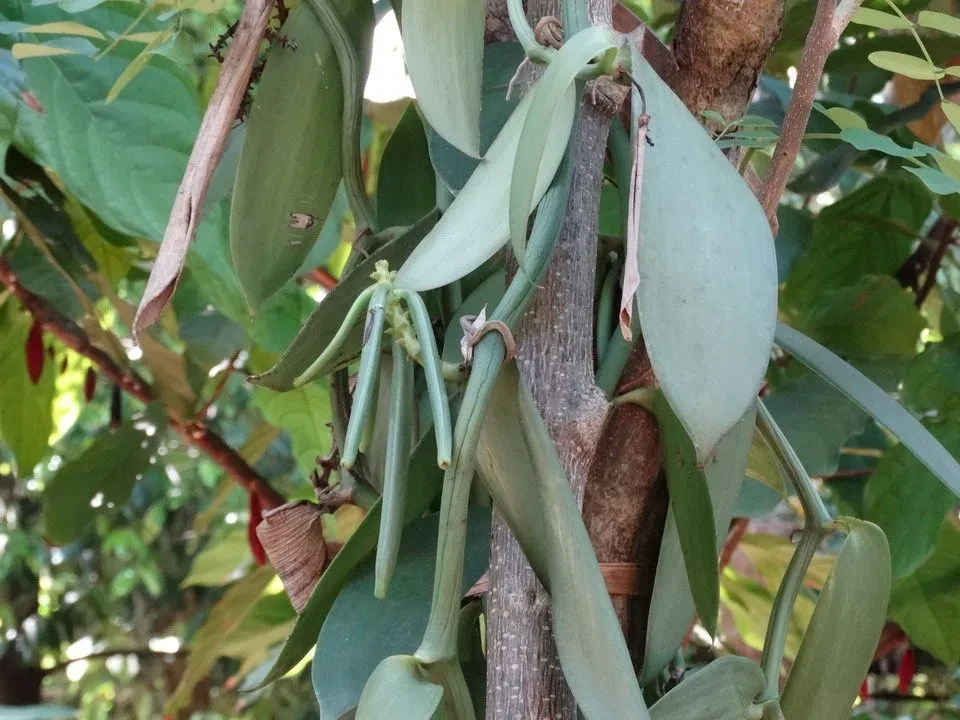
The first ones undoubtedly represent one of the most interesting experiences lived on the island. It happens every day to use spices, whether it's drinking tea or using extracts for medicinal purposes. Everything is done with complete ignorance regarding the origin and cultivation of the plants from which these products are derived. We discover pepper, which differs only in the harvesting time and not in the type of plant: it starts green, then becomes slightly pink; we harvest it, and once dried and peeled, it turns black. At this point, another layer can still be removed to finally obtain white pepper, which is the most prized and potent of all. We discover nutmeg, enclosed in a red container that also serves to scent the food. vanilla, which resembles a long green bean. cardamom, cinnamon, which is simply the lower part of the bark of the corresponding plant's branches, collected, wrapped and dried strictly in the shade, and we learn that the curry normally used to season rice does not exist in nature, but is produced by mixing different types of spices to create some variations. The yellowest one is used with vegetables, while the darker one goes well with meat and fish. The darker variant costs more because cloves or rarer spices are added. The advantage is obviously given by the purity of the ingredients, where poorer mixes will be less tasty and must be used more quickly, otherwise the aroma will be lost. We also discover the cocoa... a fruit that resembles a clumsy pear: you open it and take out the large seeds while removing the white substance surrounding them; these are peeled, chopped, and toasted using a similar process to that used for coffee. And one could continue doing this for quite some time. A series of lessons learned with great interest, both from a culinary and therapeutic point of view. The staff explains the characteristics of the various plants, is well-prepared, and at the end takes us to the nearby shop for a purchase. In addition to spices, you can buy medicinal oils, sandalwood, and similar products, or perfumes made from spices. This is perfectly understandable, as there is no entrance fee and the information received was very interesting. It's not surprising that these "gardens" are found here: we are on the outskirts of the continental climate zone, but which retains the warm temperatures of the northern plains for a large part of the year. According to the English colonists, it represented the ideal place to create such plantations. And so, for over a century and a half, this area has been living off these crops: they are not exactly fields like our orchards, but rather plants scattered within a sufficiently dense jungle that ensures a good mix of sun, shade, and rain.
Enriched by this experience, we visit the workshop where batik is produced. Having never heard of it before, we discover that it was imported by the Dutch several centuries ago, originating from Malaysia. It is a system for dyeing cotton fabrics, which occurs in successive stages. The design is traced onto the fabric, then they cover some parts with wax so that they remain neutral, to be colored later, and it is immersed inside. yellow dye. At this point, the process moves to red after reapplying wax to the fabric portion that will not be colored, and then the same procedure is repeated with black and potentially other colors. The entire cycle takes four days. The result is a drawings with an exotic character and bright clothing, saris, sarongs and similar items. At first glance, the production is entirely handmade, although entering the shop suggests that there is some form of semi-industrial production given the large number of finished pieces. The prices are relatively low, which indicates a mix that does not rely heavily on industrial processes where manual labor still plays an important role.
The last stop before Kandy is located in the Aluvihare Temple Nothing compares to what we've seen so far, but it's an interesting site because it is entirely carved out of caves, with a very different configuration than Dambulla, or located in the middle of huge rocks The natural beauty, art, and spirituality blend together to create a meaningful representation. Here too, you can find Sleeping Buddha, Asian deities and depictions of the punishments faced by sinners, in a gallery that convinces anyone to behave perfectly morally. Lunch in the style of "short eats" at a restaurant in Matale. Although it is a very popular place, we appreciate that there are sinks where you can wash your hands before and after eating. This will not be the only occasion when we perceive a high level of hygiene from the local establishments. In a country that is certainly not rich, where frugality is essential, people do not lack respect for some civic principles that should form the basis of coexistence everywhere. We also discover that very few people smoke.
Nearby, we'll make a short photo stop to capture the exterior view. an Hindu temple, full of decorations that make it seem like a continuous lace work. Despite Sri Lanka being closely associated with Vishnu in his incarnation as Rama, almost all Hindu temples on the island are dedicated to Shiva, or to deities closely related to him, and those dedicated to Vishnu himself are very rare.
Kandy with its gardens, dances and Temple of the Tooth.
When we are now approaching Kandy, we turn towards southwest to visit the Peradeniya gardens. A wonderful floral display within a bend of the Mahaweli River, we also have the opportunity to see some types of plants that we had only heard about before. The garden is well-maintained., in many of its parts, the English style is still evident, rigorous and pleasing to the eye at the same time. The variety ranges from orchids to palm trees, bamboo, and the spectacular ficus trunks. It's hot, but it's not difficult to walk through a large part of the park in the shade, in an oasis of peace just a few hundred meters away from the chaotic traffic. We walk along a series of trees planted by figures who have distinguished themselves in politics rather than science; it is interesting to read the explanatory plaques placed neatly under each plant. It's time to arrive in Kandy after a challenging day that has seen us exploring between art and nature, passing through countless curiosities and lessons learned. But it's not over yet: at 17:30 there is the dance performance Sinhalese cultural performances, and since Kandy is the center of these artistic displays, we can't miss the beautiful costumes worn by dancers and performers as they create amazing routines. loud sound of drums. Sometimes they are real acrobats, capable of performances that leave you speechless. Even the less exciting moments offer an opportunity to admire their costumes. After an hour, the show has a finale outside and we quickly understand why. On a long platform that we wouldn't hesitate to call a barbecue area, only one meter shorter, flammable liquid is thrown, and then... some dancers that enjoy jumping around on the burning coals It was difficult to understand the secret and equally difficult to believe that it was simply a matter of high concentration preventing pain. The fire is real, and my feet are truly bare. Once the fire is extinguished and the performance is over, I approach the embers and notice that they are still hot, making it advisable not to get too close.
Perhaps it's also about appetite, since the long day required a lot of energy without being adequately compensated by the midday snack. But, having dismissed the driver for today, we still need to go down to the center of Kandy, cross the dam at the bottom of the lake under trees overflowing with bats that don't hesitate to let their deadly projectiles fall, and visit the Sacred Tooth Temple at the time of prayer, at 6:30 PM. In Kandy, we find ourselves in one of the three cardinal points of Sinhalese Buddhism, along with Sigiriya and Kataragama, and pilgrims are plentiful during this peak hour. The darkness highlights the beautifully illuminated building; inside, the drums resonate constantly throughout the prayer time, while worshippers gather outside the sanctuary that houses the relic believed to belong to Buddha, covering an entire flower stall Among which the lotus flower stands out, of course. This flower is always present and represents Buddha through the allegory of its birth from the mud of the marshes, emerging with leaves floating on the water's surface, and culminating in spectacular blooms. In other words, the transition from human to divine.
Arriving during the puja means we have to wait for a long time before the room where the tooth is kept opens. The room itself is not accessible. you will pass by it and you can see it a large urn it's like a set of Russian nesting dolls, containing the relic.
Now we truly deserve dinner, but we still need to reach the hotel located in a prominent position, on a hill overlooking Kandy Lake. Tired and hungry, we enjoy the buffet and the tourist atmosphere that accompanies it. Women dressed in evening gowns, arriving from the beaches of the south, crowd around the delicious Western and Eastern-flavored dishes, giving their diets a break so they can show off these outfits. In our room, for the first time, we find a stained glass window that encourages us not to feed the monkeys and always close the window door a barrier to prevent entry: after all, the idea of being woken up by a cute monkey is not something we are looking forward to experiencing in this country.