The climb to Adam's Peak
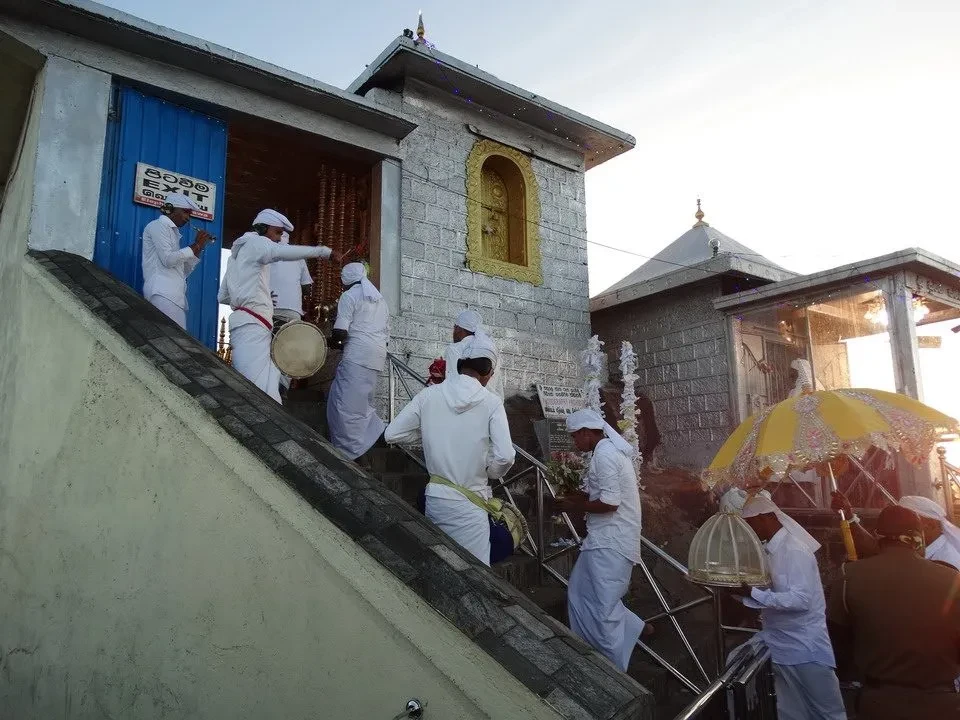
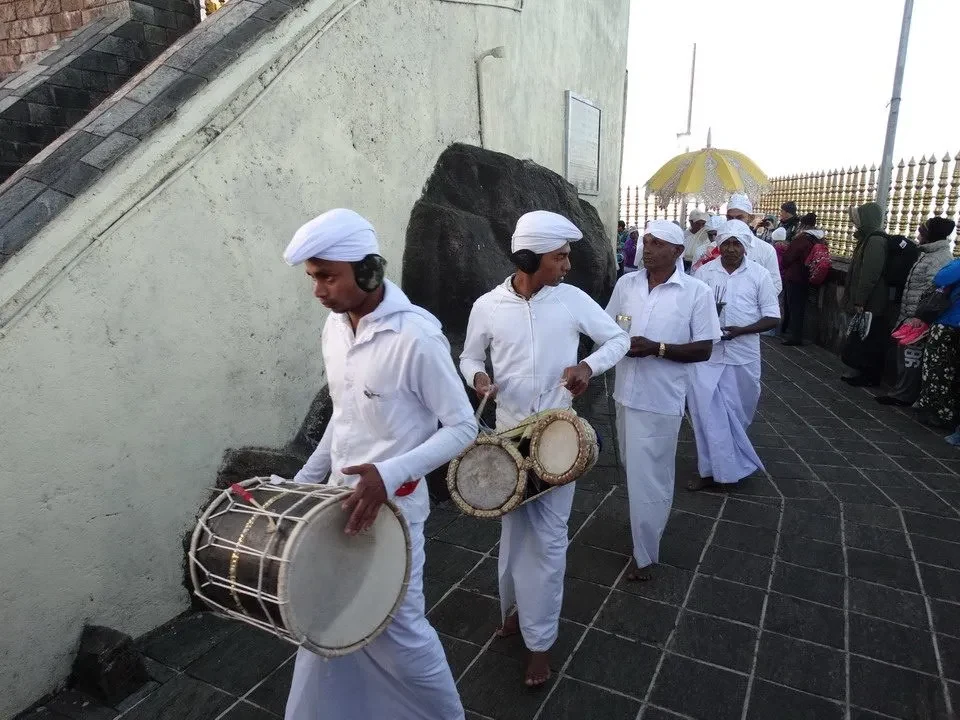
As with all occasions where there's something interesting planned, waking up is no problem at all. We get dressed and set off. Everything around us is quiet; some travelers are also getting ready to start their own journeys when only a few minutes remain until 3:00 PM. sparkling stalls underneath a collection of multi-colored LED lights, offering every kind of comfort despite the time. Once we pass through the small village, the climb begins, and the steps become noticeable, with the heat becoming oppressive, so one by one we remove most of our clothing. The first section is not steep, but this doesn't prevent us from sweating and making the walk more tiring: good training allows us to maintain a steady pace, even though we are not here for an excursion where "making time" is important. The climb is shared with other Westerners, but especially with a multitude of pilgrims, some of whom, severely disabled and unable to walk, use canes and the assistance of a companion to bravely tackle the steep staircase. As we ascend, we become increasingly isolated and exposed to the wind: the staircase becomes steeper, and at one point we find ourselves in a strong, cool wind that seeps between our sweaty clothes. It's not a pleasant experience, but we have no choice but to continue. A vendor selling drinks tells us that there are only 345 steps left, which represents the last stop for refreshments. We are about to reach the 2250 meters of the summit, where a platform has been created in the center of which the sanctuary that houses some icons and the sacred footprint. Shortly after 5 pm, we were there, with just an hour left until dawn. To cross this small place of worship, you need to remove your shoes; it's not a very pleasant sensation when you're sweaty and also being buffeted by the cold wind. We rested for a moment sitting in a sheltered alcove next to the trembling pilgrims. We put on technical and warm clothing; many of them have a simple k-way. We joined the queue to go and get something like a blessing given by the monk. At some point, the east begins to clarify cautiously, there are no clouds and it feels like we're living in an unreal dimension. Slowly, everyone moves towards that light, hoping that the fiery ball will soon rise to provide us with some warmth. It's almost 6:15 when we finally see the sun rise. Being at a latitude close to the equator, sunrise and sunset are equidistant, around 6 am and 6 pm, which explains the rather early hours observed by the locals. It's a sunrise like any other, but in this place and with these people, it takes on a special meaning. The drums begin. to echo in the cold air, and then appear in procession, bringing sacred objects and they board the staircase that leads at the shrine: these rituals are repeated since who knows when, at dawn. Meanwhile The sun rises without fail. just as it does every day, and takes its place in the sky, while the rays begin to revitalize the skin that is no longer stiff. Gradually, the onlookers turn their steps and gaze across the top of the square: there is something to see. perfect triangle designed by Adam's Peak, which faces west.
From Adam's Peak to Nuwara Eliya
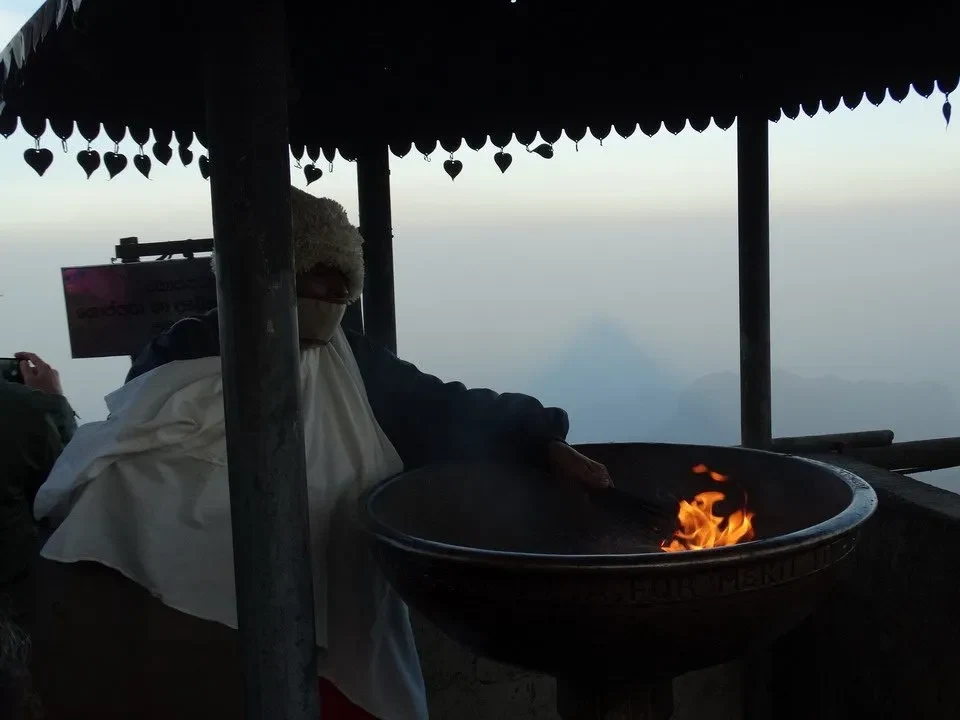
A perfectly geometric shadow is traced, even though the mountain itself isn't. The believers see it as a representation of the Buddhist trinity; after all, what could be more magical and mystical than a triangle? It lasts about twenty minutes and seems truly abstract, not the shape of the mountain lying perfectly on the plain. Satisfied and excited, we can now set off to... long staircase which represents the return: interesting because before, even though illuminated, we were unable to see beyond the artificial light. Now we realize how isolated the place is and the beauty of the surrounding landscape. The pilgrims descend, talking amongst themselves and singing, happy to have fulfilled their duty. We "pale faces" cannot help but also give a spiritual meaning to this journey: we certainly did not come to Sri Lanka just for a hike, waking up at 2:30 in the morning. But for us, it makes sense that it doesn't mean so much. There were truly many steps that led us to overcome the altitude; the lower part would even be boring as the staircase is not constant and one must pay attention to where you put your feet without looking around too much. It was after 8:30 when we reached the hotel and exchanged a few words with Kasun and the friendly owner of the property. A shower makes us feel like we have just woken up, while breakfast restores almost all our energy. In the background, Adam's Peak remains there, under the sun that is getting lower, a slight haze makes it slightly less clear, but we were truly lucky.
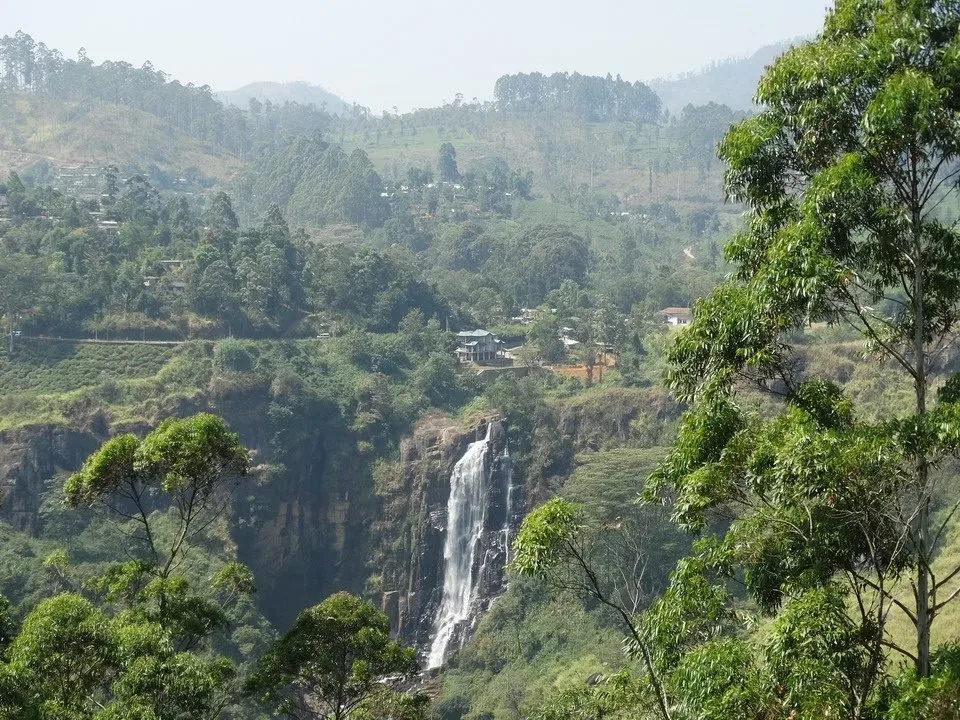
We leave Dalhousie with an unforgettable memory of having crossed a true botanical garden that stretched for dozens of kilometers. grown as tea in an atmosphere of scattered villages and tall flowering trees, creating another earthly paradise: they resemble large Nepalese rhododendrons with their entire top covered in red flowers; actually, they are typical of the hills region of Sri Lanka, and we will discover that they are... mara tree, whose wood we saw yesterday at the wood carving factory. The eucalyptus trees and a variety called "pine tree" are also prominent. It is interesting to note that as the road goes on following essentially the isometric curves without significant inclines, while maintaining a constant altitude between 1000 and 1300 meters. This provides magnificent views of the landscapes, although it extends the distances. It is clear that these roads were built to connect plantations rather than to directly cross a territory and lead elsewhere. We are located near some ladies who are collecting tea; with their quick and skilled hands, they pick the most suitable leaves and place them in bags that they carry on their backs and secure to their foreheads. Along the roadside, you can find bags filled with freshly picked tea leaves, ready for processing. We also see... St. Clair and Devon Waterfalls, beautiful waterfalls that must be much more impressive during the rainy season: we are happy to see them in their limited version, but with plenty of sunshine above us, just like the one we saw rising a few hours earlier from Adam's Peak. By around 1 PM, we have arrived in Nuwara Eliya, quickly check into our hotel and move to the Gregory Lake... another artificial basin that here seems almost like a large mountain lake: in fact, the highest peak of Sri Lanka is right nearby. On the lake, sporting activities are practiced and it seems to be the classic place for locals to relax, but not only. The town is a destination for many visitors from all over the country during the Tamil-Sinhalese New Year in spring, with flowers that are truly spectacular. We were expecting a city center in line with guide descriptions, in an English style. In reality, there are buildings that lean towards British style, but it's still a mix of vehicles, smoke, and it is just slightly less chaotic than other towns. A stroll through the covered market, where you get a glimpse of society unlike anywhere else: spices, fish, meat but especially vegetables grown by the Tamil people on the edges of the tea plantations. Here too, the crops and the arrangement of vegetables and fruits in the market stalls follow a geometric precision perfect. The Tamil population living in these areas arrived over a century and a half ago from southern India to fill the labor shortage in the plantations. It seems they came voluntarily, with the guarantee of having a job, so they now make up the majority of the population here. Tamils and Sinhalese are not easy to distinguish; both have dark skin; perhaps the former have more pronounced noses like Africans, but it is difficult to identify the differences, at least for us. It does not seem there are any particular problems of coexistence, except for the blind retaliatory actions of some decades ago by Sinhalese people, following attacks by the Tamil Tigers, an armed group that advocated for the independence of areas with a majority ethnic population. However, those working in the plantations do not appear to have been involved in violent operations.
A walk around the Victoria Park It gives us a brief respite from the urban chaos; even though it's not peak season, the flowering bushes under ancient trees are appreciated. Despite the contradictions present everywhere, we get the impression that we are in a relatively affluent area. The temperature becomes cool after sunset, thanks also to our altitude of 1840 meters, which has an impact on the vegetation, almost alpine in certain areas.