

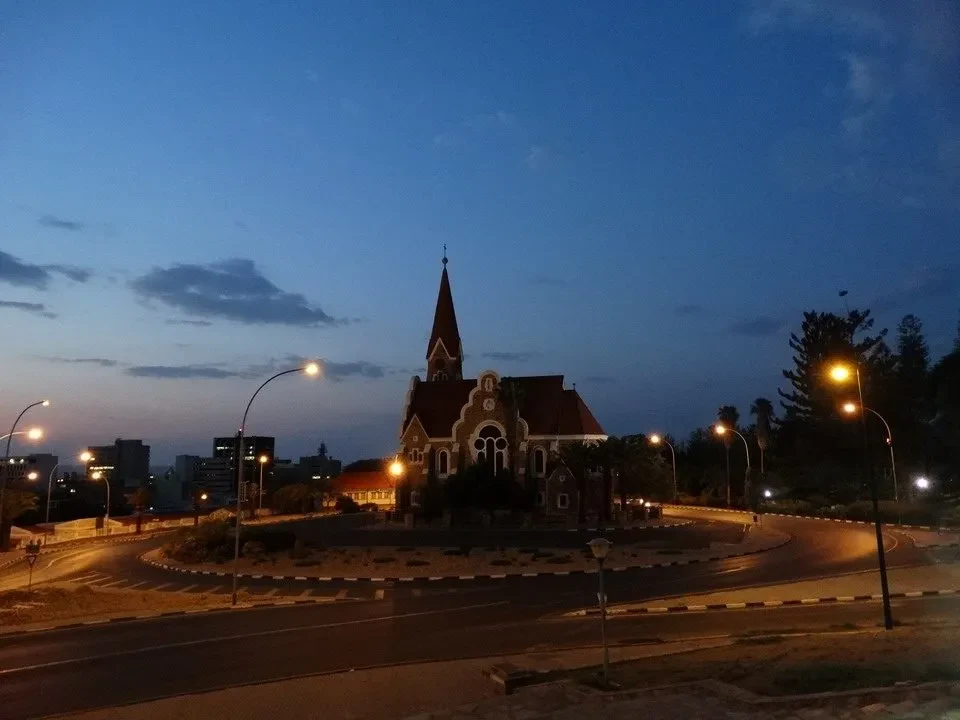
Arrival in Windhoek
Anyone who had any doubts about the reliability of Ethiopian Airlines will be immediately reassured by the sight of gleaming Boeing 787s and a service that meets expectations, given the prices. Flights are punctual from Milan to Addis Ababa and then on to Windhoek. The internal African flight is operated on a brand new 787 with all the comforts. It's full of Chinese people, so announcements are made in Amharic, English, and Chinese. It seems like a mystery how the national airline of such a poor country can have aircraft of this caliber to create a globally important hub. A comparison with the situation of the national airline automatically comes to mind, and it is worth noting that Ethiopia was once an Italian colony. Only the capital airport leaves something to be desired, but the expansion plans financed by Chinese capital will soon make it up to standard. It is probably in the Chinese investors that the development of the airline can be found. Just above Windhoek, some clouds cause the plane to shudder; imagine what we would have suffered if we hadn't been on a Dreamliner. At passport control, the staff are more concerned with ensuring that travelers waiting behind the red line before their desk are kept waiting than with the efficiency of processing formalities: the long queue moves at biblical times and seems to delight the officials as they carefully check passports. After an hour of waiting in the scorching heat, we are finally free: we retrieve our luggage, meet the car rental driver, exchange euros for Namibian dollars, and are ready to begin the adventure. The 40 km separating the city from the airport immediately immerse us in the desert environment, which is already interesting. It's a dry landscape due to the season; there are no wild animals, although it is not uncommon to encounter them even in this area, only beautiful villas or ranches on the outskirts. We pick up our Toyota Hilux 2.4 4WD with camping gear including tents on the roof and a kit containing a 20-liter water tank, kitchen equipment, refrigerator connected to the second battery, compressor for inflating tires, and two spare wheels. The vehicle also has 2 fuel tanks with a total capacity of 140 liters of diesel, which ensures that you can make long journeys without the risk of running out of fuel, something that is particularly dangerous in this part of the world. We are also given detailed instructions on how to use the vehicle for driving on sandy roads or other challenging conditions, deflating and inflating tires, opening and closing the tent, and everything else necessary to proceed and camp. At this point, we can start calmly, beginning with the sleepy Sunday afternoon in the Namibian capital, paying attention to the rather large size of the vehicle and the fact that you drive on the left side of the road. We immediately reach the hotel we had booked earlier: in a quiet area slightly outside the city center, although we immediately notice that all the windows are protected by bars. Afterwards, we visit the downtown area of Windhoek, which is opulent thanks to numerous banks and international offices, justifying their presence due to oil, diamonds, and general mining activities. From a tourist perspective, the city has little to offer: we go to Independence Avenue for a walk, but there are mostly modern buildings mixed with others in German style dating back to the beginning of the last century. We see the Christ Church and the Independence Monument located in the command center area. We even find ourselves facing the government building after sunset, without anyone telling us anything. For safety reasons, we avoid getting out and taking pictures, especially since Joe's Bierhaus awaits us, a true symbol for foreign visitors to the Namibian capital. The restaurant, decorated with a mix of naive, ethnic, and tropical styles, features historical, colonial, and creatively designed objects, as well as some that appear to be waiting there for disposal: you can enjoy delicate game dishes (three-course meal, kudu, springbock or kudu steak; with appetizers ranging from carpaccio to smoked and marinated kudu. The desserts are in pure German style: waffles, strudel, and various decorated cakes. By 10 pm we don't need to wait for sleep, after spending the night on the plane.
Despite the independence achieved in 1990 by South Africa and the fact that apartheid was abolished at that time, it is easy to notice the differences between the original population and the white people: depending on the type of work they do, their efficiency and a whole series of parameters that determine their social status. In general, there are few people around, especially after sunset. When you get out of the car, you immediately feel the need to be careful with your belongings and not pass through secluded areas. The parking lot is elevated, with a predominance of SUVs and off-road vehicles; the brands are mainly Western, along with the ubiquitous Toyota. In the suburbs and in the province, there are cars that seem to defy gravity. Many streets are lined with jacaranda trees with purple flowers, which have already been seen in Asia (delonix regia).


