Day 1
Ulaanbaatar
U.B.: The coldest capital city in the world, where nomadic DNA is trying to adapt to urban life.
Flight to Ulaanbaatar
We quickly realize that the journey will be an adventure and that we need to prepare for some discomfort, as soon as we board the Tupolev Tu-154 departing from Moscow bound for Ulan Baatar. Although it's a Russian airline, the aircraft has all the characteristics of a Soviet-era plane. Before departure, we are subjected to a real sauna; a wave of heat descends upon us, trying to test the passengers by roasting them inside the fuselage.
Despite the pessimistic forecasts, the flight is actually on schedule and we arrive essentially on time in the Mongolian capital. The airport is small but functional. The runway is also slightly uphill, as the guides say, but it's definitely not scary, especially considering the aircraft we are about to land with.
We quickly cleared customs and met our guide, named Andy. Outside, our driver, Kambah, was waiting with a Land Cruiser 3.0, which will convince us in the coming days about the quality of the Toyota brand, far more than just an advertisement with attractive celebrities.
Museums and memory in Ulaanbaatar
The road leading to the city shows Ulan Baatar as it is on any given day: bustling with advertisements near the airport, but very sad in the shacks surrounding the center. The city is located north of the Tuul River and surrounded by beautiful mountains. The center displays a recent modernity, with first Soviet-era buildings and then modern structures, while the outskirts are rapidly expanding with gher camps (circular felt tents), attracted by the false promises of the city. With this type of housing, migration is made easier than anywhere else.
We head to the Hotel Michelle, located in the central area near the Chinese and Indian embassies. It's a good hotel, without unnecessary luxuries that would clash with the local reality, as we expect and intend to experience. We leave the largest suitcase at the hotel containing items not strictly necessary for country life, and are ready to begin our journey, starting with a visit to the capital.
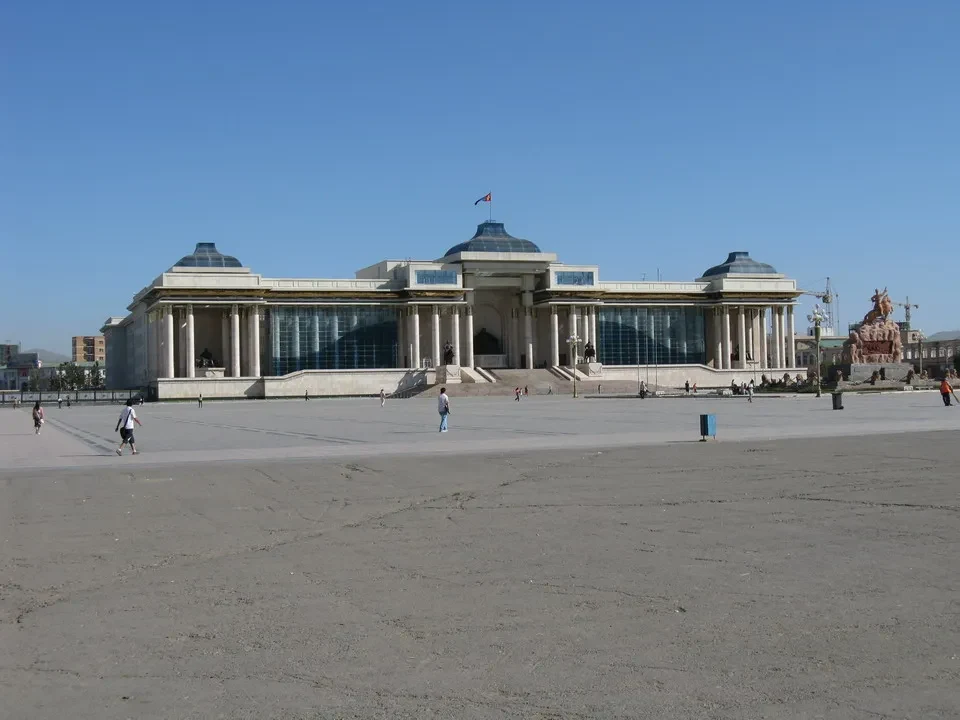
The highlight is undoubtedly Sukhbaatar Square, dedicated to the national hero to whom Mongolia owes its independence from China in 1921, but also its subordination to the Soviet Union. The square features a central equestrian monument of the hero. On the north side, the building adorned with a colonnade is the seat of Parliament, which is also home to the Presidency of the Republic and the Government due to rational reasons. In the center of the colonnade is the monumental Statue of Genghis Khan Sitting, the true heart of Mongolia. After all, the largest kingdom ever is precisely this one, and every citizen knows it and takes pride in it. Especially now that they have become citizens and are no longer subjects. The Square is the beating heart of the city and the entire country. People gather here both for moments of joy and sadness, regardless of the weather. In early July, there were clashes following the controversial victory of former communists in the parliamentary elections. Accusations of fraud led to the burning of the party headquarters and the killing of 7 protesters by law enforcement. 700 people have been arrested, while another 200 are still in prison on charges of sedition. Investigations are currently underway to determine the source of the protests, believing that the destabilizing project has roots abroad. Here too, it seems that the Democrats are being supported by Americans, while the former communists should remain loyal to their former ally. Large numbers of law enforcement officers can be seen, trying to maintain the stability that has been difficult to restore after last month's clashes. However, the country is developing rapidly: many new buildings are visible, and the center is full of construction sites. Some projects are very ambitious and seem to even contrast with the Eastern style. We continue eastward, towards the headquarters of PRMR data on fire, where she has remained ever since. Lenin statue. Now removed from the squares and minds of all satellite countries, and especially Russia, it persists here for reasons unknown. But we will try to provide an answer later.
Politics and society in Ulaanbaatar
Our guide explains that there is still a very efficient intelligence service that carefully listens to criticisms of the regime. Politicians are trying to stay in power to take advantage of the undeniable benefits resulting from resource exploitation. In particular, regarding building permits in the capital and mining concessions. After the collapse of the USSR, the communist party was able to rise again from its ashes, returning to power through elections that were at least in name democratic. They governed reasonably well for several years, using their knowledge of administration within the bureaucratic apparatus. When the Mongols chose a new government, the inexperience of those who had been long-time opposition figures led to several prominent individuals becoming involved in corruption stories. The greed for power overwhelmed those who had criticized the same crimes for years. The result was the return of the old regime, confirmed albeit slightly in the latest elections.
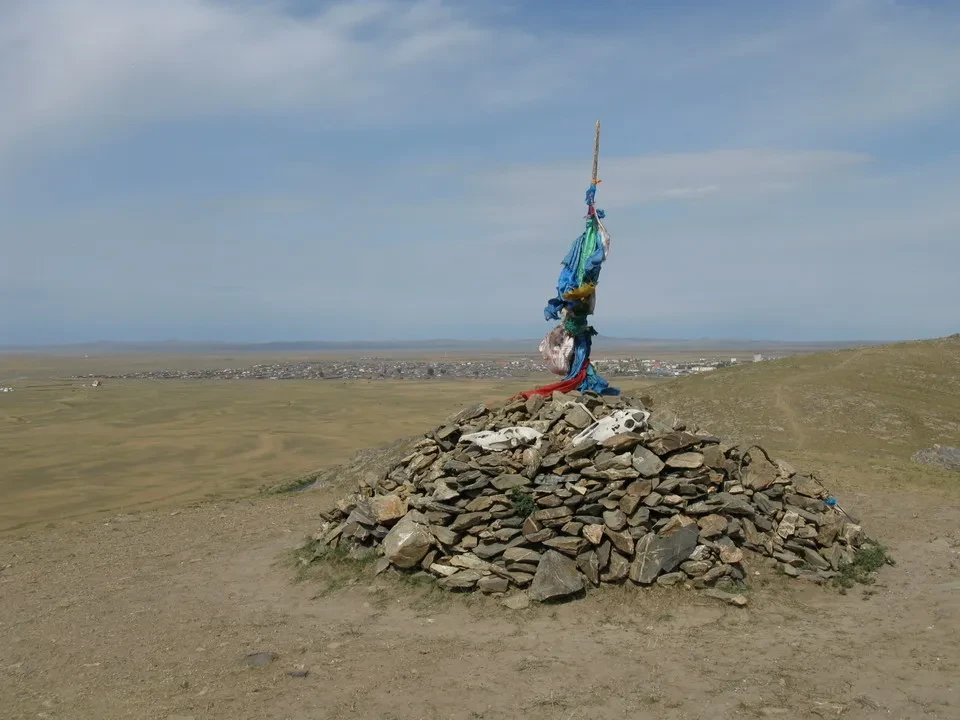
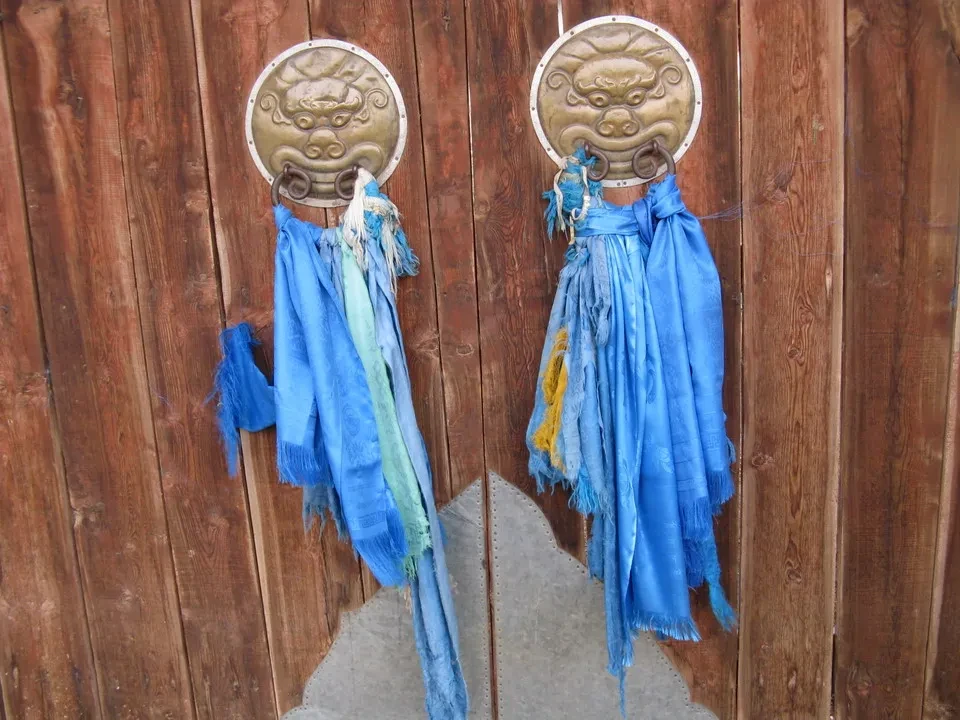
Andy also informs us that the Mongols are very superstitious and therefore refrain from certain actions on some days, or observe religious rituals in order not to incur divine punishment. It should be noted that Mongolian Buddhism is indeed of Tibetan origin (i.e., Lamaist or Buddhist with yellow hats), but it is also influenced by shamanism. Although this religion is specific to the northern regions bordering Siberia, its influence has been considerable. This applies to all: presence of ovoos. An integration that has developed over time, permeating a tolerant doctrine like Buddhism. Another distinctive feature are the hatags.... the sky-blue (or sometimes yellow) scarves of Lamaist and shamanic origin, which are raised on poles in the center of ovoos or other places considered significant or worthy of protection, such as inside a car. In contrast to Tibetan Buddhism, here they are said to be more tolerant, to the point that lamas can even get married. The spiritual leader of Mongolia is the Dalai Lama, who has already visited the country twice since it became independent from Soviet rule. As retaliation, China last time closed the borders for a week, effectively forcing Mongolia into devastating isolation. This highlighted the country's economic dependence on its powerful neighbor. The Dalai Lama cares deeply about Mongolia, as it is the only Lamaist country where religion can be practiced freely, unlike his Tibet. He therefore sees this state as a spiritual foothold towards the rest of the world.
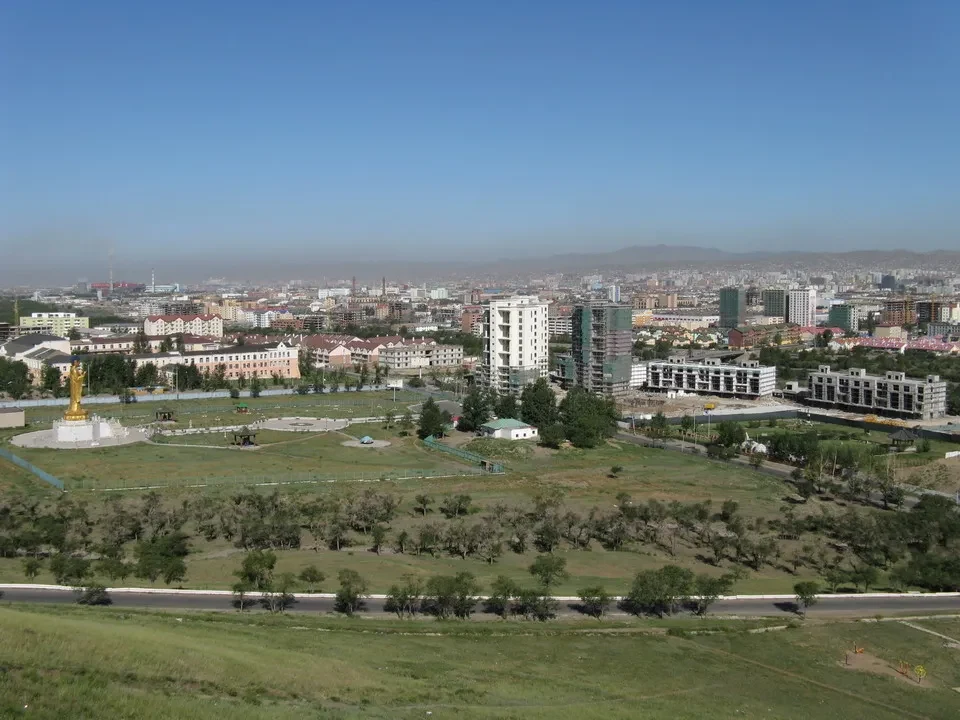
The city in general cannot be considered beautiful: right in the center there are open manholes that serve as large garbage bins, and the condition of the sidewalks requires constant attention when walking. The people you meet on the street have an orderly and clean appearance, regardless of their social class. Fashion also takes on understated tones according to Eastern style conventions. Smog dominates amidst chaotic traffic, and where flowerbeds should be, there is only weeds. In the gardens within the most significant monuments, only weeds thrive. Clearly, the Mongolian people do not have a great sense of aesthetics when it comes to green ornaments. All this must be said from our point of view. One could argue about the need for decorated gardens, especially since enchanting landscapes are just a short distance away. There is considerable support from foreign countries (primarily Korea and Japan, but also some wealthy Arab or other states with rich Buddhist communities). You often encounter recent monuments or renovations: they are all sponsored by abroad. Even the beautiful Parliament building was financed by an Arab country. It seems that if Mongolia could not rely on this assistance, it would still be in the conditions left by the Soviets when they left 18 years ago. This does not mean only neglect; rather, it is a total indifference to urban design and accepting what comes from abroad as a gift of providence. They only complain that the occupiers, when they abandoned the country, also left it without industries and completely dependent on foreign aid. Indeed, the USSR drew resources and reciprocated with goods. Perhaps forced collaboration has also brought some benefits. Being more backward, these have certainly been greater than those experienced in Eastern Europe. However, the fact remains that during that period, a significant portion of the cultural and intellectual heritage of a people with origins to be proud of was destroyed. Ending an era, Mongolia found itself with resources it cannot extract and without any productive capacity. Many regret the times of the welfare economy, when everyone had a job and minimal equality guaranteed at least a living. The Russians brought new things: if during heavy rains, the gutters filtered water, the imported nylon helped to waterproof them. Furthermore, the alliance with the communist country opened doors to the allied world. You can find people who have been in Eastern Europe or Cuba, and some even speak German or Spanish, learned during trips to other satellite countries. Everyone had to learn Russian at school, but now it is an optional subject. The regime also thought about fitness: at a certain time, a siren would sound, and both workers in factories and office employees had to do exercises to maintain a certain level of physical fitness, which, combined with the lack of economic resources, prevented Mongolians from gaining weight.
The urban face of Ulaanbaatar
Apart from the slowness that characterizes workers in the capital, one encounters busy but stress-free people throughout the rest of the country, focused on fulfilling the necessary tasks required by the situation. The excessive haste is not needed. Instead, consistency and being present at the right time are essential. Trying to accumulate treasures here makes no sense. It is important to pay attention to the needs of the present while keeping an eye on the future, without particular plans or strategies. This system helps them to be happy with what they have and to fully enjoy it.
The fall of the Wall made us realize that the developed Soviet Union was actually decades behind the West, and it facilitated a rapid change in customs, with all its positive and negative aspects. Moving to a market economy, although limited, we faced the inevitable gap between a few wealthy traders and an increasingly uncertain urban population. The geographically distant location from major economic centers and the lack of infrastructure further exacerbated the difficulties related to development, especially considering that the country literally lived under the influence of both Russia and China. With the latter, there exists an atavistic and justified distrust, which can even turn into open hostility. However, China's economic aggression has managed to penetrate the Mongolian fabric, making it essentially a subject in terms of imports. This reinforces the belief that if Mongolia had ended up under Chinese influence in the past, it would now simply be a province of the Yellow Empire, just like Tibet or Inner Mongolia.
Ulaanbaatar
In Ulan Baatar, there are three thermal power plants that operate on coal and provide hot water to heat urban apartments during the cold winters. Unfortunately, not many people can control the temperature with a thermostat. This often results in having to live in apartments that are too warm and experiencing a huge temperature drop when you go outside. This is the coldest capital city in the world, and winter temperatures frequently exceed -30°C, remaining below zero until April. Ironically, the season we consider the most beautiful, spring, here corresponds to the worst period. The cold persists and is accompanied by icy winds from the north that cause sandstorms. If this season is particularly harsh, livestock are decimated after the hardships of winter. Currently, there are 25 million head of livestock, although this number was previously 33. This figure, which remains high, proves that less than 1% of the land is occupied by human settlements.
The poverty level is estimated at $100 per month. A public employee earns around $200-$250 per month, while a doctor in a public hospital only earns about $300. Those working in the private sector can earn up to $500 for the same specialty. Food costs very little, and a good main course at a restaurant is around 2500 T. (the exchange rate is approximately 1100 T per $ and about 1700 T per €). However, diesel fuel, which increased sharply during our trip, reached 2020 T., equivalent to about 1.10 €, a fortune compared to Mongolian standards. Mobile phones seem less expensive, and everyone has one of the latest models. Telephone charges also don't seem particularly high when compared to the intensive use of mobile phones.
The worst traffic is concentrated in the city center. There are acceptable public transport options (usually provided in collaboration with countries like Korea and Japan) alongside truly overcrowded passenger vehicles. The only thing they have in common is the large amount of smoke they produce. It's interesting to note that despite driving on the right side of the road (like us), there are many vehicles with the steering wheel on both sides. Given that these are mostly used, imported vehicles, both options are permitted. This explains the joke that cars drive on the left in China, on the right in Japan, and somewhat randomly in Mongolia. The average vehicle is surprisingly high: Land Cruisers stand out, but you see all kinds of mid-sized cars, while Russian cars are becoming increasingly rare. This is at least in the capital: outside, the UAZ minivan reigns supreme, a true workhorse on the dilapidated roads of the rest of the country. The frequent off-road vehicles are also from UAZ and Japanese manufacturers. As for trucks, they still come mainly from the former protector country, and many would look right at home in a nostalgic 1930s film. In a country where distances are vast and the road network is limited to a series of disconnected and impassable roads in bad weather, travel is done by UAZ or Mitsubishi Delica buses. These connect various cities and villages without fixed schedules: they simply depart when they feel there's enough passengers to justify the journey.
Politics and society
We head south to reach the top of a hill, where the Soviet-Mongolian Friendship Monument (Zaisan) stands. It consists of a large concrete circle supported by two pillars, inside which there are mosaics depicting the friendship between the two peoples. At the base is an ovoo facing towards the mountains.
At the foot of the hill stands an open-air monastery, characterized by a tall Buddha statue and its associated prayer wheels. Nearby is a tank, donated by the USSR in memory of the help provided by the Mongols during World War II. This is a Soviet vehicle that became famous for being one of those that reached and liberated Berlin. Around the hill, there are gardens, separated from the courtyards (hasha), which guarantee privacy for the urban Mongol population. A little further on, you can find newly built villas, symbolizing the status of a growing bourgeois class.
Visit to Winter Palace
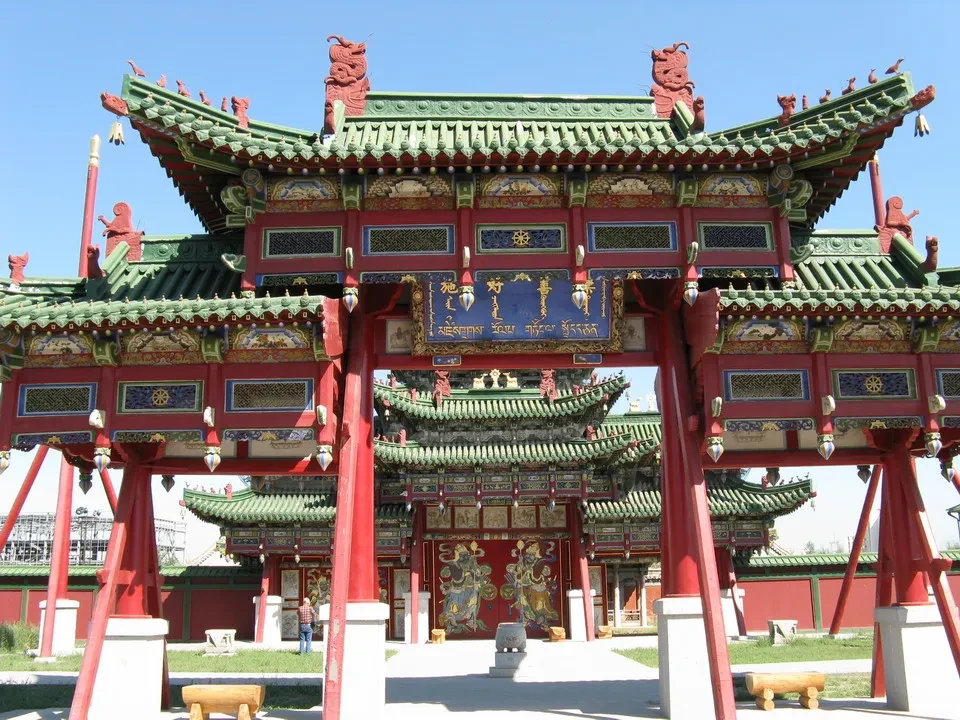
Before returning to the city center, we visit the Winter Palace built between 1893 and 1903, where the last Mongolian king, Javzan Damba Hutagt VIII, lived. This complex of temples houses numerous Buddhist artworks and the private collection of objects and clothing belonging to the king, including a covered terrace with the skins of 150 snow leopards and numerous rare stuffed animals, a result of the sovereign's extravagant exotic passions.
Next, we will move towards Gandantegchenling, one of the three major monasteries that remain after the Stalinist purges. Founded in 1838, it is the most important in Mongolia, with beautiful temples inside. In the past, it housed more than 10,000 monks and is considered a reference point for all Buddhist followers. We silently witness a ceremony. The guttural chanting of the lamas fills the air, offering us for the first time the perception of being in true Eastern Asia. Many young monks stand out: they are actually children who are guided by their parents towards monastic life from the age of 5-6. Sometimes it is genuine religious inspiration, while in other cases it is a way to avoid ending up on the streets when families cannot afford to raise them. All these monasteries have been renovated since 1990, often with contributions from other Buddhist countries. It seems that the Chinese in the 15th-16th centuries, unlike the Soviets, actively promoted the spread of Buddhism among all social classes during their occupation of Mongolia. Many men became lamas (approximately half of the male population), which ultimately weakened any active resistance towards the occupier. When the Soviets arrived, they found monasteries populated by monks (up to ten thousand for the most important ones) and implemented a policy of deportation and extermination against them.
We also see the golden statue of Buddha Migjid Janraisag (Avalokiteshvara) in the Migjid Janraisig temple, which is 26.5 meters high and contains sutras, mantra formulas, and medicinal herbs inside. All around are countless prayer wheels. The devotee, by turning these wheels, seems to be reciting the prayers contained within them, and these prayers ascend to heaven. Nearby is also the Buddhist University, and within the complex there are other temples.
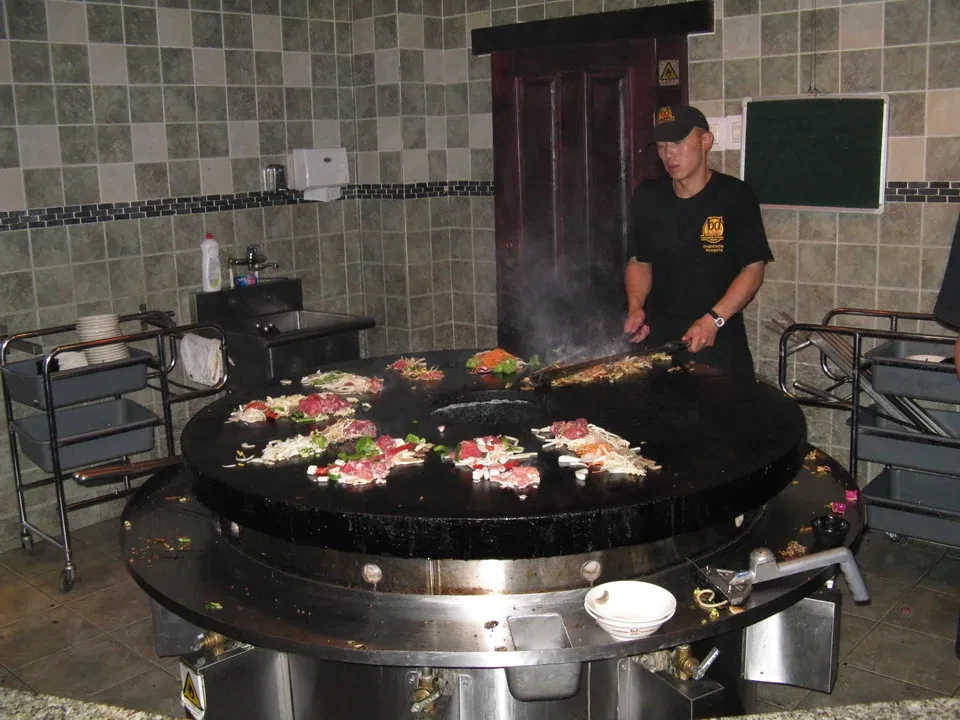
We have lunch at the Altaj Mongolian BBQ... which translates into a buffet rich with raw meat of various types. We select our choice, present it to the chefs who cook it immediately on the grill while entertaining the audience waiting, making acrobatic movements with the portions. Usually what flies in the air ends up in the plate of the legitimate customer.
We move from the State Warehouses, which we would call a shopping center here, which was once mainly used by foreigners, but is now also popular with locals. This is a great opportunity to explore and see what local shopping has to offer. We find several items that catch our attention, and we arrange to meet up on the last day so that we can have a clearer idea of what to pack for our return journey.
Finally, it's 2:30 PM and we move to the Natural History Museum, which is full of endemic animals preserved in taxidermy. The highlight of the museum are the dinosaur skeletons found in the Gobi Desert. The most recent ones are 70 million years old. The eggs from these reptiles, belonging to an era that we find difficult to imagine, are also very interesting. Now, the fatigue caused by the time difference is starting to outweigh our interest, and, thanks to the monotonous presentation of the austere lady who serves as a guide, we can barely keep ourselves awake. The topics are interesting, but the tranquility of the museum and the time difference make us consider every chair as an attractive destination for longed-for rest.
The day was hot and we saw several people (mainly women) walking around with their umbrellas open to shield themselves from the sun, or simply covering themselves with bags. It's unclear whether it's out of fear of solar radiation or to avoid tanning. As in our country once, fair skin is a sign of status. Others were wearing bandages over their mouths, probably trying to reduce the intake of smog absorbed, or as the Japanese do, to avoid cross-contamination.
Local wildlife
We return to the hotel for a refreshing shower and leave at 5:30 PM to go to... a musical performance and local folklore. Brightly colored traditional costumes, masks that are sometimes aggressive but rich in meaning, throat singing (or "kööhmii," a characteristic of this country), contortionists who are difficult to categorize – young artists or geishas exploited – all immerse us in the traditions of this people, rich in history and pride. It represents an excellent way to connect with the more hedonistic aspects of society.
With Tulga and the rest of the expedition team, we go for dinner at Modern Nomads, where we try khorkhog, a dish containing hot stones and lamb ribs. We settle for eating just the latter, which is simply delicious.
Convinced that this is enough for today, we retreat to the hotel for well-deserved rest. The beautiful life in this city will continue tomorrow! But it won't be this that will keep us awake, nor will it be the car horns accompanied by fireworks coming from the city center: Mongolia has won its first ever Olympic gold medal, specifically in judo, in Beijing. More than justified is the euphoria and national pride.