

Day 3
North Mongolia
The north, between sacred ceremonies in the temple and initial contact with rural Mongolia.
Traditions and spirituality
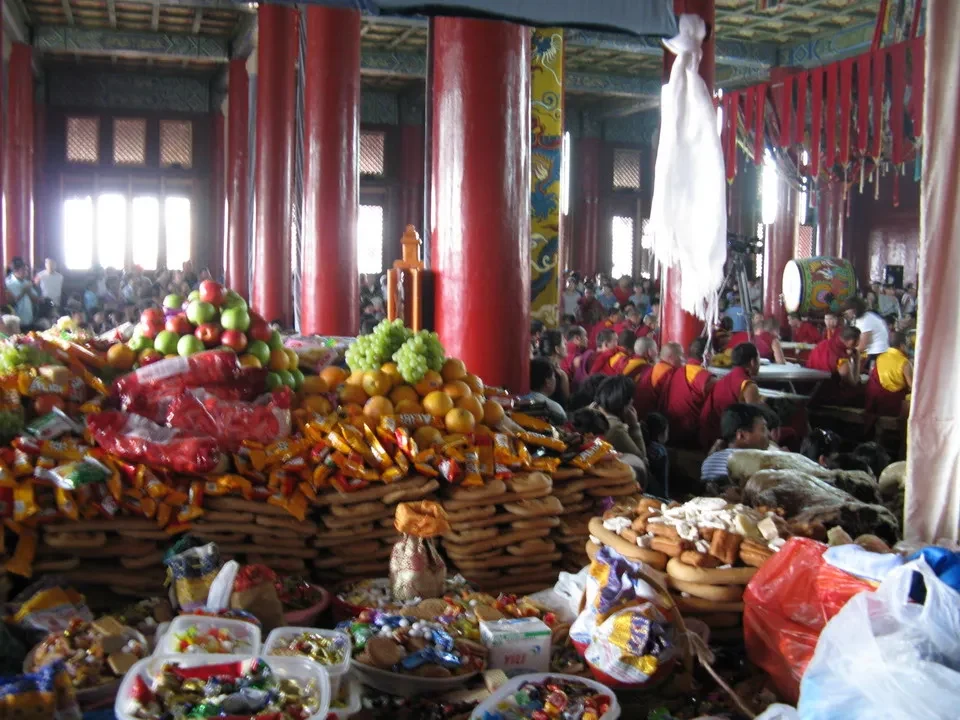
The night passes quietly and the thick blanket is very useful. At 8:45 am, we are already at Amarbayasgalant to witness the ceremonies in the temple. There are many people gathered outside, while inside, the monks... they begin their prayers. A abundance of sweets, rice and other foods represent offerings to the gods. The atmosphere is imbued with Buddhist spirituality, in a fragrant blend of warm colors and the characteristic simplicity of this religion. Time seems to have stood still, and perhaps it has. Incense smoke mixes with the sweet scent of the offerings.
The sky is clear, with some high clouds, while we head towards Erdenet , the second largest city in Mongolia, with a population of approximately 70,000 people. Large pastures with numerous calves that often stop on the road. The city has a distinct Soviet-era architecture, and to top it off, there's also a large Lenin's face mosaic on the wall of a building. We unsuccessfully try to visit the copper mine, which is closed to tourists on Saturdays. It is one of the ten largest mines in the world and alone produces 40% of Mongolian exports, consuming almost half of the country's electricity. Erdenet relies solely on this activity for its livelihood. We visit the Monument dedicated to the friendship between Mongolia and the Soviet Union.: from the broken bottles we deduce that it serves as a meeting place for alcoholics, who implicitly curse the Soviets for introducing vodka. We also buy one bottle for emergencies in case of cold weather that might affect us in the coming days.
After covering 60 kilometers, we reach Bulgan and finally leave the paved road behind. We have lunch at a rather flashy and kitschy restaurant where flies are absolutely everywhere. The road that opens up. in front of us is
This is already a preview of hell. Everything seems to be further worsened by the construction of a road that, in the near future, will connect U.B. with the north-west. This is known as the Millennium Road. Some skeptics claim that the name is due to the fact that it will take a thousand years to build. The tracks that have been built alongside seem to have been bombed, and the heavy vehicles that use them certainly do not contribute to clearing them. Dust is a constant companion that makes breathing difficult. We encounter a truck loaded with people: they tell us that they are prisoners who are going to work on building the road. We also realize here how Mongolia is more advanced than our "guaranteed democracies". In other sections, Chinese companies have won the contracts, bringing their own machinery and labor. Occasionally, we come across old trucks overflowing with sheep wool.
In this region, the dominant ethnic group is the Buriat people, who prefer wooden constructions rather than stone ones.
On the unpaved road, we start to see the UAZ minivan... which everyone says are the most reliable and will characterize the motor landscape of the steppe. The same applies to the E69 jeeps, which are excellent for durability but less so for comfort. Currently, people prefer Japanese jeeps because they are more comfortable, and the price of the Russian ones has increased until it approaches a good used Japanese model.
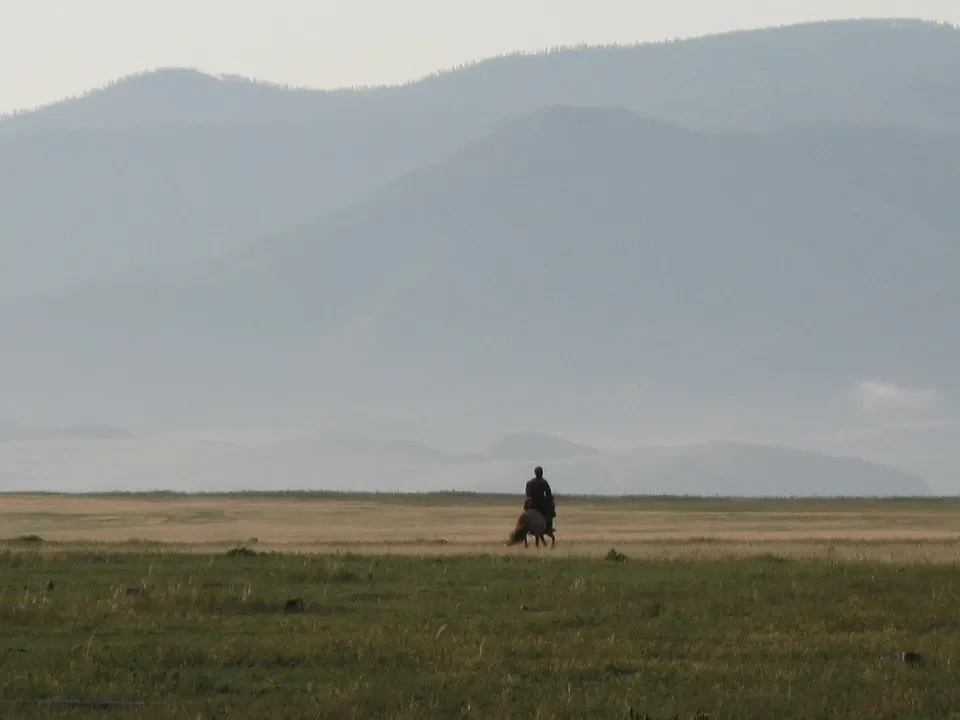
We pass the toll on the Sengel River, the longest in the country, which still needs to travel another hundred kilometers before reaching Lake Baikal in Siberia. From Bulgan to the place where we stop and set up our tent, it takes us 3 hours and a half to cover approximately 140 km. In total, we have covered 320 km, mainly thanks to the first part of the paved road. On the last stretch, as the construction work for the new road has finished, we are able to regain some speed and average around 40 km/h. The place where We set up the beds. It is located about 10 kilometers west of Houtag Ondor, near a ger nomade... where we have the pleasure of meeting the hospitable family consisting of father, mother, and a 5-year-old child with his sister. They offer us salty tea with milk (süütei tsai), which we enjoy tasting, cookies, and the aaruul (dried milk curd). The latter has the shape of a very hard biscuit, is salty, and has an acidic taste intended to please only the palates of a few Westerners. They tell us that they mainly eat dairy products at this time, as meat would quickly spoil if they killed animals. Their supply of dried meat from previous drying runs is running low, while in winter they can feast on fresh meat. The temperatures often exceed -30°C. Typically, the family sets up 4 camps in different locations each year, owns 500 sheep and 50 horses, and can be considered well-off, although the prices offered by merchants from U.B. when they come to buy the animals in autumn are becoming increasingly lower. The children go to school from September to June, and since they cannot return home, they stay in dormitories that the school provides. For the first time, we experience the proverbial hospitality of nomadic people and are amazed by their willingness to welcome strangers. What we experience goes far beyond the already flattering information provided by the guidebooks we have read. We spend the night near a stream, and before dinner, a shepherd arrives with his inevitable deel (long robe, similar to a shepherd's cloak) on horseback. Russian motorcycle He was very friendly, and we quickly showed him the only two Mongolian words we knew, ending the conversation in a short time. Fortunately, our guides were able to keep him entertained better. He's returning home, which is about twenty kilometers away. He boasts of distilling the best vodka made from milk (shimin arikh), and invites us to drink as much as we like. Dinner takes place under the light of a beautiful full moon, while the cold descends on the surrounding area and seizes our bodies. Drinking a few more beers or cups of tea turns out to be very imprudent due to the discomfort associated with frequent trips to the toilet. Getting out of the sleeping bag in the middle of the night is not a particularly pleasant experience, but it does allow us to admire the silence of the steppe while attending to our bodily needs.


