Day 10
Tsetserleg
Head south-east to Tsetserleg, a failed attempt at creating a garden city by a nomadic people.
Tsetserleg
This morning, the firefighter arrives late but the cold is somehow manageable. The guide remains asleep and after breakfast we have to wait for him for almost an hour before setting off. This happens at 9:10 am. The Arkhangay landscape is less beautiful than that of Huvsgul. The plateaus are flatter and the scenery becomes more monotonous, while the grass takes on more yellowish hues, indicating its aridity. Forests give way to endless meadows while the streams disappear. The sky appears overcast even though there is no doubt about the possibility of rain.
Traditions and spirituality
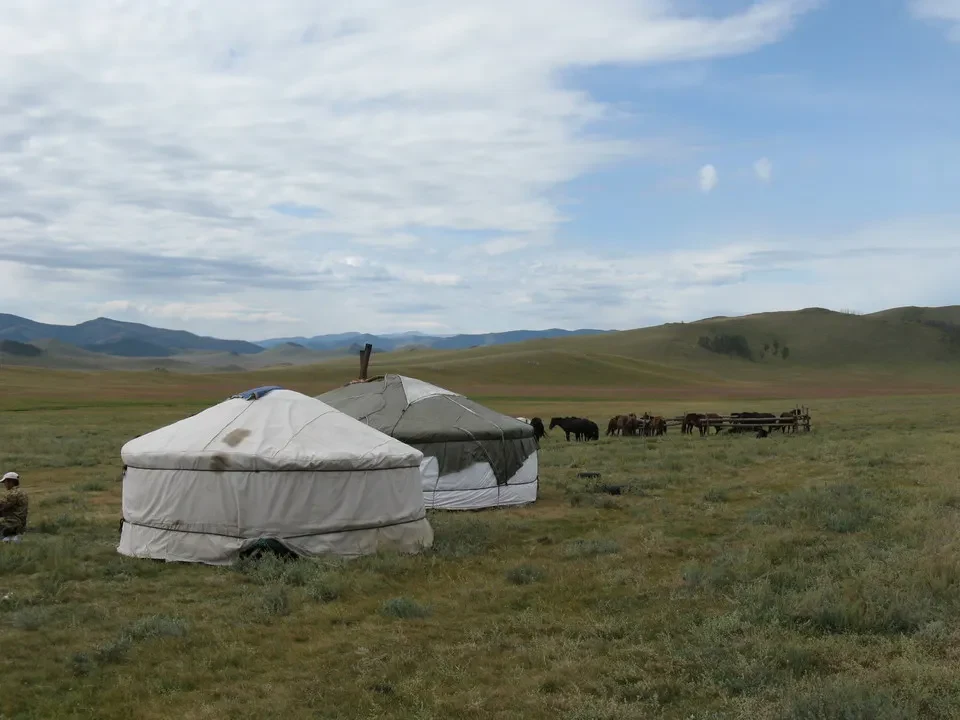
We stop to see the gorge formed by the Chuluut River, a real canyon carved by time. Nearby is the Zuun Salaa Mod... the tree with a hundred branches, covered in prayer shawls and various offerings left around, whose chaotic arrangement can only be compared to a large pile of garbage. In the middle of the morning, we take a stopped overnight at a nomad camp., like the stop we'll make to grab a coffee at a cafe. It seems almost intrusive, but it's customary, and besides, we also give gifts when we don't receive a monetary contribution. After all, this is the only way for us to understand the lives of the locals and open ourselves up to their cultures. They welcome us warmly and... taste the airag, Fermented mare's milk. It is fresh and has a tangy, fizzy taste that can be compared to sparkling water, given the inevitable aftertaste of milk. All accompanied by the indispensable aaruul. We also learn that once the butter is removed, airag is prepared with the remaining milk, by stirring it and allowing it to ferment. I add some yogurt., everything is mixed again and at this point there are two possibilities: you can let it dry to obtain the "aaruul" or distill it to produce "shimiin arikh", which we taste, enjoying its flavor.
We continue along a road that should be beautiful, with plenty of embankments. In reality, the passage of vehicles has made it a continuous bumpy ride, almost as if it were on tracks. Therefore, we should opt for the side paths, allowing us to watch the vehicles zigzagging along the sides while the main road is deserted. This is the province where the best airag is produced, and everywhere you see children covered in dust on the roadside offering the drink in recycled bottles.
As we travel, we start to see nomadic people dismantling their tents and moving them to the autumn fields. For lunch, we stop at a simple tavern in Ihtamir, where we meet a group of young people who have joined "Adventures in the World".
In a moment of naivety, I ask where the restrooms are, and a local tells me they're outside, past the kitchen. Through the kitchen, being careful not to be seen by the hygiene inspector, I search for the outdoor restrooms in the courtyard (piazza), when I see some girls emerging from beyond the fence on the right, while buttoning up their trousers. I finally understand that these are the open-air restrooms for women, and I go to use them outside, turning left into the men's section. It was all so simple…
Let's see and document. how to prepare the Tsuivan Eating them after seeing the kitchen requires a certain mental preparation, but we are now accustomed to certain things and don't hesitate, even in the presence of the numerous flies that attack us. Hanging on a wall is a picture that offers an extremely familiar landscape, and our instinct immediately urges us to look at it more closely. It's him, Cervino. It's wonderful to be able to admire this image in such a remote location. Talking to the locals, none of them know which mountain it is. They simply like its shape and can't be wrong. We had experienced something similar in Canada, in the far northern Quebec, where we saw a painting depicting the same mountain. It was in a B&B for wealthy elderly people, and it was on a much larger canvas. But it's always him!
Towards Tsetserleg
Let's head back for a quick stop at the Taykhar Chuluu... a rock formation that even scientists can't explain why it exists in that location. It is obviously rich in legends and graffiti. A horse race (Naadam) is about to take place nearby, and there is considerable excitement, with several tourists watching the crowd!
We consume the last 25 km, to our surprise we see that they are paved. The pleasure, however, is fleeting; after a few kilometers, the dirt road starts again and lasts until Tsetserleg We are looking for a hotel in this city that the literal translation wants to call "garden". In fact, there is also space for flowerbeds, but it's all overgrown with weeds. The fences are now dilapidated and the trees grow as they please. We find accommodation, which makes us miss our old place.
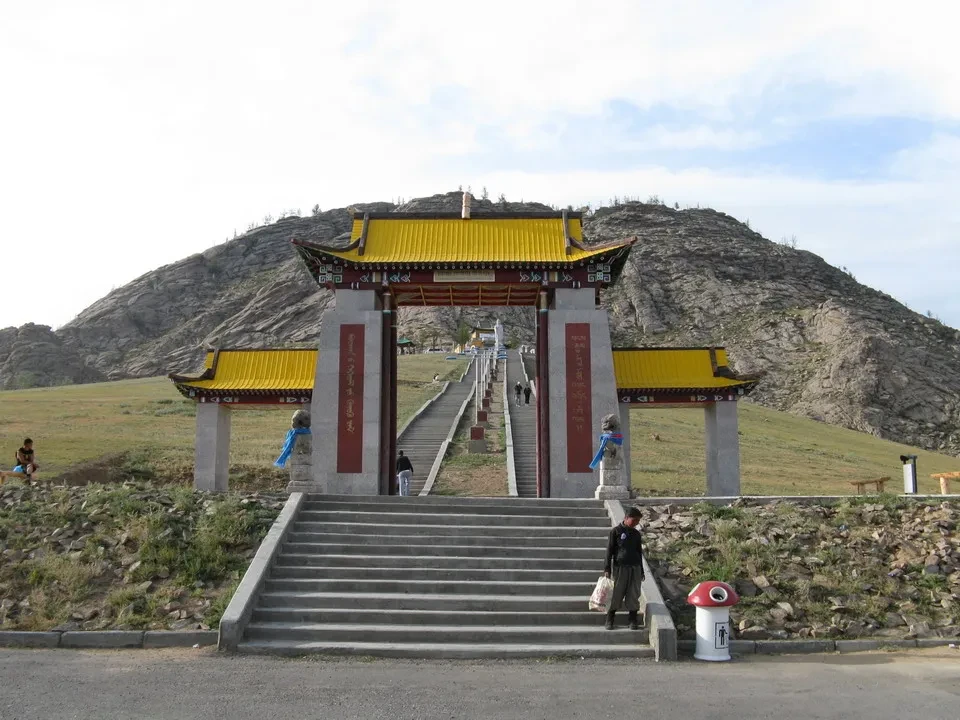
We visited the Zayaiin Geegenii museum, built in 1586. It is an ancient monastery that once housed over 1000 monks; it was closed and reopened as a museum. At least this transformation has saved it from certain demolition by Soviet atheism. Part of it is dedicated to the history of the aimag, with an old ger (traditional Mongolian dwelling) and a collection of tools that help us understand life in the past. The other part is excessively propagandistic, featuring flags from the previous regime, photos of revolutionaries, various slogans, and communist-themed objects. The propaganda is indeed against capitalism but primarily targets the lamas, whom the regime had unleashed its fury upon. The argument about the goodness of communist ideology also includes the first Mongolian to go into space with a Soviet capsule. Everything is falling apart without anyone even bothering to hang up the fallen paintings. At least in this context, we don't mind the decay and consider the visit culturally enriching.
Museums and memory in Tsetserleg
We visit the local market, which is also partly housed within containers. A notable stall features... mechanical spare parts for cars and motorcycles, scavenged by abandoned vehicles. An intelligent system for scrap and recycling at the same time. We return near the museum to go up to an abandoned shrine From here, you have a great view of the city and surrounding area. In the center, we see several pigs wandering freely on the sidewalks with the same calmness as pedestrians.
Since the two restaurants indicated in the guide are closed, we have dinner at the hotel, tasting pork, which is likely a relative of the ones we saw earlier in the city center. We order coffee and are served a cup of hot water with a packet containing an American-made chemical product. It's called "3 in 1" and includes coffee, milk, and sugar. We opt for tea, but the packets are missing. We give up and after dinner, we challenge each other to a game of billiards, finally enjoying our hotel room: the two outlets are detached from the wall (probably to check that the wires are not exposed), opening a drawer which I believe contains soap, instead a condom comes out (on the opposite wall there are two adhesive labels explaining how to put it on in Cyrillic), the tap for the bathtub and sink is unique and must be moved as needed, while the shower hose sprays water from all sides.