Day 8
Dalton Hwy II
Still on the Dalton: Wiseman (meeting Jack) - Arctic Circle - Yukon Crossing - Fairbanks
From Wiseman back toward Fairbanks
Second day descending the Dalton, although we begin by driving back north for about a dozen miles to visit Wiseman, something that will prove extremely interesting for understanding how it is possible to live even in these conditions.
Wiseman and the meeting with Jack Reakoff
Here we meet Jack Reakoff. He is 53, but has a youthful appearance and a look of subtle defiance toward the powerful, from whom he tries to keep his distance. His voice is confident but never arrogant, calm to the point of seeming almost submissive, while in reality it hides a tough shell. Above all, he shows a sharp intelligence, necessary for living in such a hostile environment. Around here it is essential to weigh every gesture carefully and to know that a mistake made today can have lethal consequences tomorrow. It is a matter of combining experience, endurance and reasoning.
He acquired that experience over the years thanks to the lessons learned from those who lived here, especially the last prospectors (pioneers in the search for gold) and Native inhabitants. He studied biology at the University of Fairbanks, then returned here (where he has lived since the age of 13) because he was incompatible with urban civilization. He speaks with the same familiarity and competence about the chemical reactions that cause the northern lights as he does about how to hunt or set traps. He alternates intellectual work with building log cabins and wooden objects.
He is a concentration of all human skills: perhaps this is the only way to manage in a place where once every three months you have to leave for the city, Fairbanks (about 300 km of dirt road), to stock up on supplies. To do this takes 3 days: two for the round trip and one to "run errands", possibly leaving the car or tools to be repaired during the day. Recently he had to spend more than $5,000 at the dentist and believes that in Fairbanks, given its isolated position, dentists are the most expensive in the world. I do not reply, but I would like to tell him that I know other places, not nearly as isolated, where dental work can be devastating for the bank account.
His subsistence life includes very intense farming activity, taking advantage of the long summer days and keeping in mind certain precautions learned the hard way or from an elderly Native woman. For example, he tells us that potatoes must be planted whole. One small mistake and the season is lost. Planting only a quarter of one, as we do, would not sprout. During the season he fills the freezer with game, making sure the supplies never fall below a certain limit. The forest is not a butcher shop that has meat whenever you want it.
Hunting is not that simple either: bringing down a 500 kg moose in the wrong place, or not killing it with the first shot so that it falls dying into a swamp, creates enormous difficulties in getting it out. Shooting animals also requires experience. Bears must be hit on the nose or in the carotid area; otherwise you only risk wounding them and increasing their aggression. Their hide is hard to penetrate, even with large-caliber bullets, he says size 35. Defending oneself from low temperatures is another activity that requires attention and experience. Temperatures of -50° are normal in Wiseman, but it is a matter of covering yourself properly and paying attention to details.
He explains how, at certain temperatures, if you throw a cup of hot water outside, it immediately turns into mist and shortly afterward falls as snow. The dark winter days require strong psychological and organizational preparation in order to remain active and productive. For many people in Alaska the problem is precisely the depression that the long period of darkness can cause, and as a consequence a sad natural selection made of suicides is created.
In winter he works as a trapper, a hunter of fur-bearing animals. He has three routes that start from the village and that he always keeps open; once a week he goes out to check whether the traps have produced anything. He then sells the furs to obtain the money needed to buy what nature cannot provide. Another source of income is visits from tourists, to whom he sells wooden objects he makes during the long, dark winter. In spring he guides some tourists to see the best northern lights in the world. He also collaborates with the University of Fairbanks, which entrusts him with tests to carry out (especially in agriculture) to see how certain products behave in extreme conditions above the Arctic Circle.
Located just south of Atigun Pass, Wiseman represents the northern limit for running experiments. In the midst of all this activity he has had four children, now adults who live or study elsewhere, and he has managed to pass on his philosophy of life to them, preserving them from cultural pollution and urban temptations. One daughter even lives in Galena, a village on the banks of the Yukon that is not reached by roads. In summer his wife works at the Coldfoot Visitor Centre.
His house is a museum, and probably not an example for Western hygienists, who in these places would in any case have a short life, lacking as they are not only antibodies but above all instincts. The refrigerator is natural: through a trapdoor in the kitchen floor one reaches a hole dug into the ground, where in winter he lets some heat filter in to keep the temperature above zero. The ceiling is very low for obvious thermal reasons, and several maps hang there, along with photos and various papers. In short, a large desk turned upside down.
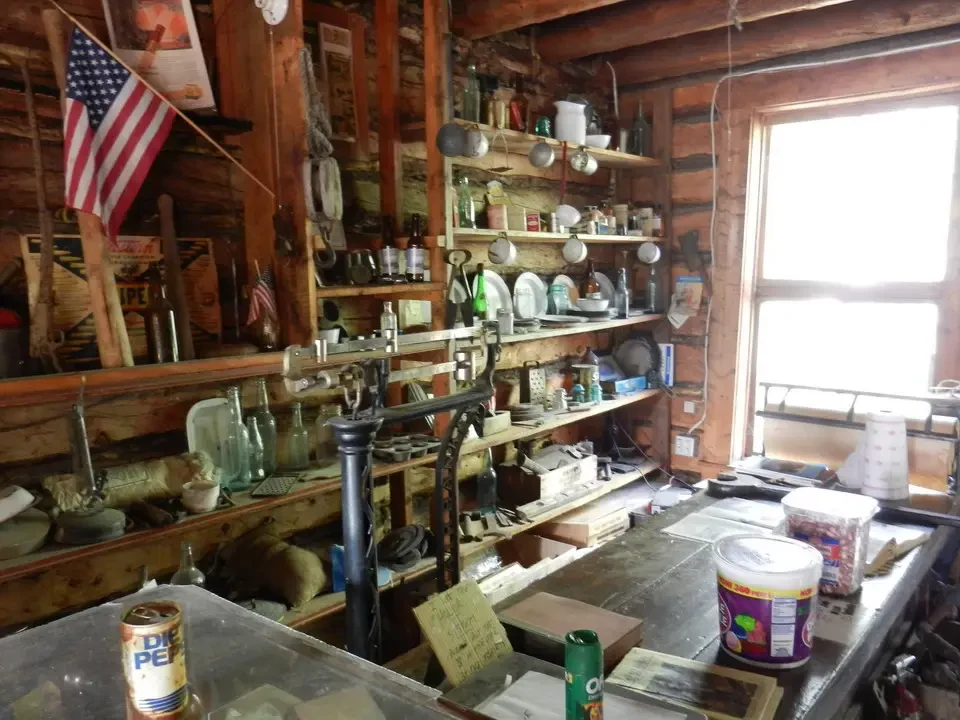
Besides his own house, he has built another one that used to serve as a bedroom for the children. It has now been turned into a drying room for medicinal plants and is kept at a constant temperature of about 25° by a stove. He has a deep religious sense, so much so that one cabin is used as a place of worship, a real little church complete with altar and a crucifix carved from a moose antler. The former General Store is used as a museum of old things, while another small log house has a wide range of objects hanging inside as well as a table with photographs showing the surroundings in winter moments, animals and hunting scenes.
His parents live in other cabins, while his sister runs a small bar that also sells objects and gifts for tourists. A necessary compromise to get through the winter. Near the village a stream flows, preventing permafrost from forming within a radius of about a hundred meters; beyond that, under only a few dozen centimeters, even in summer one encounters a layer of permanent frost. The frozen ground is found from 20 to 2000 ft deep. In a way, one could say that life in Wiseman revolves around him and his family.
To live here one must not be naive, and the story of young McCandless comes to mind: a city dweller with no experience who went looking for adventure in places hostile to him. His lack of preparation proved fatal.
The conversation then shifts to the oil companies and the project for new drilling in the northeast, in a protected area, which would also require doubling the pipeline or adding a gas pipeline. Jack is very critical of the authorities, to whom he attributes a large part of the blame for the speculative management of the resource. He is not against development, but he is keen to preserve Alaska from industrial contamination. It seems there is plenty of oil and that they want to ration it in order to keep prices high. There is no shortage of ways to do this: one of them is reducing the flow speed inside the pipeline. This is explained for technical reasons, since greater pressure inside the pipe would cause faster erosion of the walls, and 1300 km of pipes cannot easily be replaced.
If it were ever necessary to confirm that Jack is not a wild man in an environment that instead is wild, we learn that he is also able to fly planes. In the end I leave the meeting convinced that, for the first time, I have met a free man.
Enriched by this experience and somehow aware that I have wasted many years of life, we set off again toward the south. Our travel companions obviously pay maximum attention to the most insignificant details, completely neglecting the lesson that this living book of experience named Jack has just given us. A return to origins accompanied by the intelligence with which the human species is endowed, when it chooses to use it.
Near Wiseman there are gold mines that are currently closed. The prospectors had found interesting veins. Unfortunately, the area lacks the abundance of water needed to sift the mineral, so the difficulties immediately appeared insurmountable even with the available means.
Coldfoot and the Arctic Circle
We return to the Coldfoot Visitor Centre to look at its interesting information resources. We also take the opportunity to see the old cemetery, now overrun by trees and hard to distinguish from the surrounding forest.
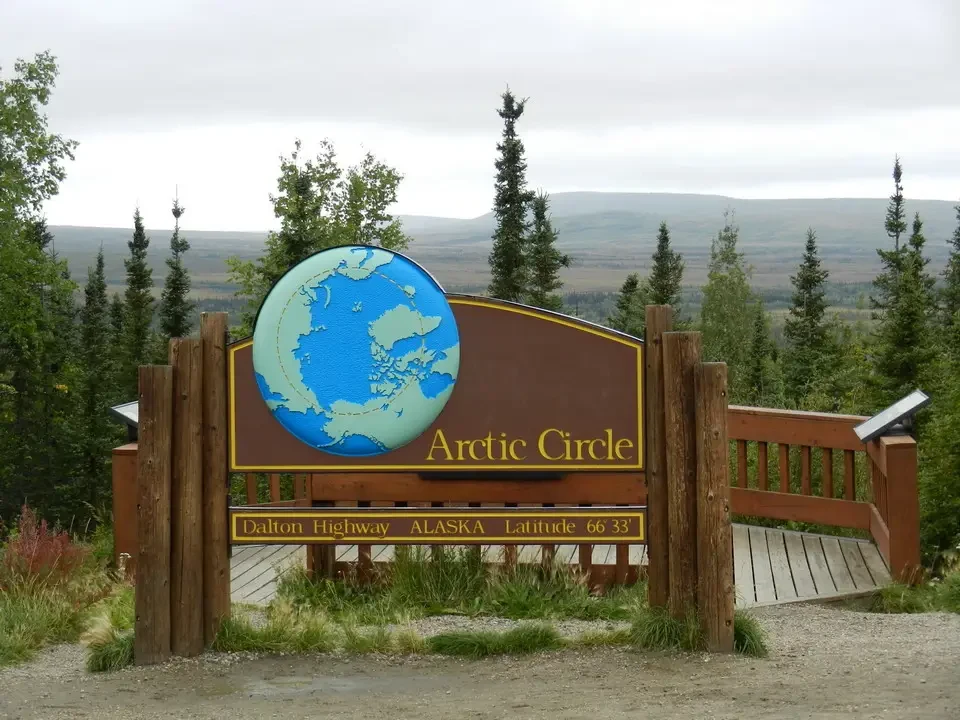
We stop at the Arctic Circle, where at last we manage to find something that arouses the real interest of our travel companions. The sign marking the imaginary line of the Circle is literally stormed by tourists who want to pass down to those at home, and perhaps to future generations, such an important (even heroic) gesture of which they have been protagonists. Crossing the Circle while being immortalized in the most idiotic poses becomes the object of a long stop and a loss of time that we will pay for in the evening.
The sky fills with low gray clouds that help make the moment sadder and colder. The soft hills are covered with black spruce, a sign that permafrost lies beneath. We take the opportunity to walk a little in a forest full of mushrooms, and when the Arctic Circle sign is finally free of human figures, we also photograph it as a souvenir, aware that crossing the limit reached by the midnight sun is in itself neither a merit nor a particular emotion.
Finger Mountain and Yukon Crossing
When the weather is at its worst, with low fog that ends up reducing visibility, we reach Finger Mountain, a huge real finger of rock that in the past, on sunny days, helped aviators identify the route toward Fairbanks.
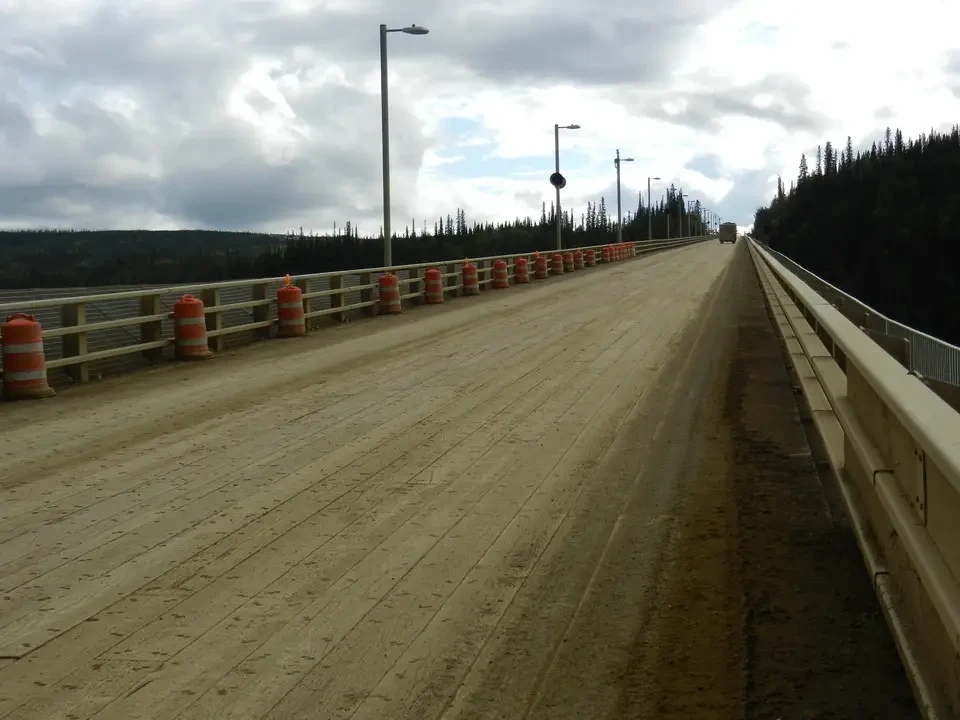
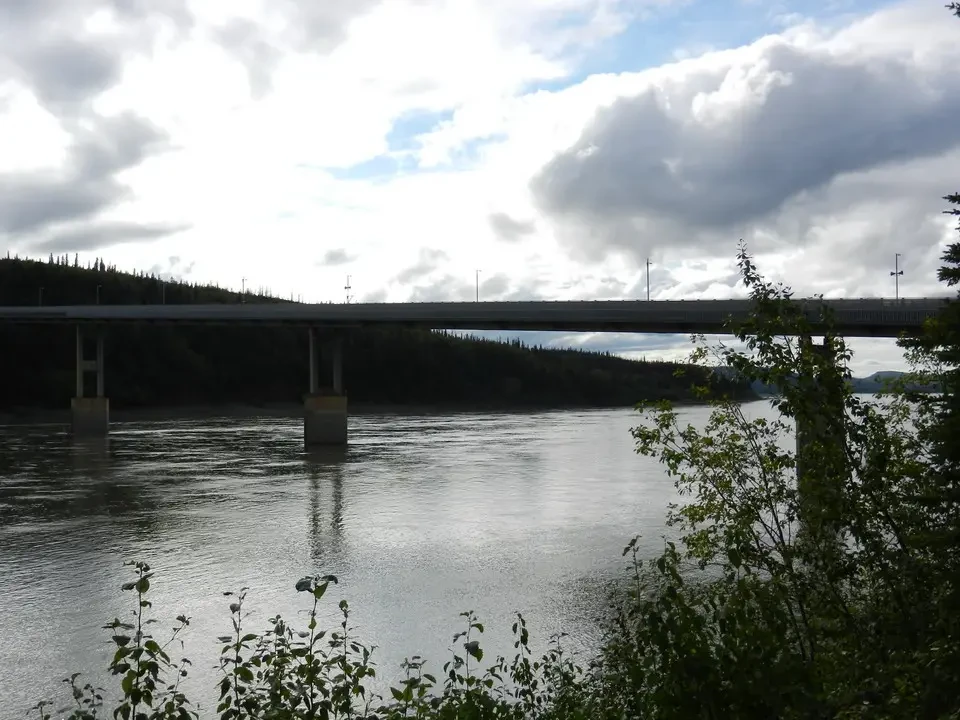
At mile 56 we are at the Yukon River Camp, where the Dalton and the oil pipeline cross the legendary North American river. The construction of the bridge meant the final completion of the Dalton; previously ferries were used in summer, while in winter the river was crossed thanks to the thick layer of ice. The problem was the intermediate seasons. It required a year and a half of work and has a wooden road surface.
We go to gather some information at the local Visitor Centre. There is a bar/restaurant that sells a bit of everything, provided one can get there through a layer of mud that clings to the shoes. Inside there is a photo album documenting the winter incursion of a brown bear when the Camp was empty. It managed to get in, destroying everything it found in its path, until it fell asleep in a delayed hibernation. This happened in 2005, when the immense fires that devastated the area created imbalances for the bears, which were unable to store sufficient supplies for winter and therefore wandered aimlessly beyond the usual time. Trucks also stop frequently at the Camp for a break.
The place is also a transfer point for means of transport. Many people who live in the villages facing the Yukon and not reached by roads travel by boat (or by snowmobile in winter) along the river and from this point continue on wheeled vehicles.
Fires, mud and the final kilometers of the Dalton
We often encounter areas completely burned by the great fires of 2004 and 2005. The causes are entirely natural and, according to experts, fall within the normal biological process that governs the forests. They serve to regenerate the woods from the ashes of the old ones, so much so that in Alaska the average cycle is 80 years, which in some areas drops even to 26. Black spruce are rich in resin and become easy prey for fire. The first pioneer plants to colonize the burned area are fireweed, followed by shrubs and finally tall trees.
It is surprising how the pipeline, which carries a highly flammable load, is completely immune to fires and, even when surrounded by them, is not affected in the slightest. Sometimes human beings get something right.
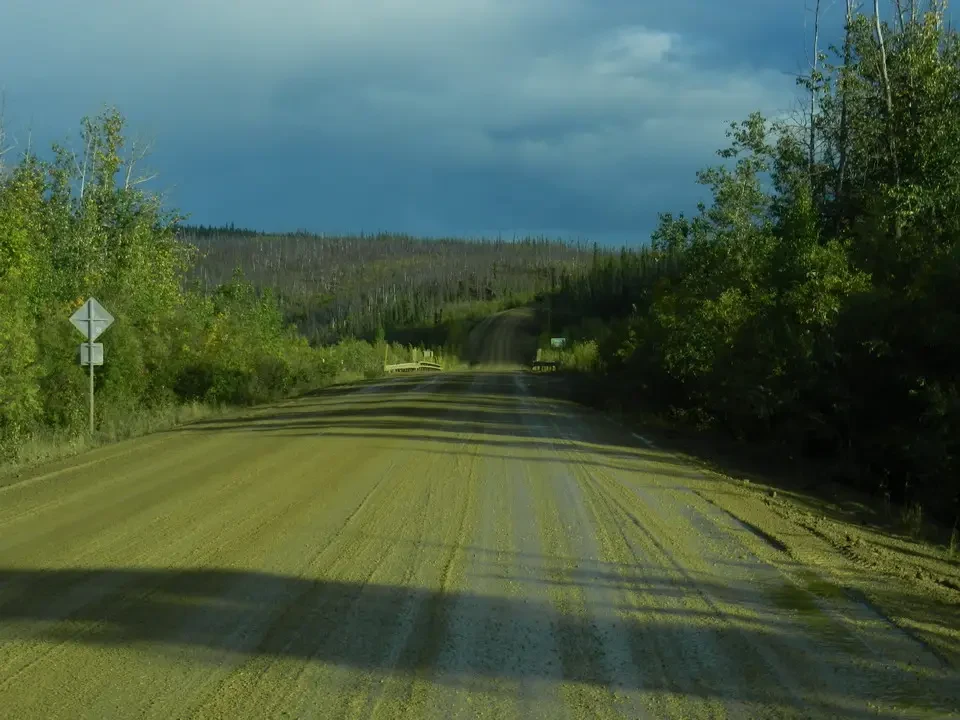
Despite frequent showers, the sky often remains clear, in a very characteristic variability that favors the formation of rainbows. The road is sometimes particularly earthy and becomes a single quagmire when vehicles pass. These frequent weather alternations favor the creation of particular and extremely photogenic landscapes.
The Dalton Hwy was created and designed very quickly, so some stretches turned out to be improvable. Satellite images had been used to design it. Unfortunately, the area south of the Yukon at the time of the surveys was affected by large fires that prevented clear results. In one area the road was traced in a very approximate way and was therefore very demanding for the drivers who traveled it, so much so that one valley was named Happy Man. Anyone who crossed it unharmed could consider himself a happy man. In the 1990s it was improved by creating a bypass that makes the route easier. It is interesting to note how, in the meantime, vegetation has taken possession again of the unused stretch.
Night return to Fairbanks
We arrive at another stopping point while time passes and evening begins to fall. We stop at the home of a family of pioneers who bought a large piece of land and currently live by cutting timber, carving it and selling tourist gadgets in summer. The family has grown considerably and now consists of 37 members. The yard is a heap of old cars and all kinds of scrap.
During the trip, talking with Emma, we learn that only 1% of Alaskan territory is privately owned, while all the rest, including forests, parks and reserves, belongs to the State or is under federal jurisdiction. This is particularly surprising since we are in a nation that has made private property a banner to be proud of. For this reason land is very expensive. No one would believe that landed property in Wiseman could be expensive, even though it seems unthinkable that there is high demand. Even in Fairbanks real estate is inaccessible, so many people live in log cabins all year round. Rent for a medium-small apartment is around $1200-1500. At the same time, about 30% of Fairbanks residents do not have running water at home because the service does not exist. In this regard, public showers can be found in laundromats.
The Dalton ends when it joins the Elliott Hwy, which after a few dozen miles gives way to the Steese Hwy. At 10 p.m. we are finally back at the East Ramp in Fairbanks, from which we had left two days earlier. Two hours to go up and two days to come down. Frankly, the return journey was even redundant, and bringing the return forward by a couple of hours would have allowed us to see everything anyway and would have been more welcome to everyone. It is nevertheless a recommended experience in places we could barely have imagined. To welcome us, we find a sunset that wonderfully seals the northern weekend just completed.
Night in Fairbanks
By now it is too late even for dinner. We return to John's B&B, where we had stayed on Thursday evening, and "dine" on a few cookies, adding them to the sandwiches from lunch. There will be time for salmon dishes later on.