Day 5
Fairbanks
Further north along the George Parks Hwy: Nenana and Fairbanks, Alaska's second city
Toward Fairbanks
Having closed the parenthesis in Denali park, we head north again with the goal of reaching Fairbanks, still on the George Parks Hwy.
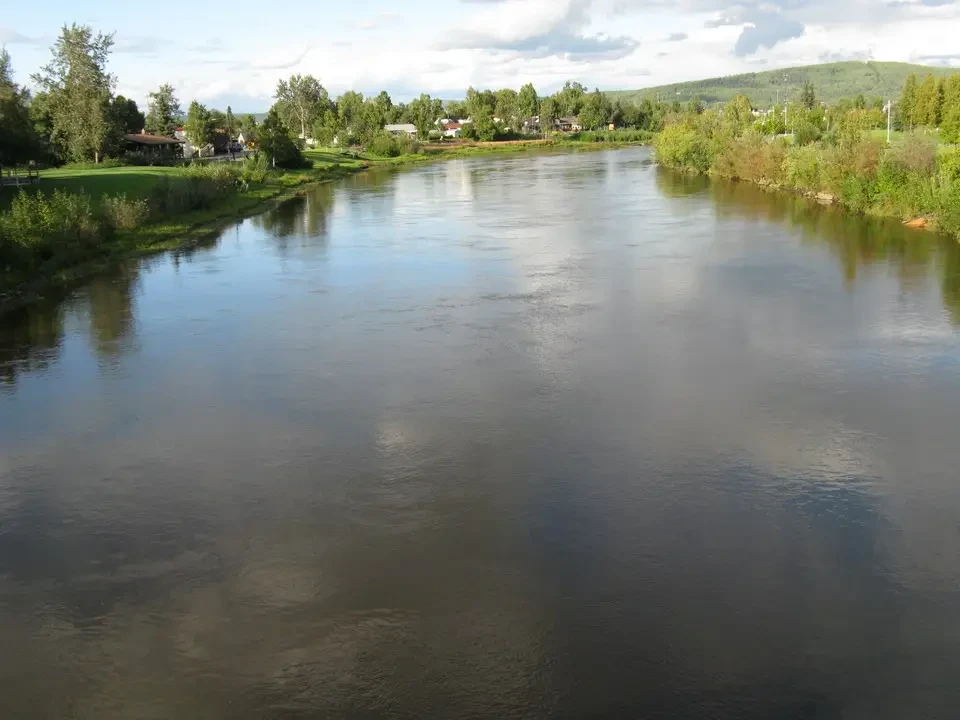
Nenana and the Tanana River
On the way we stop at Nenana, one of the many Indian villages that developed following the gold rush, which now barely tries to survive among the numerous ruined houses. Now that there are no longer reasons to search for gold minerals, the remaining population is basically Indian and mainly devotes itself to fishing salmon using the so-called fishwheels (floating systems that the water current makes rotate pulling up the fish, while a slight inclination makes them fall into a basket placed on the shore).
The guides are probably right when they write that the only reason to visit Nenana is linked to the famous bet throughout the USA on the moment when the ice will break on the Tanana River (which normally happens between April and May). The atmosphere is almost surreal, with fogs coming and going as in a horror film. We visit the area along the river, where there is also an ancient railway station now used as a museum.
Shortly after we hear the unmistakable horn of the yellow-blue locomotive of the Alaska Railroad that covers the route from Anchorage to Fairbanks. The village is located at the confluence of the Nenana River, which has accompanied us since Broad Pass, descending from the Alaska Range, with the Tanana which instead arrives from the east and originates from the same chain. The Nenana will then end its run in the majestic Yukon and then in the Bering Sea. The water that descends south of Broad Pass concentrates largely at Talkeetna and then flows south and empties into the Pacific.
As already noted elsewhere and we will have more opportunity to appreciate, the Visitor Centers are very well set up (sometimes they even overflow with opulence) and have extremely competent and kind staff, able to provide information not only on the area where you are but on the whole country. We also see a nice photo album lent by some local resident where you can see a moose entering a dwelling, with the owner offering it the honors of the house, while the animal seems to feel at ease within domestic walls.
We continue with a few drops of rain, then clearing after a few dozen miles, and with the sky soft hills covered with firs stand out in front of us, interspersed with frequent lakes.
Ester, ghost town on permafrost
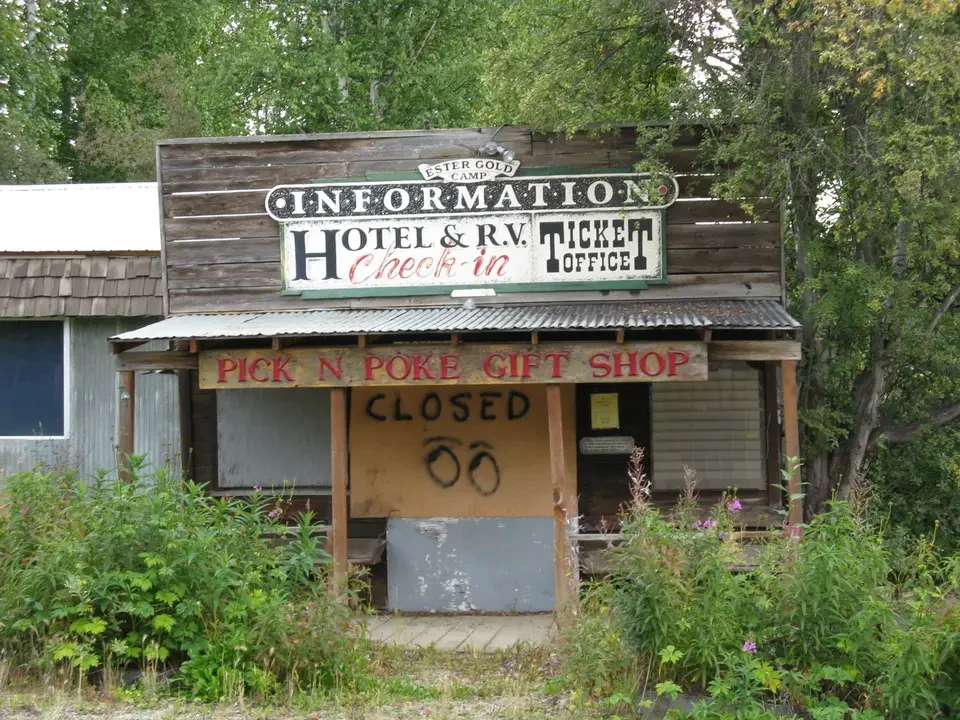
Ester is a very original ghost town consisting of some old buildings.
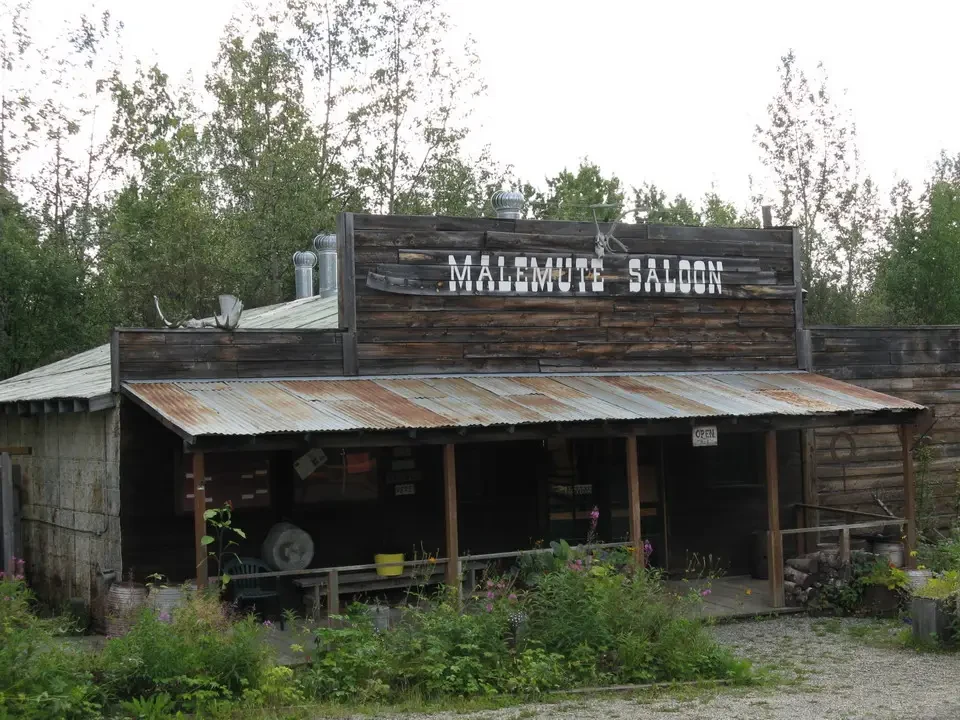
It was known to be a rather atypical community arising from the will of some mystics to remain isolated from the rest of the world. The toughest seem to have succeeded in their intent since the few remaining share an almost uninhabited town, with the usual wooden houses that are beginning to show conspicuous tilts due to damage caused by permafrost. The Malemute Saloon stands out.
Fairbanks between local history and northern life
Shortly before noon we are in Fairbanks, Alaska's second city with 80,000 inhabitants at 64° north latitude. It also arose following the gold rush and is the gateway to the last frontier, to the Arctic. We go to Northern Alaska Adventures to do a pre check-in for the next day and dedicate the afternoon to visiting this interesting town.
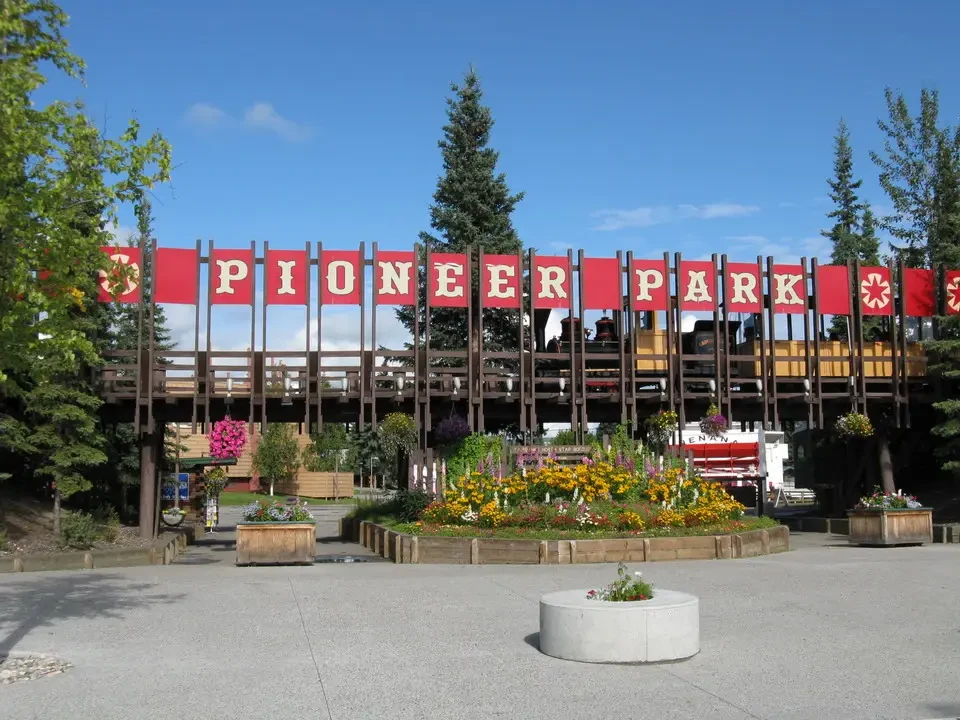
We start at Pioneer Park, walking it up and down. It is a city park that could be considered a container of museums and local history. In an ostentatiously American style everything is done on a grand scale, but not without charm. Of particular interest we consider the Native Center, which shows a long but clear film about the past and present of the natives, with a marked polemical vein towards the American conquerors and the methods with which such conquest took place.
The local history museum itself, focused on the epic of the colonization of Alaska, is very instructive. Objects of every kind testify to the difficulties faced by the pioneers who arrived in search of fortunes linked to the search for gold. We also visit the interior of the Nenana steamboat, where there are scale models of the various towns located along the Nenana and Yukon rivers, which the steamboat traveled until a few decades ago. We go to visit the residence of the first governor of Alaska.
Next we move to the suburbs to see a breeding of musk oxen and in the university area the botanical garden, near which there are some reindeer. The garden deserves careful viewing for the quality of flowers and cultivated vegetables, of particular regard considering that we are a few degrees below the Arctic Circle. Some plants are common with those of our mountains, while the vegetables exceed ours in weight and size (in particular the cabbages are enormous, sometimes exceeding 30 kg).
We go to meet John Davis, the owner of the B&B that will host us tonight (Ah, Rose Marie). There is no one in the house but on the door we find a note with our name containing the welcome and the invitation to settle in the indicated room with our luggage, so everything is open. This leaves us astonished at how one can trust to leave the door of a villa near the center completely open without fear of it being burglarized. If these are the wild lands one wonders where we live what they are. We settle quickly and while we are about to leave John arrives, who with a few words in decent Italian tries to make us feel more comfortably at home.
Downtown Fairbanks and the wealth of the north
We go out for a walk downtown passing through the Golden Heart Plaza, in what was the original core of the city, which also arose as a service center for the stampedes (adventurers in search of gold) in a very casual way. A huge development was then created by the discovery of the northern oil basins and still today it overflows with wealth linked to black gold.
Being home to a university linked to experiments in harsh climates with over 8,000 students it also maintains an image of relaxation that goes alongside that of business, created by the frequent banks and companies linked to the extractive industry. On the square there is the statue in honor of the first colonizers who came from Siberia 20,000 years ago, the so-called Indians or Eskimos if referring to the northern regions.
Along the Chena River there is also the Visitor Center, of disproportionate size which houses inside every kind of information one could desire. There is also a museum gallery where you can see the history of the region, which is also that of Alaska and consequently the common thread of almost all museums: the life of the natives – gold rush and conquest of the territory at the expense of the first inhabitants – development following the Second World War – oil. In the midst of all this there can be some stuffed animals and information about the environment.
Certainly the downtown is the perfect representation of what comforts can be obtained with revenues linked to oil, since tourism alone could in no way support such investments. In general all of Alaska owes its well-being to this resource, which if it were not there would make it an economically dependent state on the rest of the USA. Especially public structures and those linked to the promotion of tourism ostentatiously display a well-being that appears even excessive in the Alaskan context.
Immaculate Conception Church and evening in Fairbanks
We also visit from the outside the white Immaculate Conception Church which is on the other side of the river. The building was moved in 1911 by sliding it on the river during winter, thus bringing it forward a few hundred meters and on the opposite bank. This case (as well as Chris McCandless's school bus) offers the cue to mention how paradoxically it is easier to move during winter than in summer. The frost turns rivers into a lane free of trees and allows the transit of heavy vehicles as well, in addition to making up for the lack of bridges. In the north both dogs and snowmobiles can range everywhere and there are villages that can only be reached by motorized vehicles in winter.
We dine in a nice little restaurant in the center of Fairbanks, Soapy Smith's. Very characteristic old-style with beautiful period photos hanging on the walls. Very informal and exuberant tone on the part of the waiter, at times almost excessive. The salmon is average, that is good. It perhaps lacks some garnish but the taste is there. It should be remembered that to maintain high quality standards, salmon farming in Alaska is prohibited.
Since in the coming days we will leave "civilization" to immerse ourselves in the Nordic void, we go shopping taking advantage of the fact that supermarkets close late or do not close at all. We return with the vision of an incandescent sunset. The setting sun at 10:30 PM tinges the few clouds walking in the sky pink. Sun that has kept us company all afternoon, at certain moments we even opened the windows slightly and came close to turning on the air conditioning.