Day 3
Denali by Land
Hikes in Denali N.P. – first steps
Denali: Savage River, Mt. Healy and sled dogs
We are now in the Interior. Wake up at 7 and breakfast in the same restaurant as last night, where some pancakes with birch syrup serve to say good morning. Today we treated ourselves well, but we will pay for the luxury a little later in the day. In a few minutes we are at the WAC (Wilderness Access Center) of Denali to try to understand something about the complex system for entering the park, trying to optimize the two days we have available.
The laziness of breakfast makes us miss the shuttle to Savage River by a few moments, the last point reachable by car and destination of a trip. We go back to get the car and with our own vehicle we travel the 14 miles that lead to the checkpoint beyond which you enter the restricted area of the park and only authorized shuttles pass. This time luck and bad weather help the lazy ones, so much so that there are few vehicles in the Savage parking lot and we manage to do the planned loop.
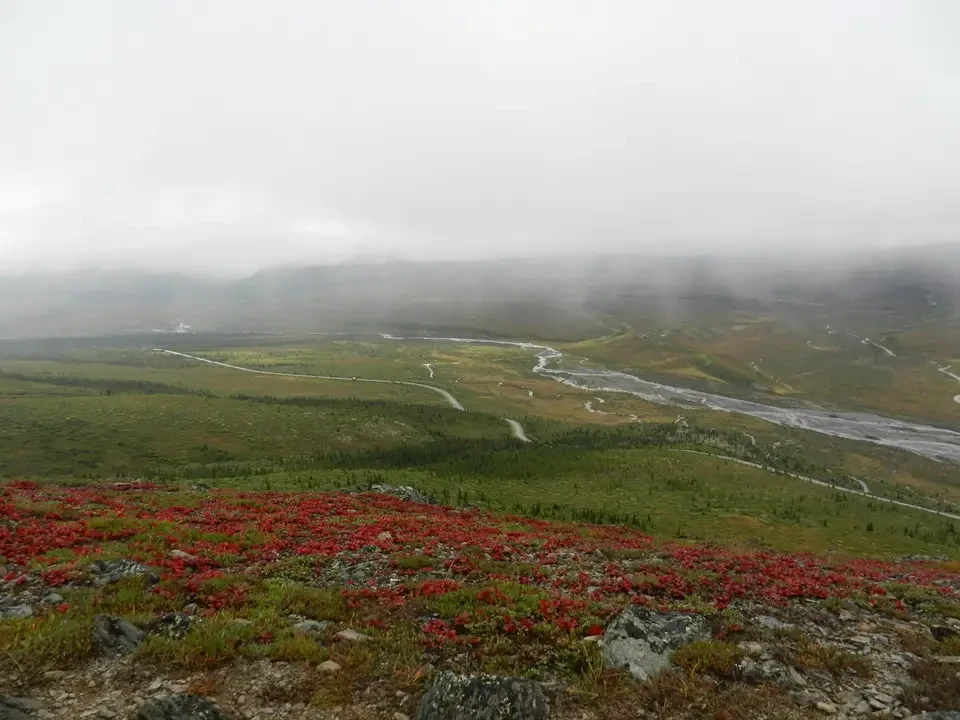
We walk the Savage River Loop Trail (3.2 km) along the river which is essentially flat and then climb 300 m to a panoramic point, Savage Rock, from which there is a nice view of the river and the valley surrounding it. In the distance we see Dall sheep grazing on the mountains. The sky is overcast but at least we are free from precipitation.
In the meantime we stop to see the kennel where we will return in the afternoon. After a quick look at the Visitor Center with its interesting illustrations about the park and a lunch consisting of bread and cheese eaten standing by the car, we go to do the second hike of the day at Mt. Healy Overlook with 600 m of elevation gain (8.9 km) and a beautiful view of the valley of the park that we will travel tomorrow and of the perpendicular one of the Nenana River. Thanks to some clearing we can focus well on what is below but beautiful days are another thing. The vegetation consists of alders at the bottom, then birch vegetation begins and ends with the usual mosses and lichens typical of the taiga at the top.
By 4 PM we are back at the kennel to see the sled dog show, an American thing where the only serious thing is the sled dogs, true heroes of the rigid Arctic winters. The park rangers still use them today to move inside the park when snow is king and motorized vehicles would not be able to function due to the low temperatures. This is how the kennel combines a practical function with a folkloric one.
Ridgetop Cabins above Healy
Tired after the intense day, we go to sleep in Healy, actually another 5 miles beyond, climbing another mile on a steep dirt road until we reach a place where you wouldn't expect two permanent residents with 5 cabins to rent during the summer. We are out of everything and the only noise you hear are vehicles speeding far away on the valley floor Hwy.
Joyce tells us how John worked in the coal mine nearby, while she was employed for 15 years at the agency that manages the park. They are currently retired and the only activity is running the Bed & Breakfast. They try to gather food and money during the short summer season and then live quietly during the winter, where they say it is not difficult to get around because temperatures do not go above 0° for quite a while and therefore there is no ice formation. The snow remains in its natural state for months.
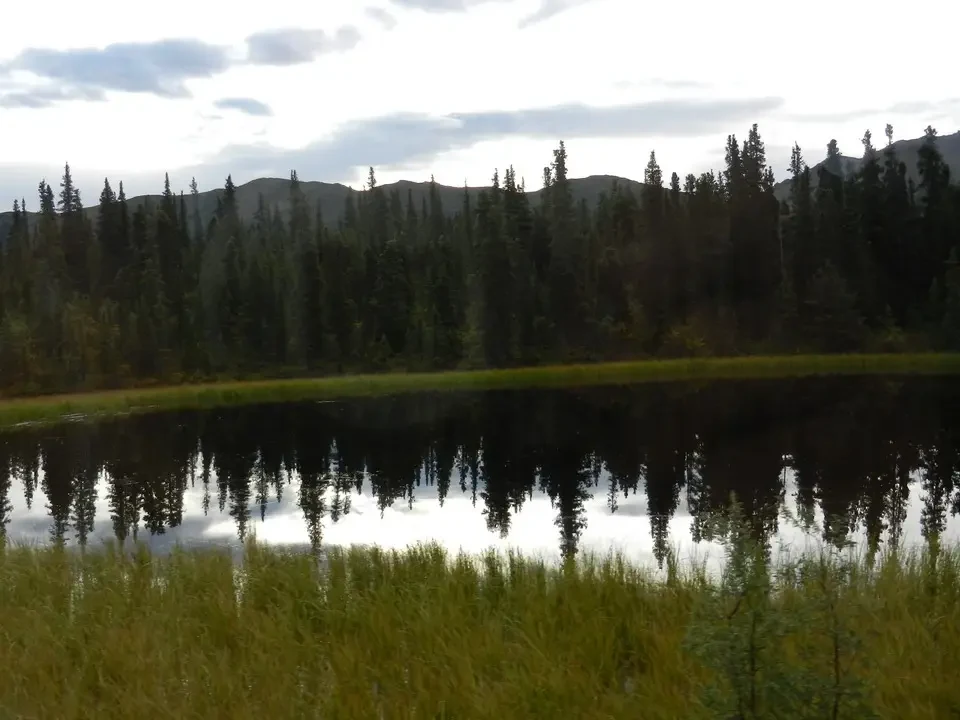
Everything we see was built with their own hands on the crest of a hill where the forest is king, and this explains the reason for the name Ridgetop Cabins. We thus find ourselves in the most distant little house, completely immersed in nature.
A presence in the woods
After dinner I go for a walk beyond our location and hear footsteps moving through the vegetation a few meters away. I try to understand what it is but I cannot make out the animal's silhouette. I back away calmly so as not to disturb or worse alarm the quadruped moving nearby, lest it be a bear. The next day, talking with Joyce, she tells us that it was most likely the female moose that occupies that territory and that at this moment has two calves. It is therefore better to stay away because in such a situation they can become aggressive.
The statistics say that every year moose kill more than bears, but these probably also take into account road accidents, where at night moose represent a real danger for motorists. Our experience in eastern Canada in 2004 is still well imprinted in the mind and probably will remain so for a while.
Bullet-riddled signs and Alaskan character
We notice that almost all road signs have been riddled with gunshots; in the following days we will learn that this is a typical trait of the Alaskan character, hunters accustomed to shooting at everything, if only for practice. This seems anomalous in a State where there is a strong sense of belonging and respect for what belongs to the public sphere.