Day 1
Anchorage Area
The adventure begins: arrival, north of Anchorage and the Mat-Su plain
Arrival in Anchorage
Although Alaska may seem distant and in fact the ten-hour time difference proves it, it only takes 8.5 hours to reach Anchorage from Frankfurt. The route heads decidedly north, skirting the Norwegian coast, then the Icelandic one to cross Greenland and reach northern Alaska passing over Canada. From here a crossing of all of Alaska to our destination in the south. A route made of ice and splendid colors, which even from ten thousand meters altitude shine as only the great North can show. The Condor flight is on time, reserving us a pleasant surprise just before arrival, namely the view of the Alaska Range with McKinley towering on our left. Not a bad start.
Entry into the USA and boot inspection
During the entry inspection into the USA they open the bag containing the hiking boots and find them dirty with soil. We think that showing up in the States with slightly soiled boots might mean at most a breach of etiquette, instead they temporarily seize them and have them washed in an adjacent room to return them to us after we were cordially questioned about where we had been with those shoes, in order to know if we were unwitting carriers of seeds at risk. Thus we begin our adventure with boots in perfect order. The whole thing costs us ten minutes of time but we leave the airport with footwear as good as new. We are in Alaska!
Eagle River and the red salmon
We transfer to the domestic flights terminal to go to Alamo where we pick up the car, a Chrysler of excellent build. There is a shuttle that goes back and forth from one terminal to the other, but we are energetic and walk with our suitcases in tow. The weather is very variable, every now and then a few drops fall amid patches of clear sky. Above all we see a certain stability of clouds over the Chugach Mountains, our first destination. We buy drinks and food at a service station, since in the coming days commercial establishments will be very scarce, or even nonexistent.
We head to Eagle River, 13 miles from the Glenn Hwy, in the heart of the Chugach Mountains, to see the red salmon that come to spawn. We cannot go beyond the viewpoint because the Albert Loop Trail is closed due to the risk of encounters with grizzlies, which at this time frequent the area to hunt salmon. The place is worth it for the view of the fish but it is not unforgettable.
Next we visit Thunder Bird Falls with a 2-mile round-trip walk to see a pleasant waterfall that can at most represent an opportunity for a day trip for the inhabitants of Anchorage.
Eklutna between lake, village and Russian memory
We return to take the Glenn Hwy again and go to Eklutna to see the Eklutna Lake State Recreation Area, a lake that manages to be beautiful even with the presence of clouds, which by reflecting prevent the surrounding mountains and glaciers from doing the same. As we approach the mountains the cover ends up prevailing over the blue sky that instead characterizes the plain.
We go to Eklutna Village Historical Park, where the Indian cemetery is located and there are also many graves with Russian names, clear evidence of the past of this area. Above the graves there are like little houses topped by Orthodox crosses, probably to give the idea of the deceased's new home, a clear symbol of the overlap between Indian and Russian customs. Certainly in case of fog it would take on the appearance of a sinister place inhabited by ghosts. Nearby there is a beautiful wooden Russian-Orthodox church (St. Nicholas Church).
A drive around the Indian village of Eklutna instead gives us a rather faded idea of the local population. Wooden houses with people intent on doing nothing with several vehicles and appliances rusting in total neglect.
Wasilla and the Iditarod myth
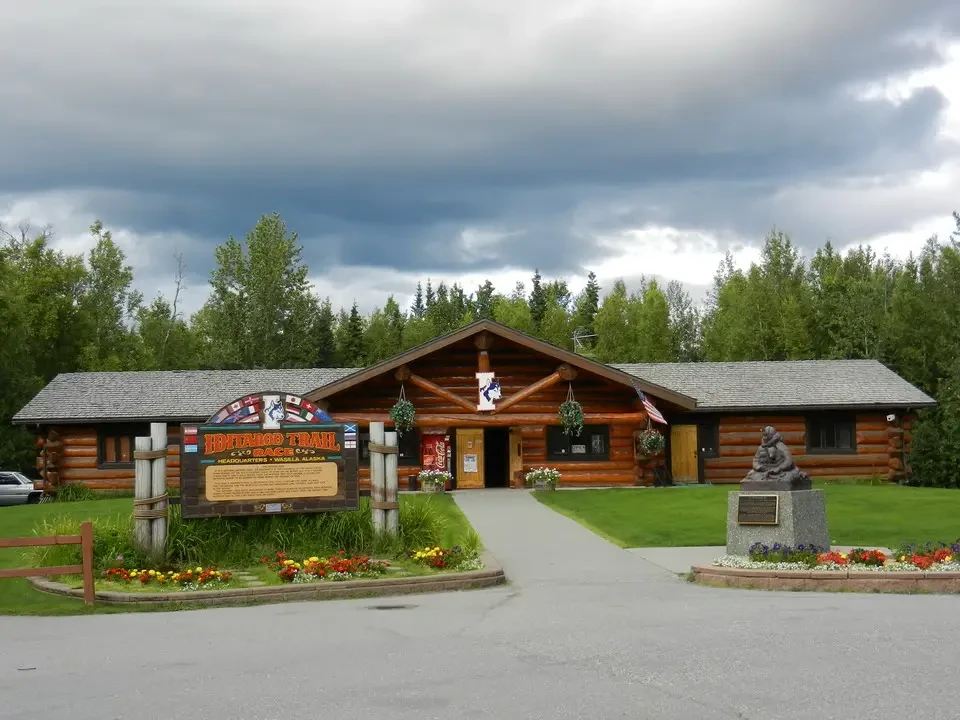
With all these commitments we manage to fight off sleep well, so much so that we move as far as Wasilla, hometown of Sarah Palin (Republican vice-presidential candidate with McCain against Obama). We visit the Iditarod Race Headquarters, headquarters of the organization for the famous 1,688 km dog sled race to Nome. In 1925 an epidemic of diphtheria broke out in Nome and there was no medical assistance. Being winter, 20 dog sled teams set off from Nenana and in 127 hours managed to deliver the serum that saved the city. The lead dog named Balto became a hero. Those who drive the sled are the mushers, the drivers. In memory of that race against time a sporting race was born that is one of the most followed events in Alaska with strong resonances also in the Lower 48 (the other states that make up the USA). For climatic reasons in recent years the race has started from Willow, located further north, but the organization and historical headquarters are here.
Palmer, dinner and first overnight
We move to Palmer in search of a place to rest. We find it at the Pioneer Motel, which also recommends a restaurant where we taste halibut. Too bad it is not licensed and we have to postpone the first appointment with Alaskan beer. Palmer is an agricultural center with a very particular history. It was born in 1935 from 203 families who came here from Michigan, Minnesota and Wisconsin due to the consequences of the 1929 crisis by virtue of an experiment that wanted to colonize new northern lands.
Evening in Palmer
After dinner we go to see the “outskirts” where prairies extend bordered by mountains. In this place are found the largest vegetable crops in the world. The short summer season accompanied by long hours of light makes agricultural production particularly rich and vegetables develop more than elsewhere.
We also see many buildings of a religious character. When we return it is 8:30 PM, corresponding in Italy to 6:30 AM the next morning, that is Ferragosto. We judge that for today we have resisted enough and we grant ourselves a well-deserved rest.
Overnight
Palmer – Hotel