

Day 1
Eastern Hajar
The adventure begins among the wadis.
Flight to Eastern Hajar
The overnight stay on the Oman Air flight from Milan to Muscat was not one of the most comfortable, but we finally arrived at the Omani capital at 6:30 AM, with a good half hour ahead of schedule. The airport has been recently renovated (in January 2018) and presents completely different conditions compared to what I saw just four years ago.
Having already arranged the visa online and paid the 5 OMR for it, we immediately proceed to passport control, where the process should not be particularly complicated. Once outside the passenger area, we purchase a SIM card for 5 OMR containing 5 GB of data and valid for 10 days; afterwards, we go to Europcar to pick up the off-road vehicle, which is quite nice. Pajero with just 16,000 km of life. Here, the process is slower and takes about half an hour to complete. The vehicle inspection before handover will also be very thorough. At this point, the country opens up to us, and by around 8:00 am we are ready to face it, fortunately with limited traffic, thanks to the holiday: it's Friday.
Arrival at Eastern Hajar
The itinerary includes a visit to the Jebel Hajar (mountains) eastern: We quickly discover that traveling in Oman is not so difficult: the lanes are wide and the traffic is generally quite orderly. Once you accept that on highways with 4 to 6 lanes, overtaking occurs equally on both sides. Nakhal (Nakhl) It is the first village marked on our action plan, with a tour around the interesting Built in 1650 which dominates the Batinah plain, one of the most interesting but currently closed for renovations. We thus come into contact with local life, with men peacefully engaged in conversation under the shade of lush acacia trees. A relaxing atmosphere that persists even on festive days, and we quickly learn the first lesson from the Omani people: stress should not be part of their DNA. Despite demonstrating attentiveness and efficiency in various situations, even in subsequent days, we will see how they are not particularly inclined to engage in relationships based on tension or raised voices. This is a measure against the heat that regularly grips the country, but we can only appreciate this attitude.
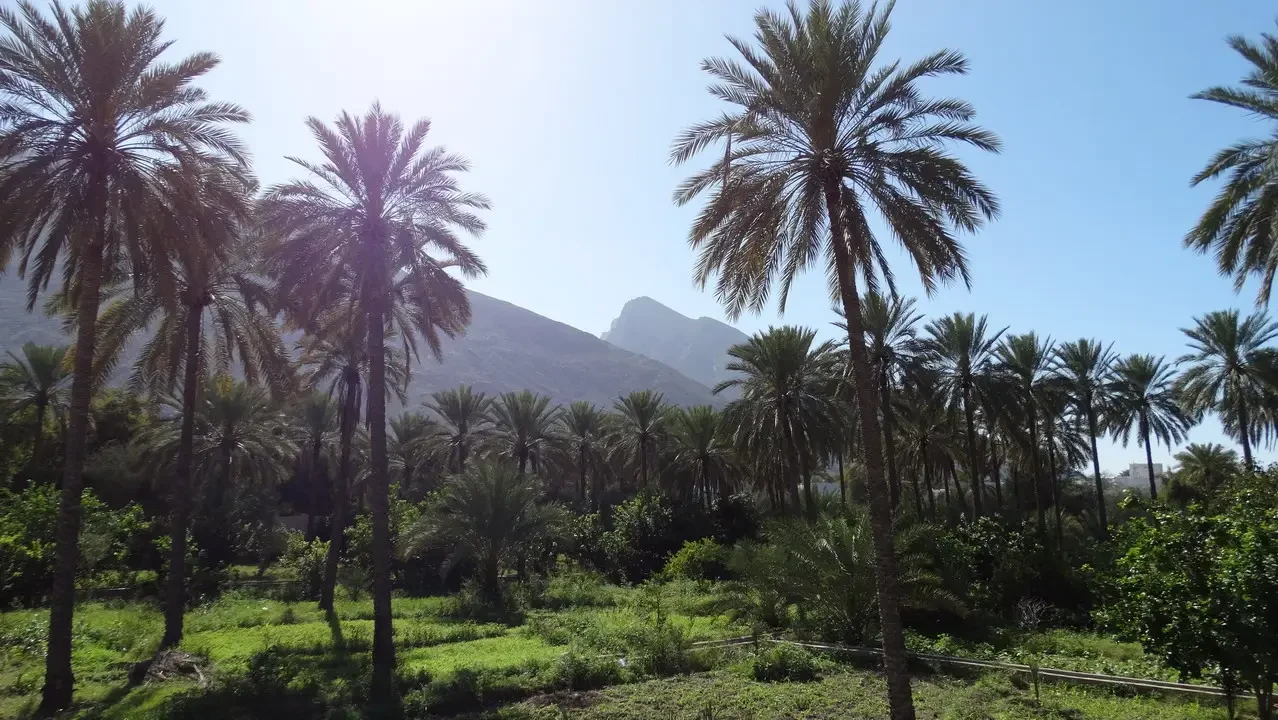
We haven't yet exchanged our money for Euros because doing so at the airport is not convenient, so we are waiting for the currency exchange to reopen. We stop at a supermarket to buy water and some food for lunch. At the location of Al Awaba Let's head towards a decidedly mountainous area, taking the unpaved road that runs along the valley floor. Wadi Bani Awf, one of the most spectacular in all of Oman. It is immediately clear that the year was particularly abundant with water, to such an extent that the walking route that winds through a gorge in the rock (the Little Snake Canyon(a crack from which the canyon begins) is instead home to a stream. It's still a beautiful scene worth capturing. Furthermore, there are villages, increasingly isolated, while the road becomes steeper, requiring a 4x4 and maximum attention when driving in an environment far removed from our usual surroundings: a dirt road, between a cliff on one side and a high rock wall on the other, we often find ourselves driving uphill, hoping that no other vehicle comes from the opposite direction. We get used to this situation, which ultimately turns out to be even fun, thanks to the respect that drivers have for their fellow adventurers. In some areas, where the terrain is less steep, you can occasionally see scattered villages, bordered by small streams of water and some palm trees offering valuable shade, all set against a Martian-like landscape. Not far from one of these, we even see a football field on artificial turf, almost as if to challenge nature that has placed this people in such an inhospitable environment. We finally reach the pre-determined spot for the final observation and a well-deserved lunch, with local bread and cheese eaten standing up but with a stunning view before us. We are at Bilad Sayt (photo), and then we head towards Al Hamra: but this area will be carefully explored in the coming days. There is also the option of returning to Rustaq via a different road, but we don't trust it much: no one passes through and it turns out to be very narrow with quite steep climbs. We are able to obtain this information thanks to the friendly approach of some guides who are taking groups of tourists around and do not hesitate to provide information to those who show interest in learning more about their country. We encounter many tourists, but few travel independently; most prefer to use a driver/guide, as many travelers are now quite elderly. During our trip, we will also meet many Western families with children, which confirms that Oman is a destination suitable for everyone.
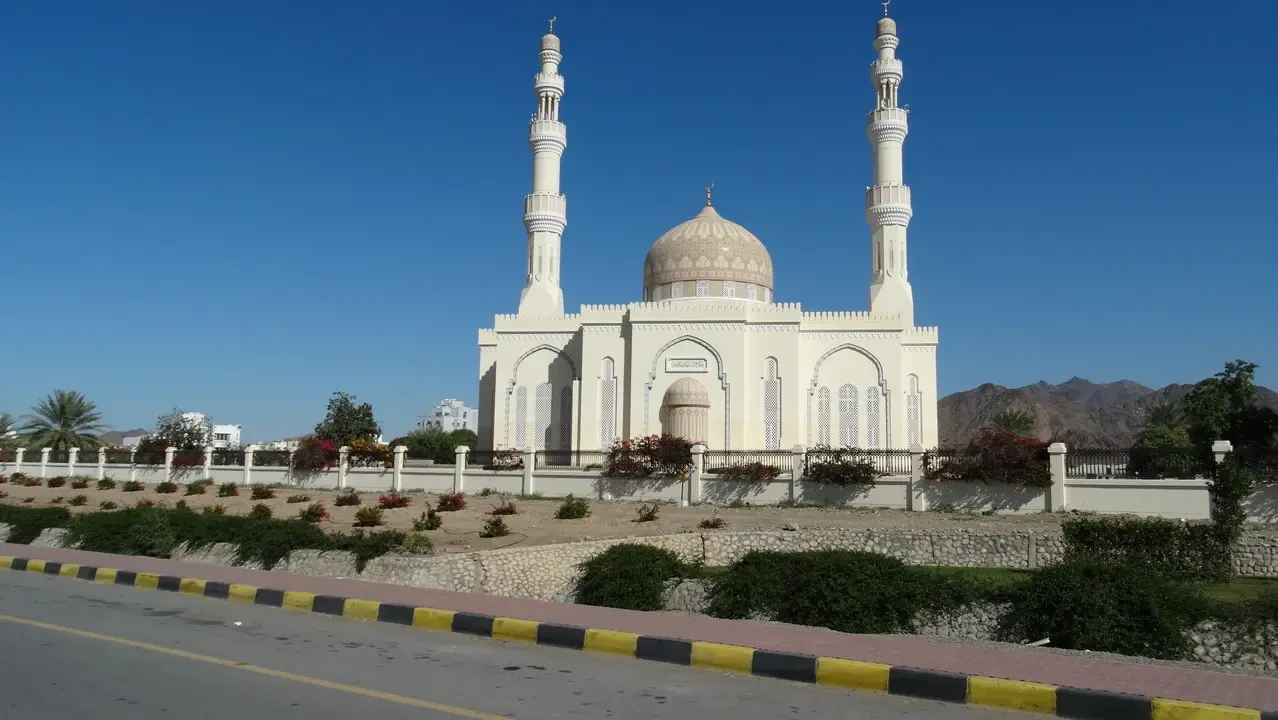
We carefully retrace the Wadi towards paved areas, passing through Rustaq, also here the location of a strong fort from the soft lines of raw bricks covered with a layer of cream-colored plaster, so much so that they seem part of a comic strip. As we descend along the highway leading to the sea, we encounter the typical festive traffic, to reach the small towns of Barka and Seeb... This is where the Sultan's residence is located, as the Mutrah Palace (in Muscat) is only used for receptions and official ceremonies. However, it is not far away, but the environment is definitely less urban, and even for the rulers, life must be less stressful. At this point, it is necessary to mention the aforementioned Sultan, or rather, the former one, as he passed away on January 10th. Unlike other politicians and rulers around the world, Qaboos was able to govern Oman with a firm but enlightened hand, balancing modernity with tradition perfectly. In essence, he did not fall prey to the extremism of building projects that characterized neighboring countries, nor did he succumb to obscurantist trends that characterized other countries bordering the Gulf. This balance allowed for consistent development, skillfully mediated by a religious vision closely linked to local culture, the Ibadite-style Islam. You can see this from the beginning when entering the capital, where the architecture adheres to traditional guidelines and buildings do not exceed a certain height: Muscat stretches along the coast for 50 km but there is not a single skyscraper in sight; on the contrary, it seems that building beyond 7 floors is prohibited.
We avoid the highway to explore small towns that are insignificant from a tourist perspective, but which offer us the opportunity to understand everyday life in Oman. In Seeb, we take a walk along the pier where you can find the beautiful small football pitch where children play happily and the touchline is marked by the movement of the waves. The market is lively despite being Friday.
As the sun is about to set behind the Jebel Hajar mountain range, we arrive at the capital, immediately admiring its elegant harmony, despite the rush hour traffic. We find the hotel without any difficulty, a quick check-in, and we are lucky enough to locate a local restaurant just a few hundred meters away, easily walkable. There are guided menus that allow us to sample various dishes of Omani cuisine in a decidedly typical setting: sitting on a rug with our backs against cushions surrounding the wall. In addition to sampling a variety of dishes, we also try the Dried Thunafish with rice and grilled calamari with bell peppers and onions. Afterwards, continuing on foot, we head to the mall, which could be found anywhere, with shops and brands fundamentally similar to ours (lots of Italian fashion, American food, etc.), hoping that one day they won't replace the famous and characteristic souks. There are no signs of this yet. We make some purchases and exchange currency for Rials. The first impression of Omani shops highlights a wide selection of fish (we had already suspected it and now have definitive proof), unleavened bread, and traditional sweets in the best Arab tradition, as well as juices of all kinds (given the prohibition of drinking alcohol, people find valid alternatives). There are fewer fizzy drinks, which also indicates a focus on healthy eating. The fruits and vegetables are good, considering that the country is self-sufficient in this area.
Along the route, there are small restaurants packed with local people watching an Omani football match: 7 hours by plane to see the same scenes and passions that we normally experience at home. Another interesting fact is the nearby entrance to a... private hospital: Similar chandeliers are difficult to find in 5-star hotels.
At this point, after almost 40 hours of being awake (or close to it), we simply can't go on with our current energy levels. The only thing that represents a dream come true is the thought of sleeping until tomorrow morning. The feeling experienced when you lie down on the mattress is quite unique: the body sends a signal to the brain indicating relief from the new position. We will indulge in it, but only for a few hours.


