Day 2
South of Muscat
Coast and wadis: water in all its forms.
Morning in Muscat
Falling asleep was definitely not an issue; waking up at 7 am to start the day, especially when it involves navigating, was more challenging. A quick and satisfying breakfast in our room, and then we hopped into our off-road vehicle for this Sunday, which is equivalent to Sunday for Omanis. We drove along Sultan Qaboos Street, a true highway filled with neatly mowed lawns and vibrant flowers lining the edges. The irrigation systems were working efficiently, taking advantage of the cool morning hours.
The temperature is extremely pleasant, with no clouds in sight and a range of 20 to 25 degrees Celsius throughout the morning. In the afternoon, temperatures can reach up to 30 degrees, but they will be well-ventilated and have relatively low humidity.
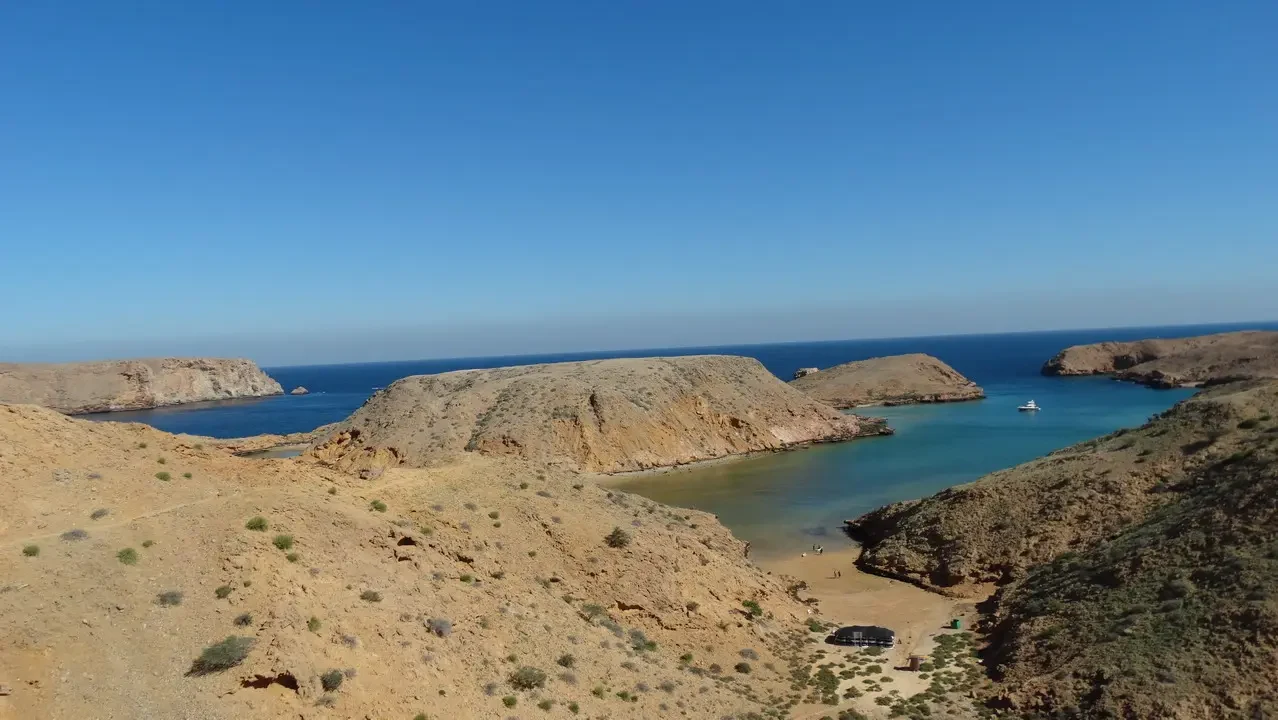
Today there are several stops planned, some quite far apart: of a natural, historical, or cultural nature, etc. The first is Bandar Jissah, which should represent a viewpoint actually turns out to be a resort where we sneak in without getting the memorable view we hoped for; however, the huge construction site could be useful for an engineering student. It will definitely go better for Bandar Khayran, here the environment is different; it's a village with a decidedly rural atmosphere, and we are greeted by a group of goats with long fur that appears very soft, while others in company with scrawny donkeys are grazing on the arid landscape along the road. Scattered among the simple houses are elderly people whose white robes match the color of their beards, which hang down from their chins. Both long, wrinkled, almost emphasizing their state of aging, and at the same time, they exude a certain charm of wisdom. Contrasts that don't contrast. We finally reach a small beach, surrounded by a khor, a sort of small fjord, equipped for fishermen who we see busy trying to make a living nearby. Reddish and porous walls rise above us as we walk along the steep slope of the valley, damaged by winter rains: they seem to climb all the way up to the sky before plunging into a pastel-colored sea. We also see a detour that invites us to quickly ascend a promontory, from which a color theory stunning. While returning, we spot a square with excellent views of the Al Bustan Parliament. We return a few kilometers into the southern part of Muscat to regain the internal road that cuts straight through the mountains and leads to Qurayat, a quiet village by the sea where life seems to flow without concern for the rest of the world. When the mountainous terrain makes it difficult for roads to pass, they are literally carved out for dozens of meters to allow their crossing almost flat. There are indeed some gentle slopes, but they are definitely much gentler and so insignificant that you don't need to accommodate the changes in altitude imposed by the mountains or build long tunnels.
The urban face of Muscat
Qurayat We were greeted in a very calm environment, thanks also to the fact that it was Saturday: we actually don't expect major differences in the peak hours of weekdays. It is a fairly large town and not easy to get around by car. A walk along the pier for some photos, while parents have fun with their children in a playground, and the view... a gentleman sitting in the shade of a palm tree while reading the Quran, it gives us an image that is worth more than a philosophy book. Here too, there are few women, a decidedly reserved attitude and connection to domestic activities. This low level of participation probably allows them to develop other intellectual skills, so many women have had successful careers and hold positions of higher status compared to Western women. From this point of view, we also note that it is not so much about discrimination as it is about cultural heritage; another theme is whether the whole thing can be shared or not.
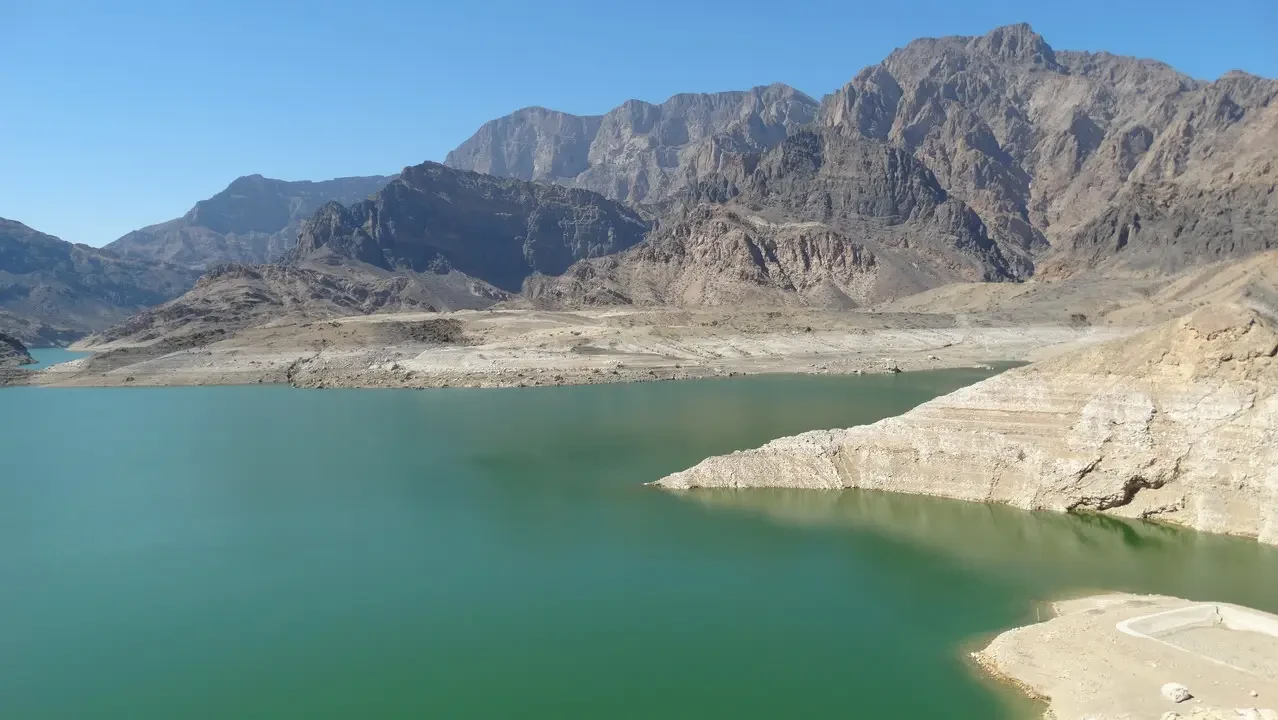
The next stop is Al Mazari to see the wonderful dam that overlooks the town, the Wadi Daykah DamIt is clearly a favorite destination for day trips by residents of the capital city. Everything is perfectly organized to accommodate picnics, with covered areas surrounded by precisely manicured lawns. The water is a perfect blue, into which red rocks are thrown, creating a frame. Given the availability of convenient picnic spots, we take advantage of them for a light meal, finishing with the delicious cheese purchased yesterday in Nakhal.
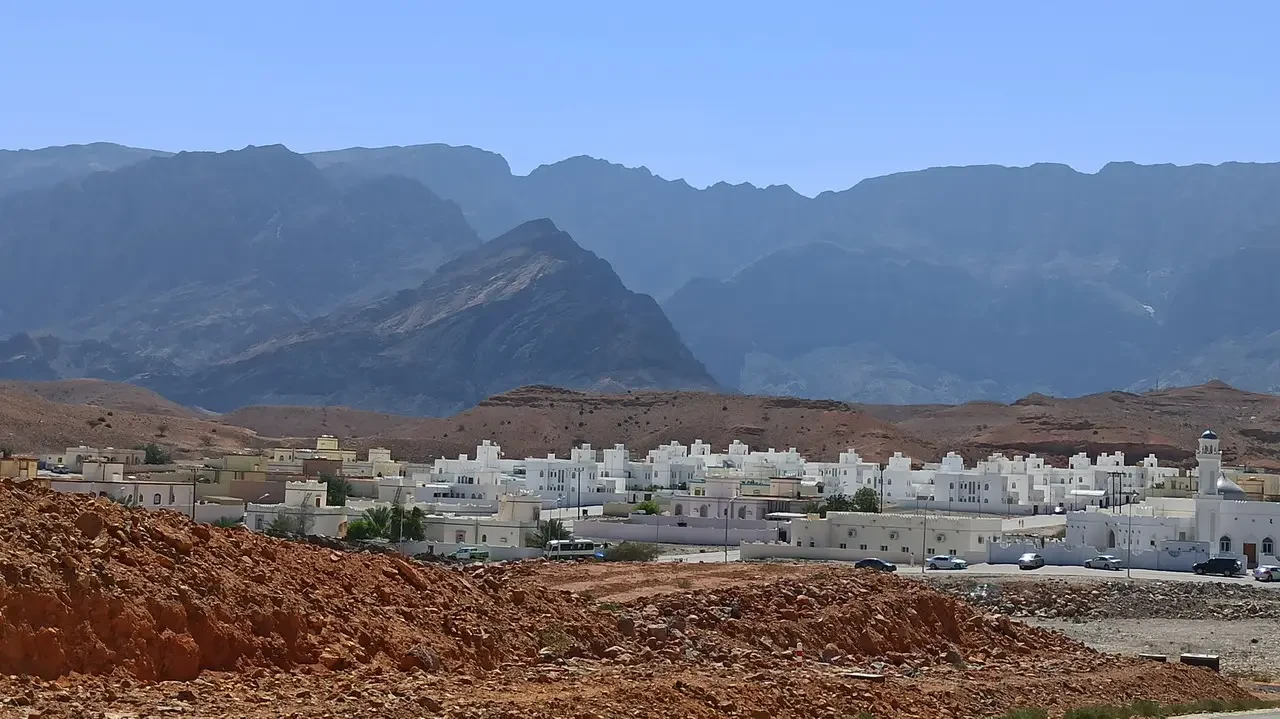
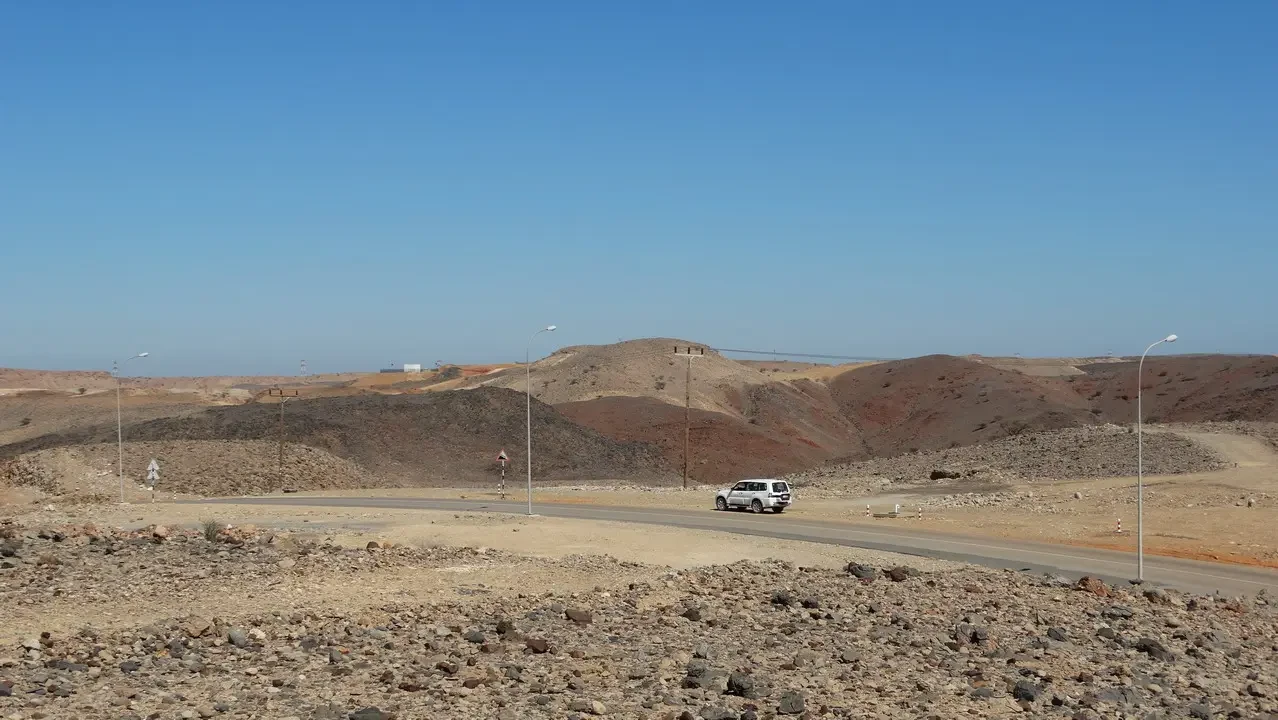
As we approached, we found ourselves facing the spectacle of white village of Asayh, with houses that we could describe as terraced villas, nestled like a gem amidst a profusion of red rocks. It's wonderful and unexpected, sparkling under the scorching sun with a sky that enhances its brilliance. Al Mazari will definitely be more historical, but we think a brief visit through the narrow streets between the rough brick houses, scattered without order, is sufficient to create a maze from which it is easy to escape because it is small. The traffic is almost non-existent, so there are no problems. Although it's not very evocative, it's useful for understanding how the entire country was before the reign of Qaboos: simple houses, unpaved roads and substantial isolation. It surprises us to see many cars parked at the entrance to the town, discovering that a funeral is taking place when we see a multitude of white robes (only men) inside a walled perimeter. The stones of the area reveal a geological aspects completely unique: while the outer surface is a dark, almost burnt-looking colour, similar to stones struck by lightning, what lies beneath takes on the typical reddish hue. This phenomenon is particularly noticeable when the road construction required cutting through some hills.
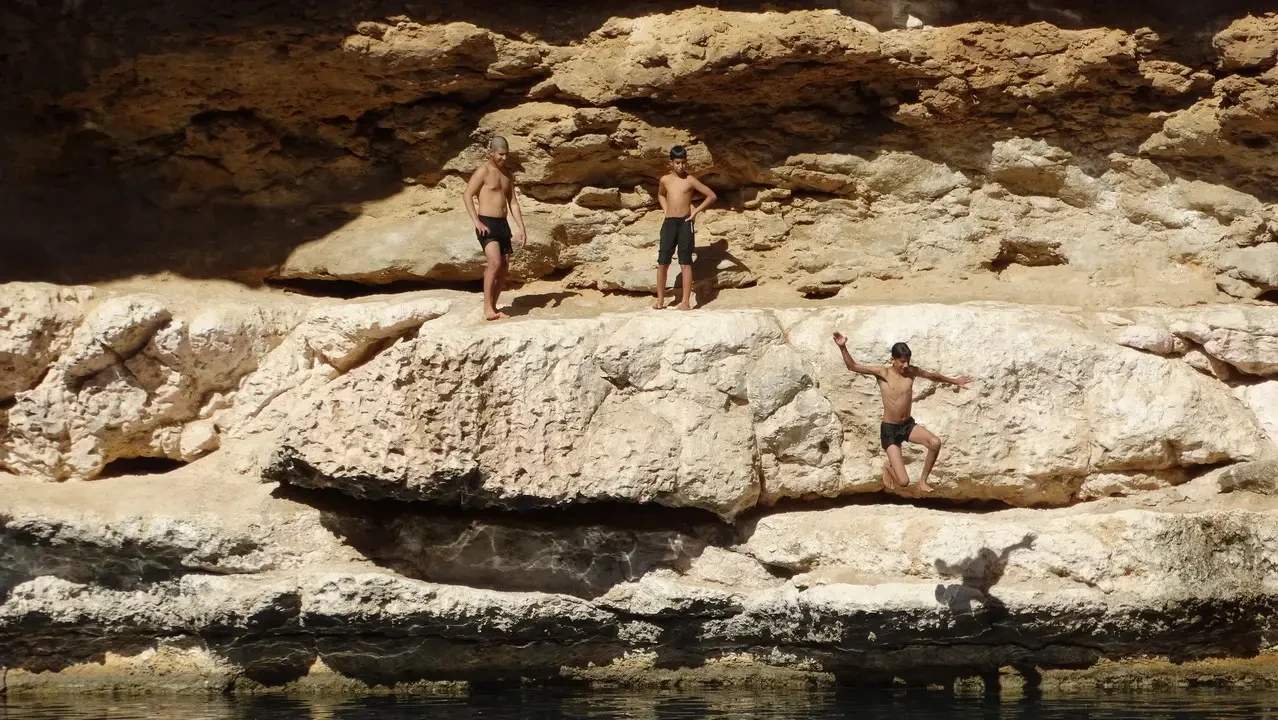
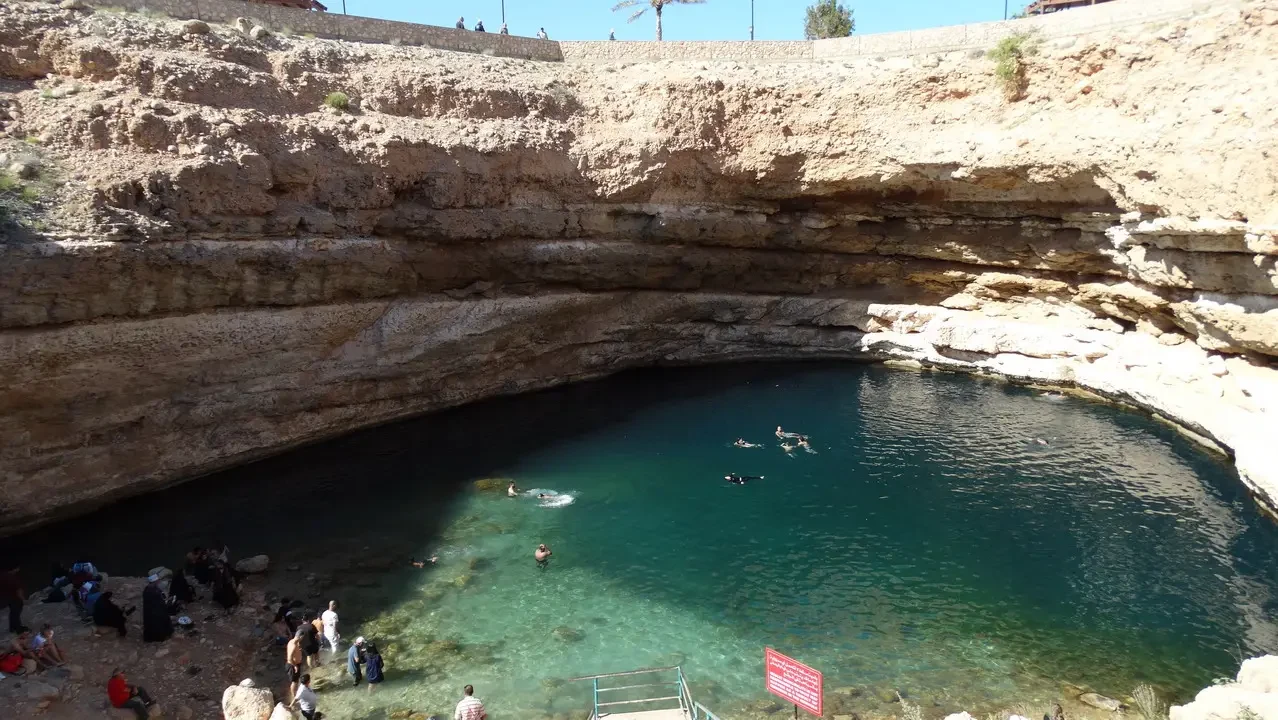
We return to our previous route, heading south to see... Bimmah Sinkhole (photo): it's a "hole" in the ground, just a few dozen meters from the sea, where people swim and young children become aspiring divers. It's a deep cylinder, several dozen meters long, with its roof having collapsed at some point, leaving this natural pool. The water appears dark from afar due to the underlying rocks, but becomes clear as you get closer. It's Saturday, and I can see groups of men here too. women separated as is customary, cheerfully framed by children.
Local wildlife
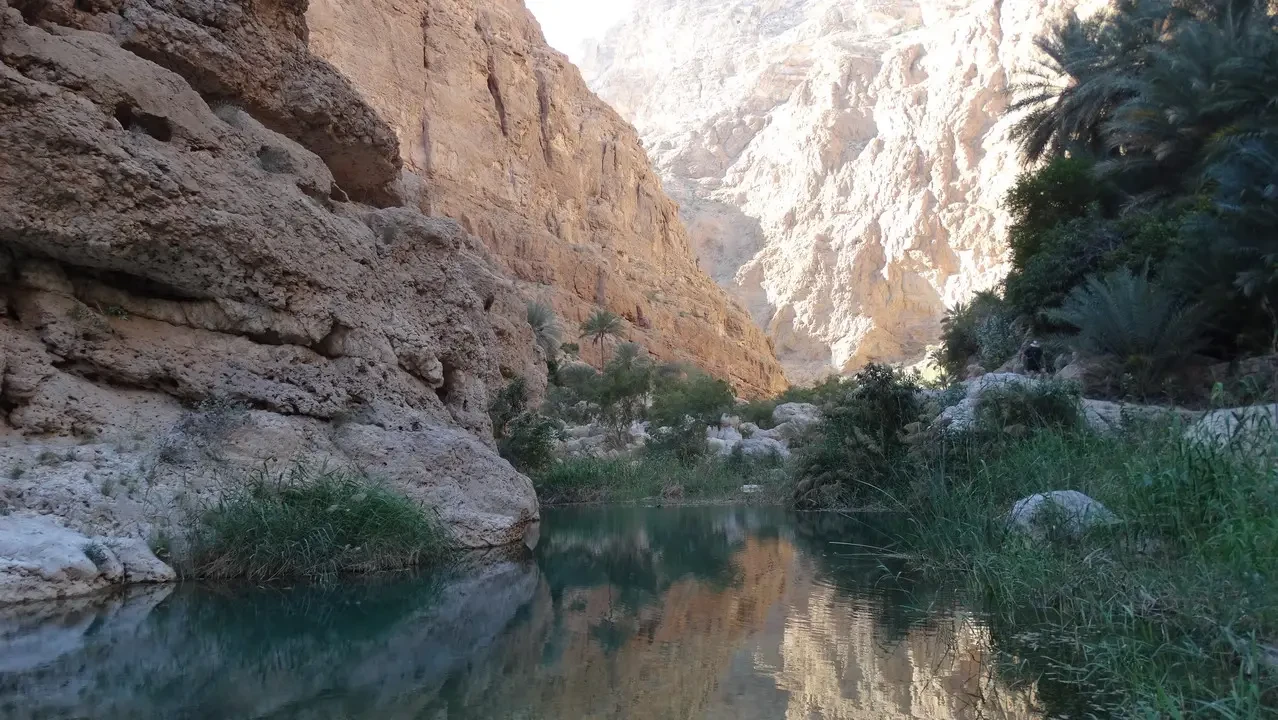
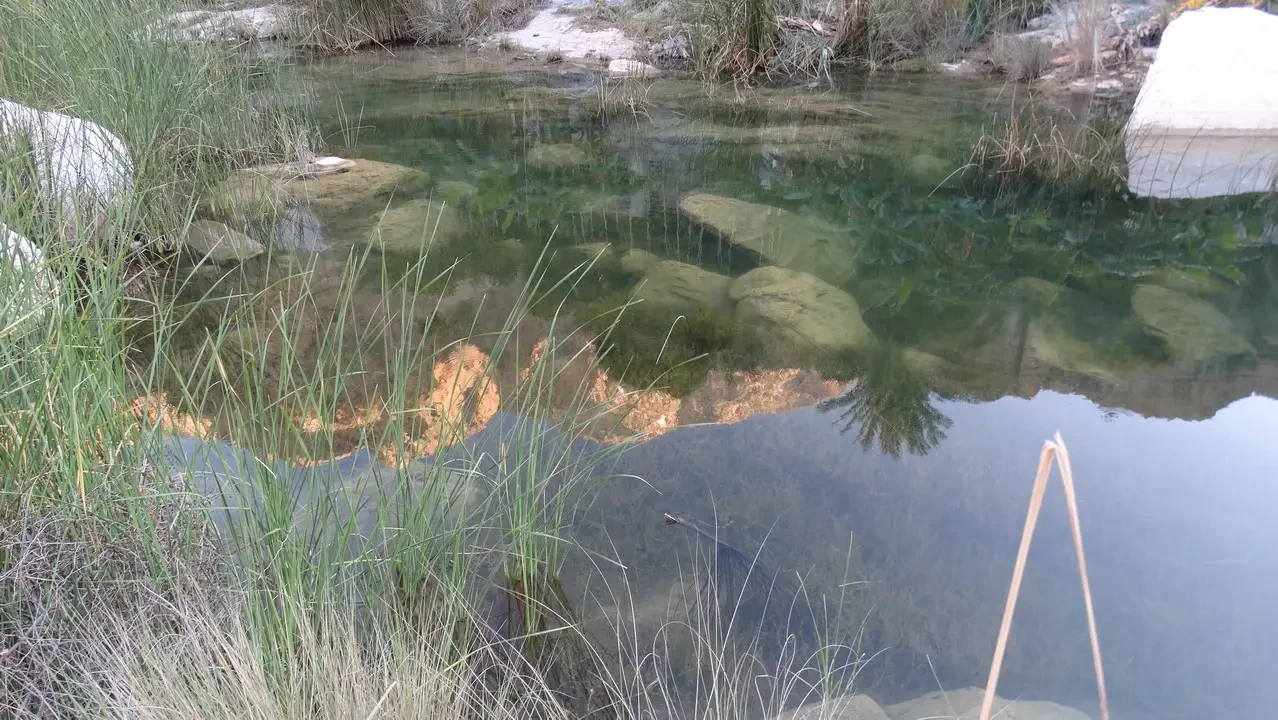
We arrive at the Wadi Shab (photo), which we cross in a motorboat near its end, when it is already close to the sea, ruined by the highway overpass connecting Muscat to Sur (although it would have been difficult to find alternative routes). Once on the other side, we walk along the bottom of the wadi, passing large rocks and crossing the stream that occasionally forms natural swimming pools. At first, we find fenced-off areas with date palms and vegetables, well connected to the water supply and mixed vegetation of reeds and palm trees, which later give way to increasingly rare patches of green. We walk for about an hour, crossing some passages that are also quite challenging between the steep wall and the jump that ends in the water. Along the route, we encounter well, irrigation channels that have served for centuries to bring water to the gardens and have made it possible to live in these places where otherwise the stone desert would have reigned unchallenged. At some point, the wadi turns left and opens up into some natural swimming pools, we believe this is the right time to start returning home, while the sun is now only illuminating the highest part of the walls making them even redder, if possible. The visitors are mostly Omani families, but there is also a greater presence of international tourists, as it is one of the must-sees for anyone visiting the country: note the presence of many Asians (Southeast Asia) and Americans. We take the boat that will quickly transport us to the shore where we left our car, after a visit that was definitely worthwhile, with steep walls that descend vertically into the wadi's bottom, which has essentially been carved and leveled by floods over the centuries. The stones encountered are large rocks that the water could not move, but only smooth, as well as human perseverance has skillfully tapped into the main form of life to create a civilization. The falajs, although now made of concrete, still make a better impression than the polyethylene pipes, but it is important to understand that development comes at a price in terms of compromises. Now the ponds reflect only more walls in shadow, and it would be worth quickly visiting the Wadi Tiwi: (photo) we continue for several kilometers off-road, daring to navigate through the narrow streets of a small village. From here, we reach a point where we need to cross the stream and then proceed on foot or by car along a steep and narrow road. Both options are inconvenient as it's time to return, and walking would mean spending a lot of time while getting completely covered in dust. Driving with the Pajero would be a continuous and dangerous attempt to avoid those descending down the narrow dirt road. We simply take some photos and head back. Qalhat... where there's nothing to see: and perhaps that's precisely its charm, along with the fact that Marco Polo and Ibn Battutah passed through it in ancient times. But everything seems to have stopped as these two famous travelers would have seen it: it's a ghost village, some elderly people are waiting on the doorstep for time to pass, the salty air seeps into the narrow streets lined with houses scattered haphazardly, as is traditional. It's also difficult to find someone to talk to and ask for information about the place. The guide says that the renovations may not have been completed, but we found that they haven't even started. However, there is a silence rich in history, it seems like a time machine has activated and brought us right here, where fishermen and merchants once made the country wealthy, hundreds of years ago, as if browsing through a history book. There must have been wealth in this area, you can see it from the appearance of the houses, even though they are in ruins. Lace and decorations everywhere on crumbling walls, a clear sign of abandonment, some houses are already overgrown with bushes, the windows look like toothless mouths, life has gone elsewhere. To wake up all you have to do is raise your eyes towards the mountain and see the viaducts of the highway that we will soon travel along in the direction of the nearby Sur: it represents the only means of communication as there is no coastal road or it is limited to a path.
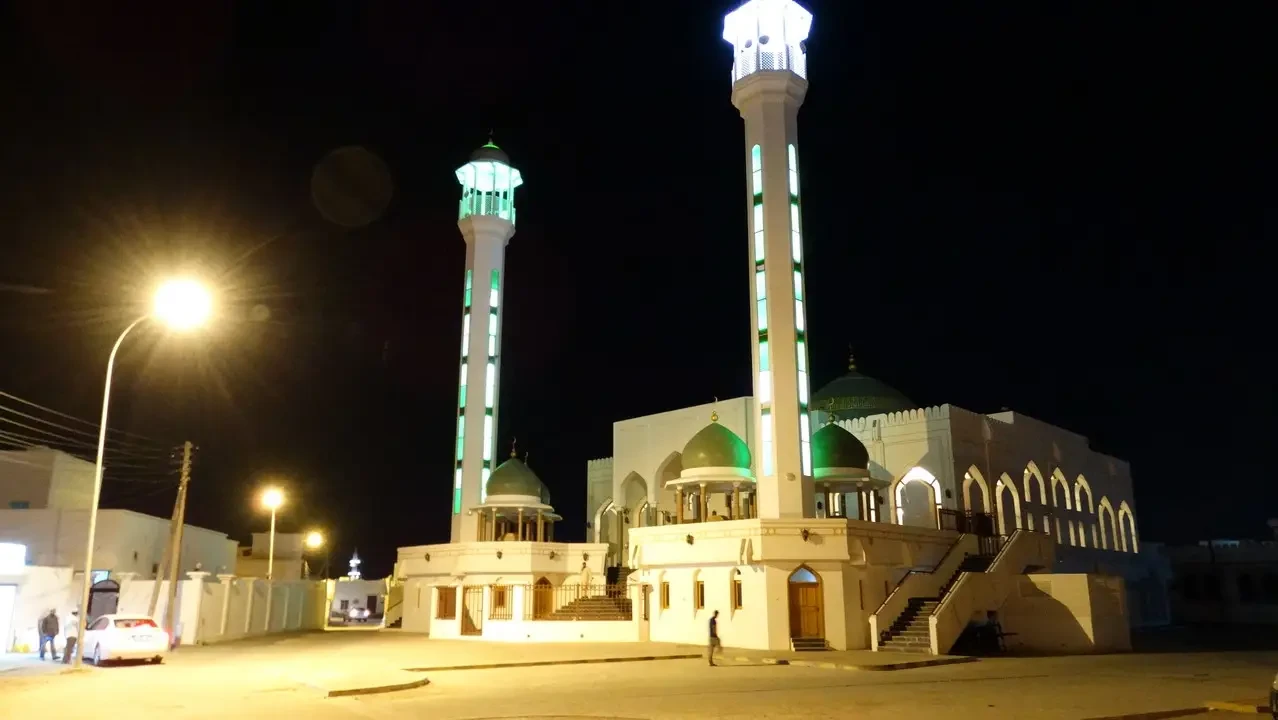
Sur We are greeted when the sunset has already occurred, the hotel is located outside the city center but is comfortable. We go into town for dinner where we enjoy some delicious food. excellent fish We discover that it is a town of considerable size, and the center is very chaotic even during these evening hours. A walk to see the illuminated mosque might be enough for today.