Day 6
Muscat
The peace of Misfat, the balance of Muscat and the modernity of Abu Dhabi all in one day.
Morning in Muscat
We wake up thinking that if today I open my eyes and see a charming and peaceful village, tonight I will close them inside a concrete tower in the chaotic Abu Dhabi. There couldn't be a greater contrast, but to form an opinion, you need to see a bit of everything, and challenging yourself occasionally means plunging into the midst of a modern city.
After yesterday's busy day, today we are going to... breakfast with calm in the small room with a view of the guesthouse, not before having satisfied my soul by admiring the sunrise and enjoying it from that botanical garden which is the palm grove. In the area between two neighborhoods of Misfat, a stream flows, sheltered from the scorching sun and along a slope where abundant springs are clearly visible. A small forest has thus emerged, which wise farmers have cultivated and irrigated to obtain abundant harvests of dates, and in what we will call the undergrowth, the vegetables necessary for daily consumption. It is beautiful to visit on foot, following a short path marked with white, yellow, and red notches on the rocks, amidst the falajs and the bathtubs used for containment and washing.
The The sun rises From the rugged peaks of the Hajar mountains, heading towards Muscat, we find ourselves subtly nestled among the foliage. Within a few minutes, paradise is revealed and it feels as though we are in the classic tropical environment. We are indeed in the tropics, but with a desert-like feel, and it must be difficult to find such abundance anywhere else in the Arabian Peninsula, except perhaps in Dhofar, where monsoon rains create conditions similar to those of humid areas around the globe. Breakfast is a delightful surprise, and the atmosphere of the place completes the experience. Time seems to have stopped, but we need to get moving; it's already 8:30 when we say goodbye to the friendly managers and set off for Muscat; after a few minutes, we are already parked up, admiring the wonderful view from a hill overlooking the plain of Al Hamra and more. The whole scene is slightly hazy due to the morning fog, which reflects sunlight in its own way. Now we really need to go and cover the 200 km that separate us from the capital. The highway runs peacefully through a wide valley of the Hajar mountains, passing through Nizwa and continuing with little traffic until Muscat, where we take the Expressway to... Mutrah.
The urban face of Muscat
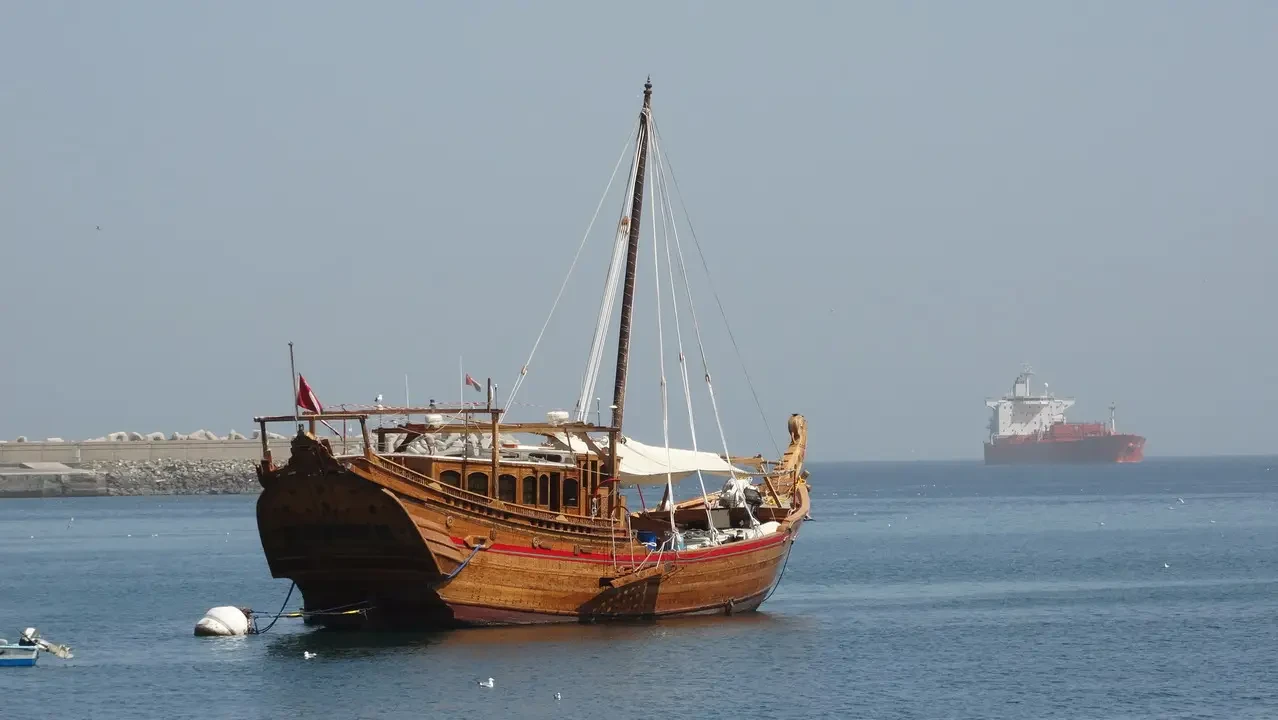
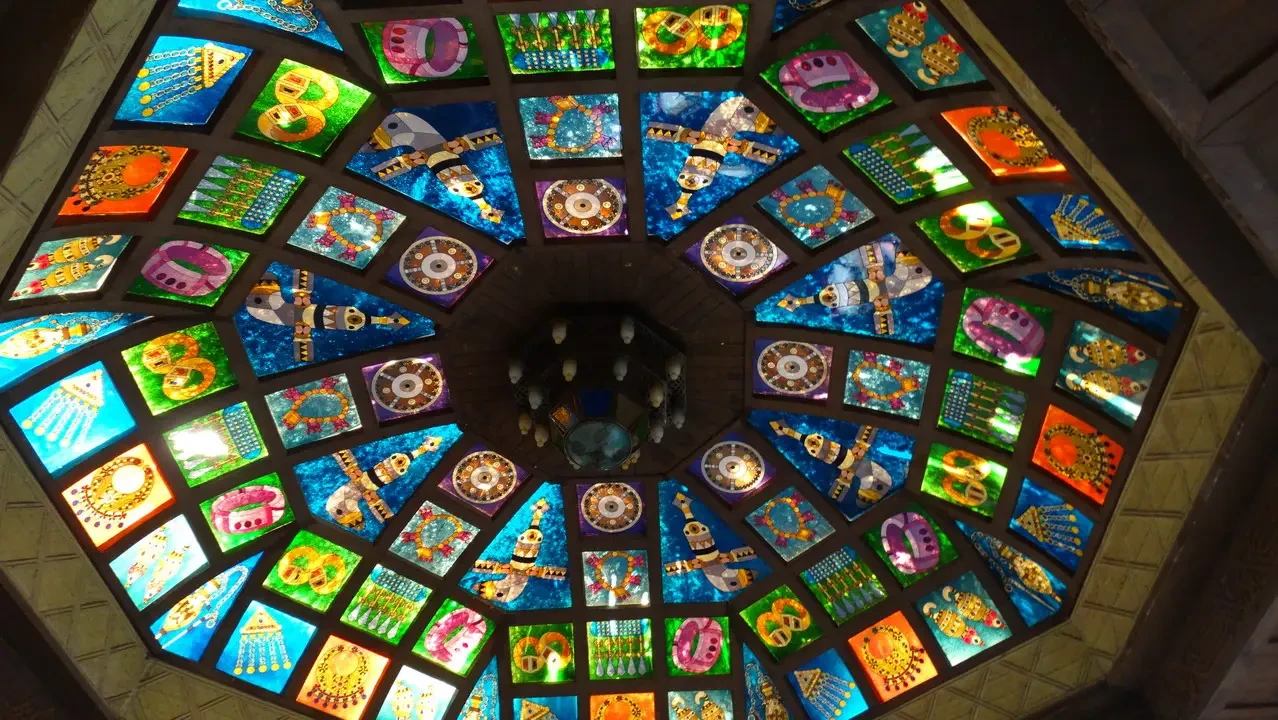
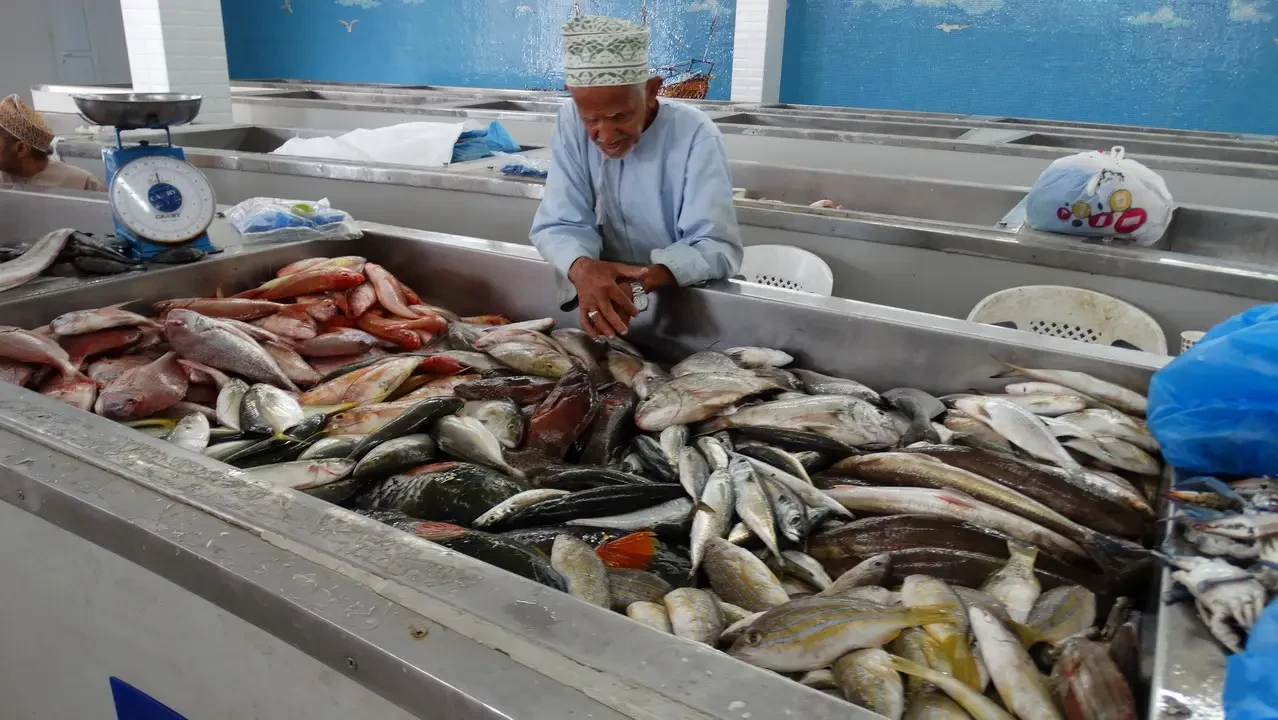
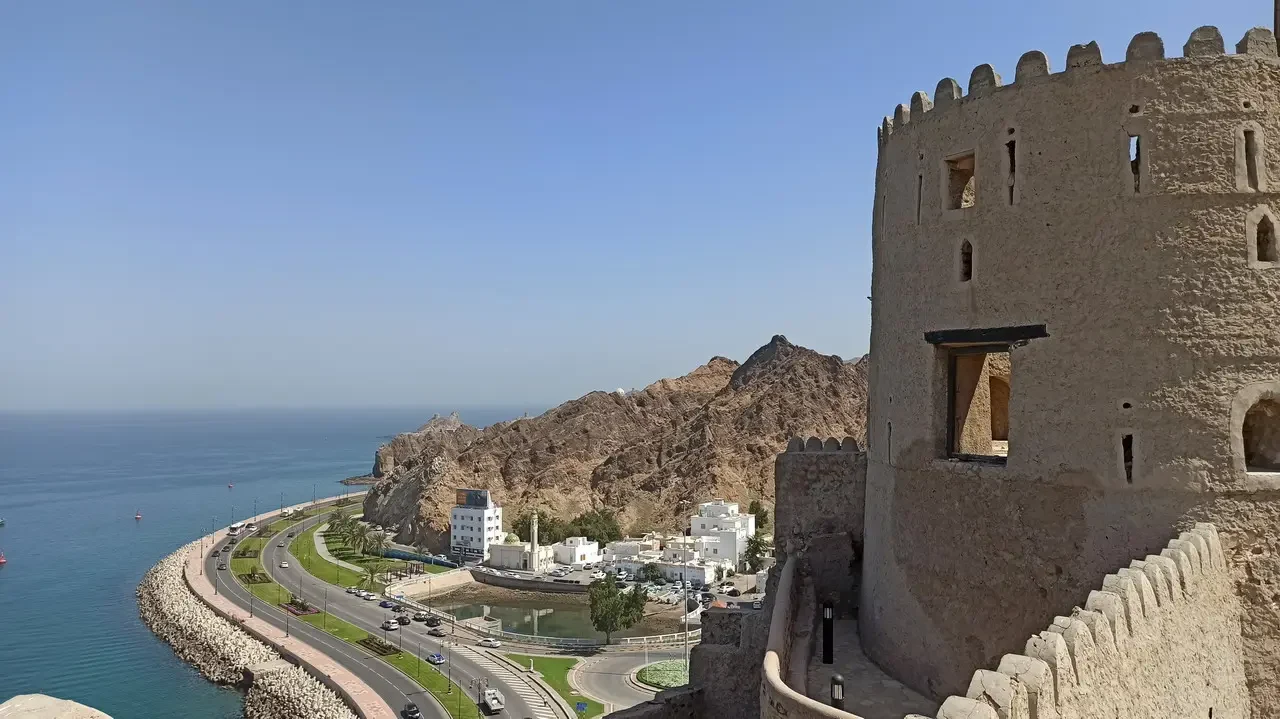
Here we find easy parking in the city center, actually too easy because we don't realize it's a paid zone and when we return, we find a nice fine of 10 OMR (approximately €23) on the windshield. It was pointless to try to pay it: as we are not the owners of the vehicle, it will be sent to the rental company and charged later. We cross the street to go see the beautiful fish market, a place that is attractive both for its views and for the taste buds. Everything is very well organized, with particular attention to hygiene. In addition to the variety of fish among which many yellow-fin tuna, some small ones stand out sharks(there are several recipes that include them) and races Also of large sizes. It's nice to look up from the displayed product and observe the social context and negotiations: it seems like everyone knows each other, and that's probably the case. They talk constantly, it's unclear whether they're talking about fish, price, or something else. At some point, an agreement is reached, they shake hands, and the deal is done. It's customary among Omanis to shake hands even when you don't know each other, and the meeting is casual. Speaking of meetings, just before we entered the market, we asked a peaceful gentleman for some information to help us navigate Mutrah, which led to a long and fruitful conversation that went far beyond our initial intentions. He accompanied us to the dock where the fishermen were loading the fish onto stretchers ...and they bring them to the aluminum stalls at the market, so we also have the opportunity to see the Sultan's yacht, which is destined to become a museum, and another that will be used for ceremonial occasions. In the meantime, we discuss current affairs and are told how Oman has managed to develop while navigating the pressures of foreign powers in a region where one would first fire artillery and then think about it. Simply finding a satisfied citizen with their government would be like finding a white fly in our country; here, they praise it convincingly and probably for good reason. We also address the sensitive issue of religion: without controversy, they tell us that the teachings of the Quran are very clear, and that waging war in its name is sacrilegious, seen as a opportunistic political strategy aimed at exploiting the ignorant to sacrifice themselves in its name. But those who have read it should not find reasons to practice violent methods. The Ibadi branch followed in Oman is indeed conservative in terms of customs but – and we can clearly see this before us – the freedoms enjoyed are many. Perhaps it is a system that allows and controls the aggregation in the face of the strong temptations of the modern world. To achieve this goal, education and generally an education based on established principles are also necessary, such as those that prevent deviations such as crime and terrorism. The Sultan used to say in contrast to other wealthy countries in the region that First, it is necessary to build the people and only then to build the country., referring to buildings. His teachings will likely be followed by the new ruler, and this is also because his philosophy seems to have become ingrained in the Omani population. Faced with such words, whose truth we were able to verify in the previous days, we would have spent the entire day listening and asking further questions. But the schedule indicates that we should continue. So, although with regret, we say goodbye to this friend we met by chance and continue walking along the Corniche, keeping an eye on the beautiful houses whose lace-like decorations seem to be made of intricate patterns, while anchored in the bay are the painted, glossy wooden boats. traditional sailing vessel It takes us back a few centuries. A walk of a couple of hundred meters leads to the entrance of the market passing by in front of the mosque …and in the Shia district. Here, entry is not permitted as the locals do not welcome visitors; it seems they are Persian merchants who established an enclave here during the age of maritime trade. They are respected, but prefer to keep to themselves. Right next door, however, is the bustling souk area, one of the most beautiful, with elaborately decorated vaulted ceilings and shops selling all kinds of products and vibrant colors. The first part is clearly geared towards tourists: a Spanish cruise ship must be docked here, and it feels like being on an indoor promenade: you can buy fake Omani gadgets and trinkets. As we move along, the products are less interesting for tourists, but the market takes on a more authentic dimension, and you can see the real negotiations between women and merchants. The sun is getting hotter and more direct on our heads, but to enjoy a panoramic view, you have to climb the stairs that lead to… strong, we don't let it scare us and reach it satisfied with the small investment, which has been paid back by a amazing view: We start from the arch designed by the coastal road with white houses illuminated by the sun on one side, and head towards the seaside road interspersed with a green lawn that leads to the old town on the other, passing through the interesting fort where we are, which was built to protect Muscat from occasional attacks by sea. A strategic location that has essentially become ideal for taking beautiful photos, aided by the wonderful weather. On our way back, we pass by the souk again to see the part dedicated to gold. Without much protection, the shop windows display jewelry of all kinds, up to heavy necklaces or even crowns. To us, it all seems a bit tacky, but it's because we are looking at jewelry made of pure gold.
Muscat is surrounded by hills, which are indeed dry but perfectly complement the greenery present in the city. Flowers, meadows and trees everywhere, showcasing an opulent yet measured beauty. We become aware of all this when we move to...Old Town... where the impressive Sultan's Palace (Alam Palace) is located, which is stunning and surrounded by spacious gardens with lawns and flowers. Qaboos preferred to reside in Seeb, using this location only for official meetings. There were also flags at half-mast due to the official mourning. The entire area is used for administrative activities, but there is also a historical section with forts. Al Jalali and Mirani and a couple of museums. We also see the main entrance in the city that now serves as a decorative element, but which was regularly closed in the evenings until the early 1970s to isolate the old town from the rest of the country.
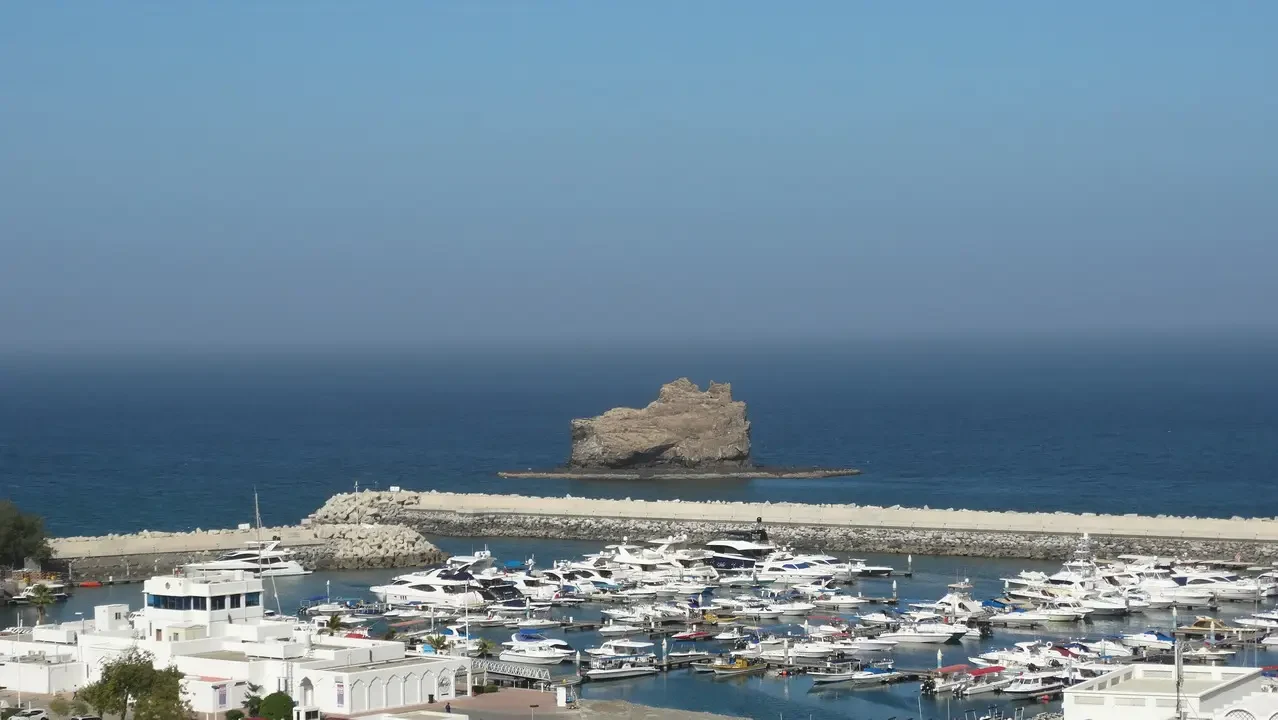
We continue south, not far from a rugged coastline of rocks that slope down to the sea. Here, beaches are rare, and the coves have been used as settlements that have taken advantage of the sheltered location. Al Bustan, where the famous hotel is located. Palace, a luxurious hotel among the most opulent in the Middle East and the Parliament, united by a beautiful, flower-filled roundabout at the center of which stands the copy of a dhow Medieval. All of this is certainly fanciful and would probably seem out of place in the West, but the reality is that it never falls into cliché. Perhaps we are already predisposed to think that we are in the land of a Thousand and One Nights.
A fresh fruit juice with ice cream will be our lunch, but all these amazing constructions shouldn't make us forget that we have a flight tonight and it's best to go to the airport early, leaving the off-road vehicle after checking it thoroughly. They even want to charge us 5 OMR for extra cleaning, which is expected if the car is returned particularly dirty; let's politely ask them not to take advantage of this situation because the car should be cleaned as it logically should be after 10 days of use, but it's not in a particular condition that requires extra treatment. At this point, we can go to the United Arab Emirates, specifically to Abu Dhabi.
MCT – AUH 19:00 – 20:15
Flight to Muscat
We are flying with Salam Air, a low-cost airline affiliated with Oman Air, without any problems but with some delays at the time of landing. Everything seems to be going smoothly when I am stopped at passport control and handed over to a military officer who accompanies me to a waiting room along with several large Arab women. My passport is taken and is in an office for further checks. Time passes as quickly as a large stone rolling down a hill, and after about ten minutes I start wondering what I might have done wrong to be detained. It's true that there is an Iranian visa, but this should not cause any problems. There is no trace of my two-week business trip to Israel on the passport, so I decide to reassure myself because if I haven't done anything, they can't do anything to me. It's just a frustrating waste of time that resolves itself in thirty minutes when I receive the document duly stamped with an invitation to leave. I don't let them praise me and, in short, we go to pick up the car – a nice Yaris – from Hertz. From there, we arrive at the hotel when it is already 10:30 PM. Quick check-in and immediately to the restaurant, which closes shortly after. We also can't linger during dinner because it's best to renew the visa for re-entry into Oman, and the lounge closes at 11:30 PM.
Before departing, we had actually obtained the visa online (at a cost of 5 OMR) for entry, as the one-year validity option costs 50. After asking the efficient contact on the website, we were informed that it was more convenient to obtain another one before returning from the United Arab Emirates rather than spending all that money; the only risk is that obtaining the visa at the airport upon return would take a considerable amount of time in line. And we couldn't do that in advance because you need to first leave the country to apply for a new visa, which is also understandable. At this point, we closed the first chapter of our Omani trip and can now start another one. We appropriately brought a USB drive with photos and a copy of our passport, so we are now able to complete the application. Yes, we did forget the password, but we have requested a new one, and access is quickly restored. A couple of hours later, we receive an email with the attachment that allows us to re-enter the Sultanate, which is not insignificant since the flight to Italy departs from Muscat. The next day, we will print it at reception, and we can be sure for the next few days.
Now it's finally time to go to sleep after the elevator brought us to the 24th floor with a great view of the capital city's skyline in the Emirates. No need for anything else to help me fall asleep, I was already half-asleep.