Day 4
Lhasa I
Lhasa: an unforgettable experience – visiting the Potala Palace
Arrival in Lhasa and Muslim quarter
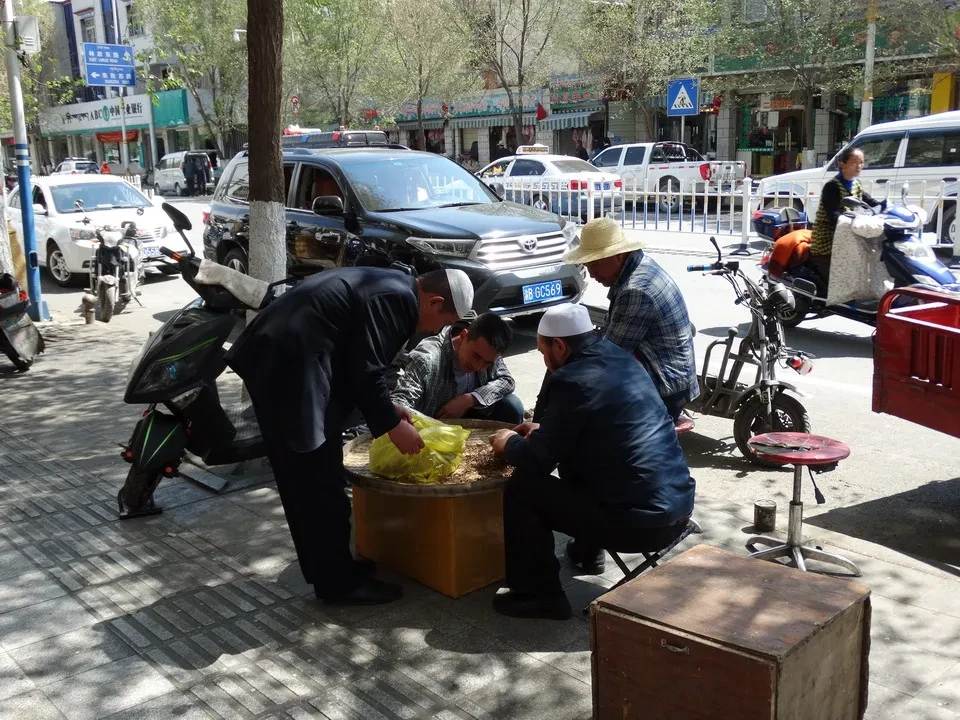
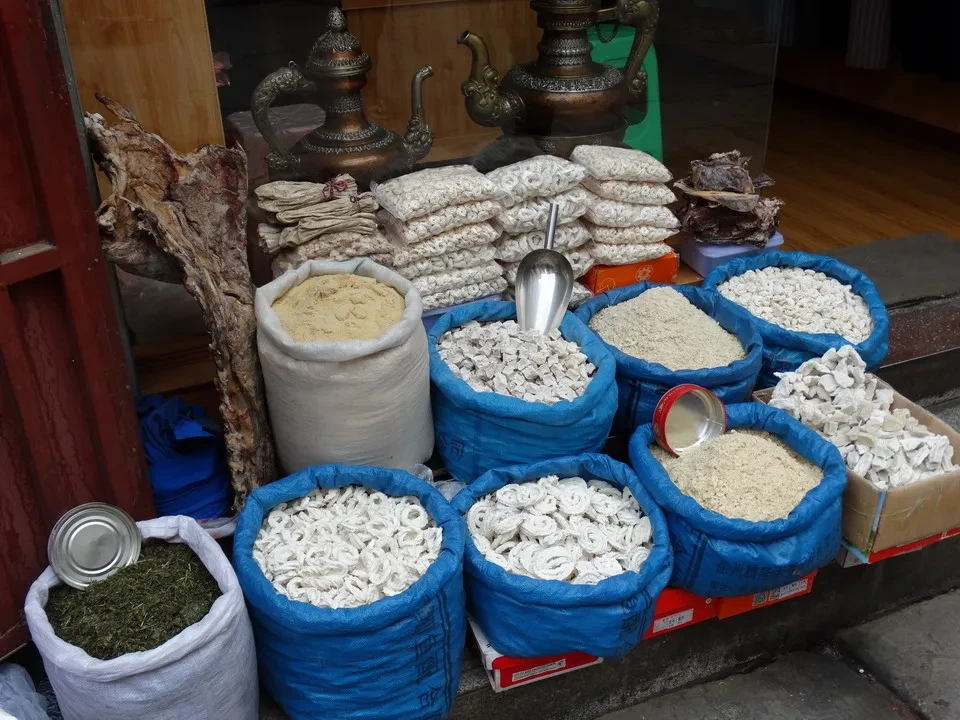
The alarm goes off at 3:30 am, thankfully we no longer have the hotel staff banging on the door, and without breakfast, an hour later the bus arrives to take us to the airport, passing through the city streets which are already starting to fill with traffic. The flight was smooth and we arrived in the modern Lhasa airport around 9 am. Our guide and the driver of the Transit minibus were waiting for us. We loaded our luggage onto a truck and received the usual welcome with the traditional white scarves, the khata, and a group photo before heading to the hotel. There was no time to waste; we needed to make up for lost time. In the three-quarters of an hour drive to the city, we noticed how construction continued without stopping, creating neighborhoods of rectangular buildings intended to house Chinese people who had been relocated to the plateau or Tibetan farmers who had been removed from agriculture. From this perspective, Lhasa had become like any other Chinese city: modern and soulless. This is even more pronounced when referring to the center of a religious confession. While the guide registered our arrival with the authorities, we took a short tour. The hotel was located in the Muslim quarter, which we had noticed immediately upon arrival due to the numerous butcher shops. Buddhists do not kill animals for food and "delegate" this unpleasant task to people from other religions who are less scrupulous. As a result, along with a group of other shops, we… Islamic zone There should be stalls with thick pieces of meat on display, especially yaks. Other shops offer dried mushrooms, spices and various herbs, to finish with the so-called noodles: These are actually worms that, in a certain season, burrow into the ground and, as they dry out, end up looking like roots. They seem to only grow above 5,000 meters, and their therapeutic properties are truly unique. The high prices provide further evidence of this. Even though the owner of the hotel where we are staying is a Nepalese whose origins come from Kashmir, the population of the neighborhood is predominantly Hui, an Islamic ethnic group that has been present in China for over a thousand years, well integrated and primarily dedicated to commerce, which has historically been their area of expertise. In the neighborhood, you can see many men wearing traditional white hats and women wearing veils. Two beautiful mosques They are located nearby, while during the rare moments of evening and morning silence, the call to prayer rings out. This is the Islam that we all wish to see and admire.
Barkhor and Potala Palace
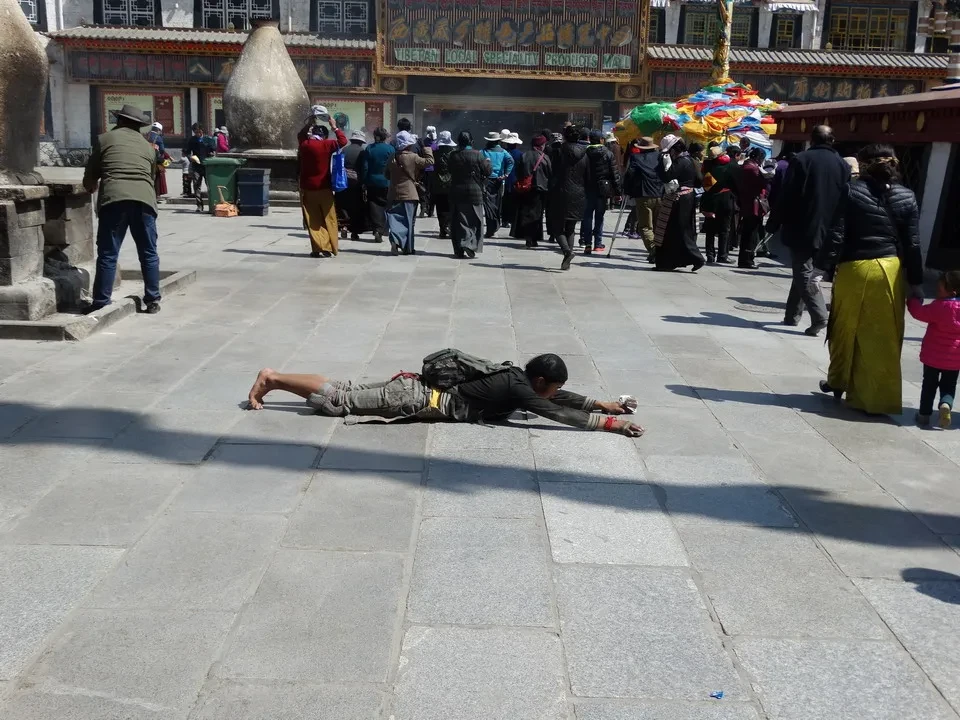
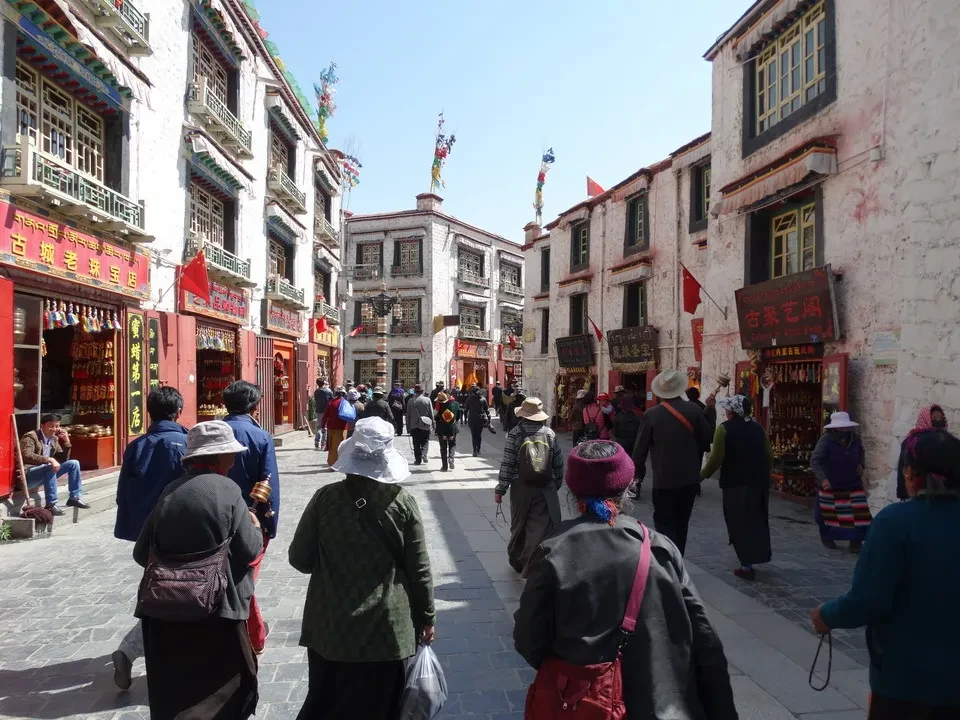
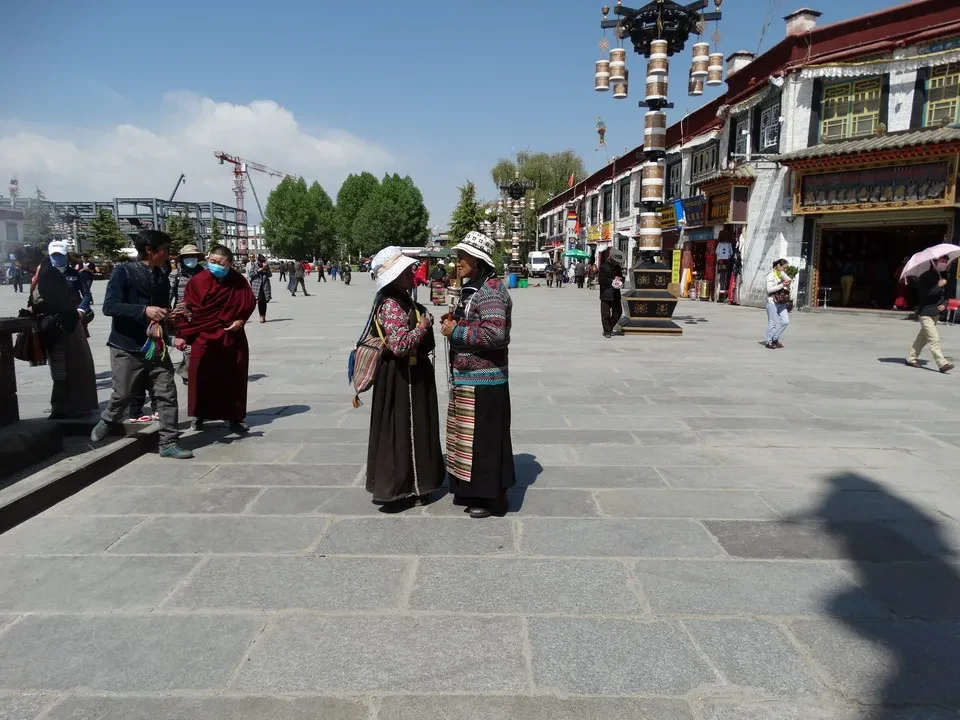
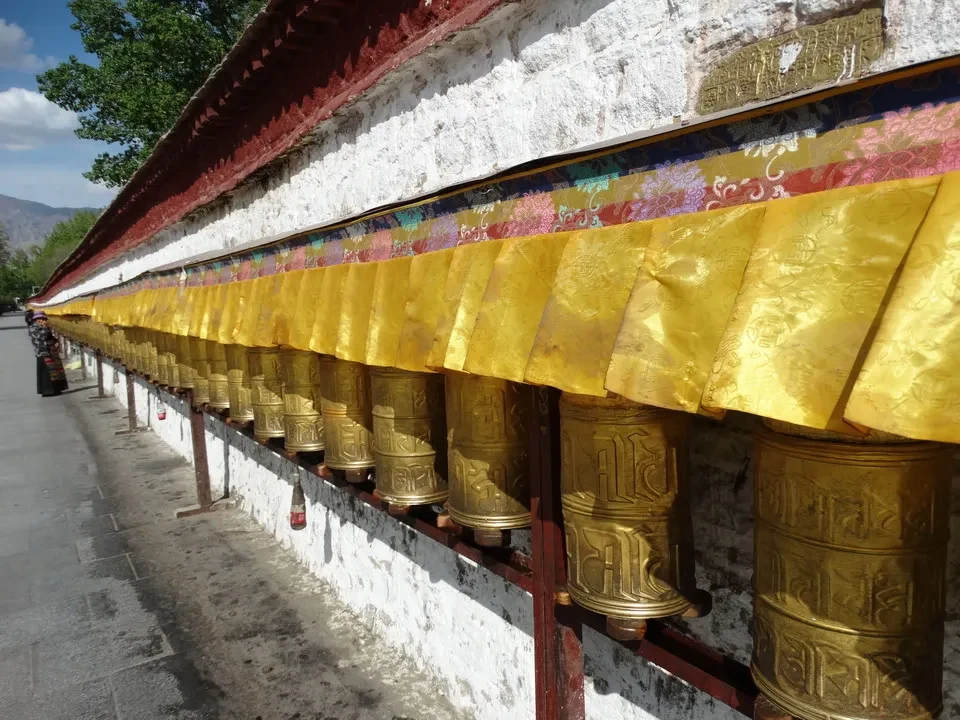
Let's explore the area around. Barkhor after having subjected the containers to the casual scrutiny of a metal detector guarded by a dozen or so police officers. A stream of proceeds clockwise and you can see all kinds of people, from the distinct gentlemen who are chatting amongst themselves, to old women turning prayer wheels or those that are they lie down on the ground.
We need to move quickly to go and see the Potala as we have a reservation and the visiting hours are limited to early afternoon. The weather is pleasant with 23 degrees Celsius and a spring breeze. After completing the usual checks to enter the square in front of it, the Potala appears with the its grandeur perched high on the hill, it's a vision almost metaphysical, that seems unreal. The name comes from Sanskrit, while in Tibetan it means "at the foot of the mountain," and it is interesting to note how from above it resembles a lying elephant. The thickness of the walls ranges from a minimum of one meter to three, and the structure is made exclusively of wood and stone, as the use of metals, which are extracted from the earth, would be an offense to the land, which is considered sacred. impressive yak wool tents They wave them high, thus warding off any malevolent spirits, and an aura of mystery surrounds the building, making its history even more fascinating. If climbing two flights of stairs to reach the hotel room was already a challenge, then navigating the narrow streets that wind up along the building becomes a real mountaineering feat for the pale Europeans who have just arrived at an altitude of 3,700 meters. Below, one can see the square's terrace Across from the monument commemorating the liberation of Tibet, built right where the old Lhasa neighborhood once stood. A devout and ecstatic crowd flows around it, approaching to enter the sacred halls, which now house only a museum: out of the over 1,000 rooms in the palace, some are well-furnished and accessible, while others have been emptied and no longer serve any purpose. The ones we will see are located in the section painted gold, formerly the residence of the Dalai Lama, while we discover that the red-painted areas were dedicated to religious activities, and the white ones to politics. The white color of the walls comes from the milk offered by the faithful, while the red color seen under the cornices is made up of stems of "pema grass," a plant harvested above 5,000 meters high, used to ventilate the interior spaces. We visit the stupas of various Dalai Lamas, with the XIII being particularly notable, but especially the V, literally buried beneath a mountain of gold and diadems. Inside, there was never any form of heating, so the inhabitants had to cover themselves with heavy cloaks. Following the path, we get the clear impression of a theocratic-political mix, which, from a historical perspective, represents an interesting and curious experience. A more current view can only highlight various points of contrast that are definitively out of place in the context of modern reality, no matter where it is considered.
Bureaucracy, fee and the Kora of the Barkhor.
We went to the bank to exchange currency, but only the Bank of China is authorized to do so. We struggled through a sea of documents, passport requests, visas, signatures, and endless checks. After that, we abandoned the idea of buying a SIM card: you need a Chinese passport, and anyway, every Chinese citizen can own at most one SIM. It didn't seem like a sufficient reason to change nationality and get a Dragon passport. Lunch at 3:30 PM at Lhasa Kitchen near Barkhor Square: despite the appealing dishes, we were tired, and even the thought of eating required too much effort. We still managed to consume enough calories to continue. When we left, it was already late for Norbulingka, so we agreed that it would be better to stay another day at an altitude of 3,700 meters to see more of this wonderful capital. The early morning wake-up call, the high altitude, and the late lunch after a general upheaval made us particularly weak. We will sacrifice one day on Manasarovar Lake and an acclimatization trip, knowing that this could be expensive in terms of training for Kailash, but starting in poor condition could even be worse. Unfortunately, the need to condense two days into one due to the denial of re-entry permits via Nepal and the forced Chengdu route yesterday, forces us to travel at a faster pace. In addition, the fact that each of us has their own minor adaptation issues doesn't make things easier. Ultimately, the first rule of Buddhism says that life is suffering, and we have come here specifically to experience it. However, a good dose of Western optimism pushes us to fight against our limitations in order to achieve our desires in this world. Today, we will take it easy and return to explore the old city with Kora of the Barkhor... it's always an amazing experience to gather with others, unique in our species, and join the human flow that moves clockwise, turning prayer wheels, chanting mantras softly, and moving forward step by step through prostrations. It is truly astonishing to witness this sincerely believing humanity that reveres its God in various forms and colors. In a fitting definition, Fosco Maraini argues that Potala is to Vatican as Jokhang is to Assisi. Here, one can see the true Franciscan faith of Tibetan Buddhism, while their Vatican has been closed and evacuated for decades... The pilgrims observe us as if we were detached bodies, some ladies touch our blonde arms, believing we are animals from somewhere unknown. It's surprising that there are still areas in the world where indigenous people observe us with such curiosity. Some come from so remote areas that they may never have encountered foreigners. This confirms that Lhasa remains a difficult destination to reach, both politically and environmentally. By the end, we will have crossed paths with about twenty people of our race. In the surrounding streets, there is a bustling commercial life, with shops selling religious objects for pilgrims, as well as others displaying dried cheeses, yak butter in solid or liquid form, as well as any other Chinese-inspired items that don't quite fit with the ancient walls, and which are displayed accompanied by techno music played through speakers placed outside the shop windows. It's surprising to see statues of deities with their faces covered: we will discover that they are kept this way until they are blessed in a temple.
Returning towards the hotel, we discover that a market has been set up where there is a lot to see. The items are displayed in an almost obsessive order and for sale. vegetables, mushrooms and all kinds of food, even ready to be cooked on the spot. We were impressed by how vegetables can be eaten immediately, perfectly clean and washed, without edible leaves: an example for our markets. Dinner at the Sun Tribe Restaurant, where we couldn't understand each other, fortunately the photos on the menu helped us to imagine what we could have. The food was abundant and added to the late lunch, risking causing stomach problems due to the high altitude. Leaving, we discovered the brightly lit Chinese street, but it wasn't Las Vegas.