

Day 2
Kathmandu II
Kathmandu: exploring familiar places and new discoveries.
From Thamel to Durbar Square
We had taken a day to ensure that all the procedures related to Tibet could be completed smoothly, so we decided to take advantage of the opportunity to visit some familiar and less familiar places in the Nepalese capital. We set off on foot towards Durbar Square, taking some time to see the Stupa of Kathesimbhu. In Thamel and its surroundings The signs of the earthquake are barely visible in some piles of bricks that replace what was once a house, while Durbar Square is a construction site: the temples are partially destroyed due to their inherent architectural fragility. The initial tremors caused the sloping beams and roof to collapse onto the square, octagonal foundations. Work continues without interruption to renovate private and public buildings; they would certainly be further along if India had not imposed an embargo that effectively blocked all economic activity for the first few months of the year. In recent months, Nepal has promulgated a constitution that is somewhat too independent, and its powerful southern neighbor quickly reacted. The prospect of an alliance with the northern country, however, fills one with trepidation. Tomorrow is the anniversary of the earthquake, which here they say is today because we are referring to April 25th, but we should remember that this year is a leap year, and the newspapers highlight as the work progresses slowly and corruption spreads: this also happens in a country with good people. According to the Nepalese calendar, which is still different from the lunar one, we are in the year 2072. It is based on Hindu tradition and anticipates the Gregorian calendar by 56.7 years. We proceed south to explore an area of the city that is unknown to us: we meet you there. a couple of nice streets, Towards E Chikanmugal, and a dynamic and pleasant snapshot of everyday life, with people cooking at home, barbers, and street dentists Other small shops stretch along, dark and almost like another world. Everything is closely related in terms of merchandise: you can see rows of carpenters, tailors and so on, not to mention the jewelry district around Durbar Square, which showcases free competition. We conclude our walk along the smelly banks of the Bagmati River with attached waste sorting center It's not clear whether this also involves waste management, given the pigs that are busy eating organic waste. The Nepal clearly still has a long way to go from an environmental perspective. We return to the center for lunch, which almost forces us to return to Thamel due to the lack of restaurants. We try Gurkha beer, 5° but with a lighter character than the famous Everest, and then take a taxi to... Swayambhunath, the monkey temple, also known as the stupa that stands alone on a hill to the west of the city.
Swyambhunath and Bodhnath
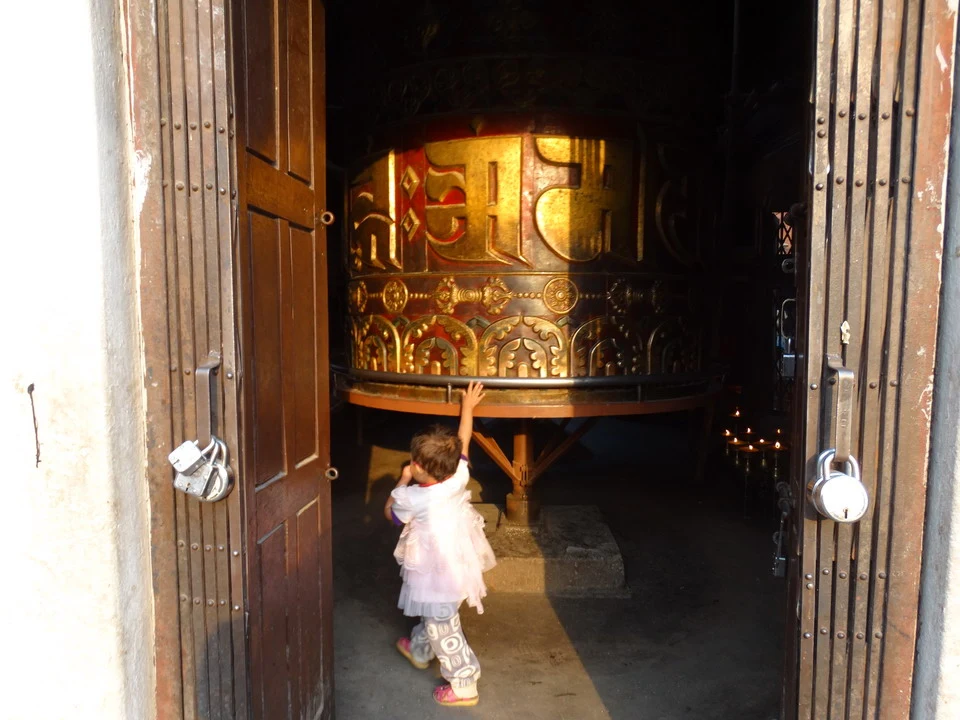
Along the west staircase It's a community made up of faithful people, vendors, and some tourists. In fact, we still see a few pale faces in the city, which makes us suspicious about the success of the season. Upon returning from Tibet, we will see how many Westerners have arrived, revitalizing the economy: and this can only make us optimistic that Nepal can succeed this time too. Another taxi ride and another stupa, this time it's a Bodhnath Unfortunately, the upper part has sustained damage and for safety reasons, it was removed up to the level of the dome, where a small construction site is now working to restore the monument to its former glory. The plinth representing the earth and the dome symbolizing water remain; the harmika, which represents fire, the spire for air with 13 levels to reach Nirvana, as well as the umbrella indicating space, have disappeared. Perhaps I will never be, and probably I don't even intend to be, in accordance with Buddhist principles that involve detachment from earthly things, therefore I feel a sense of suffering when I see this collapse, which, just one year ago at this time, was still standing above the dome, symbolizing air and the various levels to reach enlightenment. Perceived from another angle, what we see can appear as a representation of the mandala, which means construction, destruction and reconstruction in things as in life; what symbolism could be more appropriate. Bodhnath cannot remain indifferent to those who are sensitive to Buddhism and Tibetans, who here are united in a single dimension: seeing the people complete the pilgrimage around the stupa, I small shops from which emanate music and scents, the temples from which you can hear the chants of monks o of devotees, are all feelings that transport to a different size It feels like we're light years away from the chaos of the Nepalese capital. The monks and Tibetans who are here are clearly refugees, and if they were to return home, they would be immediately imprisoned, which makes this place of exile even more poignant. We enter the temple where a monk, having learned about our planned trip to Tibet, performs a short individual ceremony before hanging a red thread around our necks. This is a ritual that we can only appreciate and hope will bring us good luck in the days to come.
Funeral, traffic and dinner in Thamel
As we return, we come across a funeral procession, with participants dressed in white, the color of mourning. Many are even wearing tank tops while close relatives wear an orange robe. On the way back to Thamel, our reckless taxi driver provides us with a concise summary of chaotic urban traffic and the real possibility of immediately ascending to heavenly realms. We avoid the possibility of ending earthly suffering this very evening and reunite with Prachanda and R.K. for a pleasant evening of drinking in the restaurant Located in a palace that once belonged to the royal family. The abolition of the monarchy made it free and available for culinary activities. A specialty is the Dahl Bhat, accompanied by elaborate traditional Nepalese folk dances.


