Day 9
King's Canyon
Kings Canyon: geology and color games – Alice Springs: the capital of the Red Centre
Morning at King's Canyon
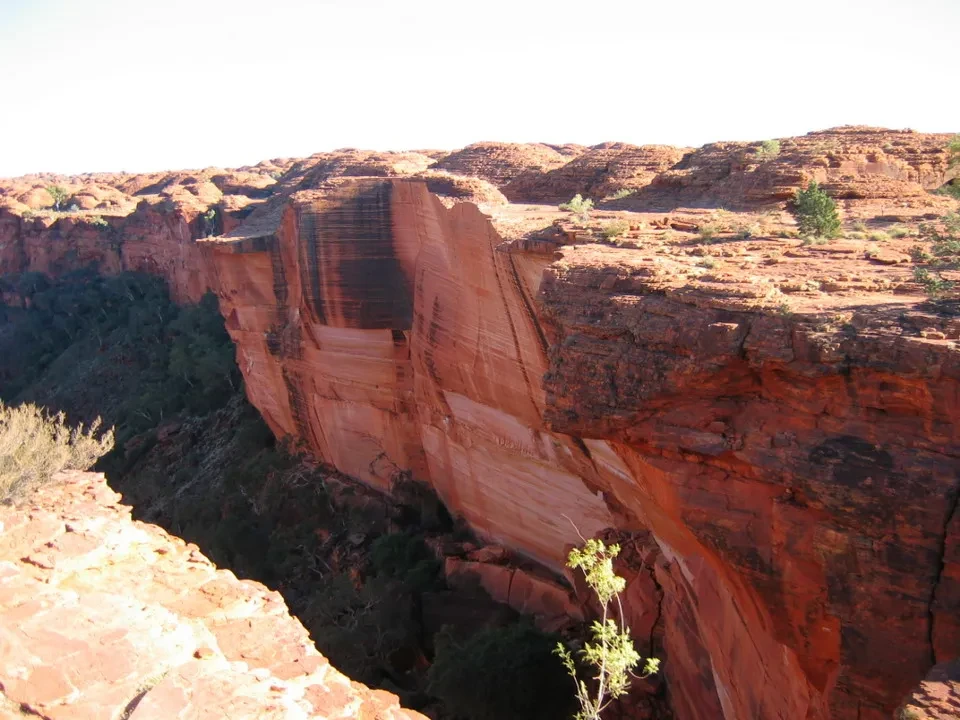
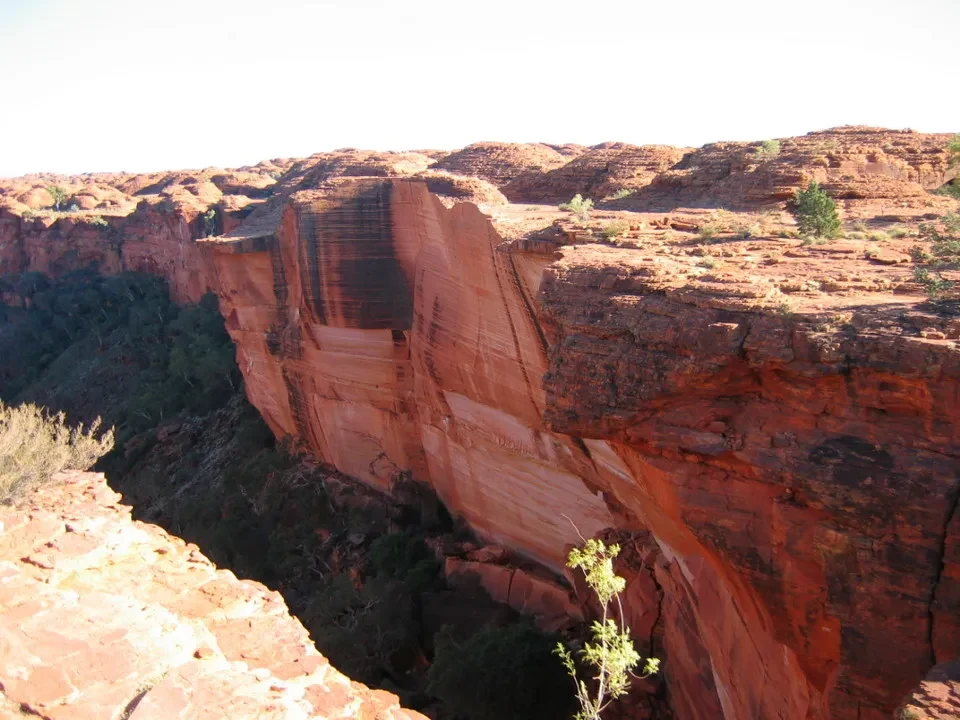
We wake up at 6 am, taking advantage of the fact that we are on vacation and can relax… Today's itinerary includes a visit to Kings Canyon. We start the Kings Canyon Walk, a 6 km loop that is recommended to be walked at dawn to fully appreciate the color variations and avoid the heat. It starts steeply with a natural staircase designed to make it easier to climb. This takes us to the upper rim of the canyon, where we walk along its western side, making several detours to see the steep slope that descends directly vertically, in particular the Cotterhill Lookout... where we venture to the edge, holding on to a bravely grown tree in the rock, to take some photos. Approaching the bottom of the canyon leads us to the Garden of Eden, an oasis of green that has grown thanks to some almost permanent puddles and its sheltered location from the winds. It is truly a lush area in a place where the red of the desert dominates everything. Some walkways allow you to cross over to the other side, always at a higher elevation, where you can pass through what is called Lost City. These rocky formations, formed by vertical cuts into various sections, seem more like Nuraghi or enormous ravioli. As for the sedimentary rocks, which were formed horizontally, they have been eroded from above and are more worn on the upper part, eventually forming cones that appear similar to domes of a ghost city. The canyon was formed. approximately 400 million years ago, following the fracturing of the upper sandstone layer (a reddish-colored sand and very light weight), there was a hard rocky crust beneath which the lower layer crumbled like sand when rubbed against it. The lower part, called Carmichael Stone, is even more fragile, almost earthy, so that after the initial erosion along the Sandstone, we arrived at Carmichael, which has also been eroded horizontally, going under the upper layer and leaving it in a suspended position. At some point, this last layer fractured sharply, creating the canyon as we see it now. The fragments of the broken rock are still visible today.
Creek Walk
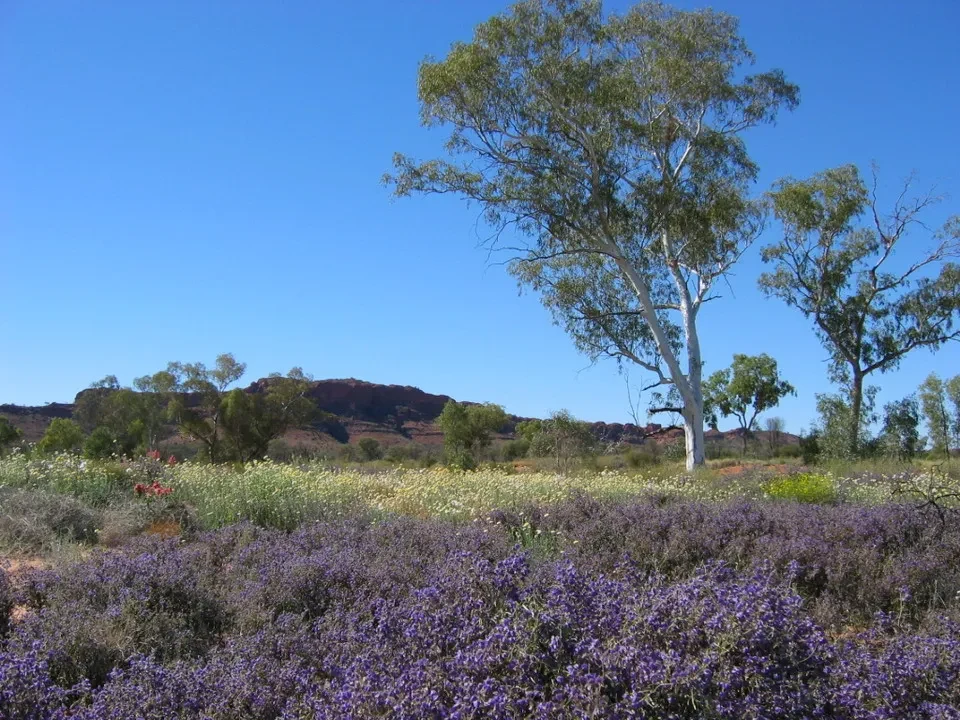
We start descending on the opposite side from where we arrived. In this desert and rocky environment, it's interesting to notice how vegetation grows in every crevice where roots can reach the earth or where water can temporarily stagnate. It seems that the land tries everything to make anything that falls into its embrace sprout. There are some beautiful examples of low palm trees without trunks but with leaves worthy of their coastal relatives. Where we find fan palms, a kind of mimosa, the air fills with a very faint but unmistakable scent. We also encounter a long lizard, at least forty centimeters in length, which sticks out its tongue and hides among the rocks. Another walk along the bottom of the canyon, the 2.6 km King's Creek Walk. The flowers are beautiful. that offer one un unparalleled spectacle.
Creek Resort
At 10:45, the temperature reaches 31 degrees, and we continue on our way towards Alice Springs, following the same road until Erldunda. Both the Mereenie Loop and Giles Rd. are only accessible by off-road vehicles, so they are not suitable for our vehicle. At some point along the road, we see spheres of varying sizes, from that of a small apple to that of a melon. They appear to have fallen from a truck that was transporting them. Upon closer inspection, we notice that they are attached to a plant similar to a melon, whose stem is now dry and almost invisible. This makes it seem as though they were simply discarded; however, we cannot determine whether they are useful in the kitchen or not. A quick visit to King’s Creek Resort where we meet some camels, descendants of those brought here by the Afghans, when these were the "desert ships" and camel drivers were among the few who dared to challenge these harsh regions. They were retired when the Ghan railway was built (see below). Now they are used to take tourists on walks.
Arrival at King's Canyon
During these days of desert experiences, we have observed that some trees have leaves that are sometimes a very intense green but always very thin, and from which, when squeezed, no sap comes out. They feel dry to the touch, even though they are green. This also applies to eucalyptus trees, similar to oleanders, mimosa or conifers. There are also flowers that appear dry, such as those we use in our country for ornamental purposes. However, these are alive and healthy, but nature has adapted them to minimize water consumption. Some plants have leaves like sage, with a color that can be compared to wormwood, and many of them have a certain fuzziness. Along the Lasseter Hwy, we re-encountered our Aboriginal guide from a few days earlier, in another place but still without gasoline. He must be very careless… This time he manages to catch a group with off-road vehicles and caravans. We can't understand whether it went well or badly for him: instead of cash, they gave him some gasoline, even though that wasn't his goal! At 3:30 PM we are in Alice Springs to visit the Royal Flying Doctor Service museum, located next to the hospital. This center was created by Flynn to provide healthcare to the outback population. The kind lady who explains the history and structure of the service tells us how the rainfall is very irregular in the area, with just a few meters separating flood from drought. The airstrips are built alongside towns or stations to allow for the landing of small aircraft, as the roads are unpaved and the first settlement can be several hundred kilometers away. Some airstrips are even located on paved roads and are rarely used; we saw one a few days ago when we were going to Hawker. They are actually more common in South Australia. There are very strict regulations for their use. The police block the roads at least an hour or an hour and a half before the plane is due to land.
Stop at Todd River
We reach the Todd Tavern, a central hotel with shared facilities. It's extremely functional and quiet, just as we wanted. The price-to-quality ratio is definitely better than at the Yulara Resort, although this one costs $50 while the other costs $180 per room. We stroll along the main street, which is full of shops selling souvenirs, but also has gardens and trees, giving the impression of a livable city, even though they advise us to park our car in a monitored area next to the hotel. It seems that the surroundings are not always recommended, but the center is quiet and welcoming. The signs prohibiting the consumption of alcohol and some unarmed Aboriginal people do not detract from the positive opinion, while keeping an eye out. We have dinner at the hotel's restaurant with a kangaroo dish and a rib-eye steak. Another short walk to see the city at night. The Todd Mall, the main street, is only a few dozen meters long and runs parallel to the Todd River, which is almost always dry, and is also full of eucalyptus trees along its banks. This species is capable of storing underground water reservoirs in the upper part of its deep roots, which are used during dry periods. It is said that the Aboriginal people survived by knowing this secret, which was later discovered by the first pioneers. The photos of the Todd River during the rains show how it takes on a torrent-like character and often floods the bridges that cross it.