

Day 12
Mossmann
Mossmann: visit to a tropical forest and a sugar factory. On the Daintree River, searching for crocodiles.
Mossmann
Practically as soon as I hadn't slept, we went to the reception to express our dissatisfaction and threaten to write an unfavorable report for Lonely Planet, which had recommended it, and we obtained a refund for the second night that had been booked in advance, and decided to go to Port Douglas. In the meantime, we went to have breakfast and take a walk to discover what the late-night tour had prevented us from seeing.
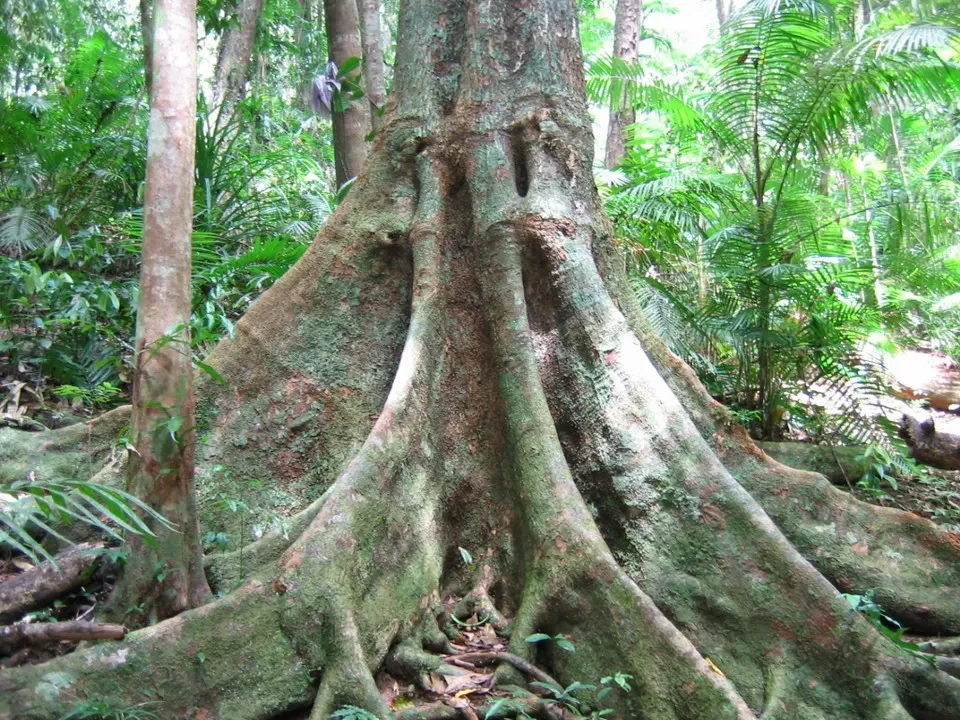
Upon arriving in Port Douglas, we immediately look for accommodation for the following two nights and find it at Port O'Call. We also book our tour of tomorrow on the coral reef with Quicksilver here. At 11:15, we leave this charming fishing port that has managed to preserve its natural charm or, better yet, has successfully kept the historical part separate from the modern one, relegated to the area for catamaran docking. This is indeed the starting point for visiting what everyone claims to be the most beautiful part of the coral reef, Angincourt, where we will go tomorrow. We head north first, taking a couple of photos from Flagstaff Hill Lookout, and then arrive at Mossmann. We see that there is a sugar factory in the area and that tours are offered. Since our next activity is scheduled for 13:30, we take advantage of the opportunity to visit Mossmann Gorge, where we follow a 2.7 km trail leading to the rainforest and featuring some gigantic figs We arrive on time at the Sugar Mill for the guided tour and follow the sugar production process: once harvested, the sugarcane is loaded onto wagons and transported to the factory.
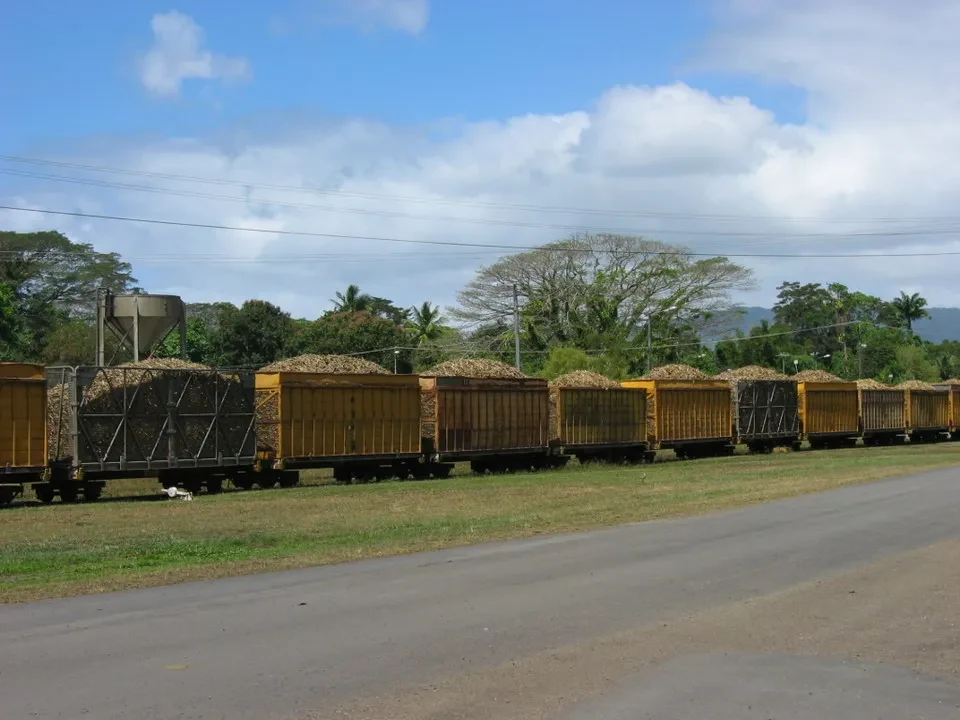
The route allows you to first see the grinding process, then the separation of sugar from molasses through centrifugal rotation, and finally drying and evaporation to obtain the sugar as we see it. Sugar currently sells for around $9 per ton when raw and $22 when refined. It has annual cycles, and this is precisely when harvesting takes place. Everywhere you can see a line of wagons loaded with on the narrow-gauge tracks along the roads, waiting to go to the sugar factory. The cycle is of 5 or 6 years, after which the land is left to rest. Work at the sugar factory is seasonal; about a hundred people work here, but when the season ends, some groups of workers stop for maintenance while others seek different jobs for the summer months. The staff are mainly involved in monitoring as production is entirely automated. We buy a jar of cane syrup to have a sweet memory on pancakes.
Arrival at Mossmann
At 3:30 PM, we enjoy some chocolate and bread while continuing north; this is the midday meal provided to us. Along Captain Cook Hwy, it's all sugarcane plantations. With a detour of 10 km, we arrive at Daintree Village, where we board a small boat for $20 and take an hour-long tour on the Daintree River. The river itself, although interesting at sunset with its rich vegetation of mangrove forests along its banks, wouldn't be worth the trip on its own. What attracts people is the population of alligators I live there. These are the formidable estuarine crocodiles, which also attack humans not for defense but to feed. Our guide is also the driver of the small motorboat; he has the air of someone experienced and knows well both the river and the animals that inhabit it, as well as the tourists. He tells us how difficult it is for a crocodile to reach adulthood in its natural state. Normally, the eggs are eaten by other animals or when they are young, they find enemies among fish and even their own relatives. Indeed, the crocodile is one of the few cannibal species. He narrates these stories with a mixture of disgust and irony towards the reptiles, who ultimately provide him with his daily bread. Our photo shoot has positive effects: we spot four, including one that is somewhat hidden. and a small one... which we need to approach carefully as it is perfectly camouflaged, attached to grayish roots that emerge from the water. One of the large ones allows us to get close and it remains still with its mouth open to warm up. They can reach a length of 6 meters; the one we saw closest reached 4 meters and seemed enormous. They live on their own territory, at least 1 km away. In fact, if we spot one, it will be very difficult to find another nearby. This is what happened to us, when we found a male and a female just a few meters apart, probably for mating purposes. However, this is strange as mating occurs in December. They mainly feed on fish or animals that come to drink in the river, such as kangaroos, birds, and cattle. We have been told that last year alone, twelve cows were killed in the area. Indeed, beyond the tree belt surrounding the river, there are pastures. The traps are usually placed underwater, where they can stay for up to 4 hours without surfacing, managing to reduce their heart rate to one beat per minute. When prey approaches, they jump on it, emerging from the water with great determination. They have excellent resistance to long periods of fasting.
It was a well-narrated visit, guided by the owner who runs this activity with his wife. When the "crocodile hunters" meet, they exchange information to facilitate sightings, and they also have a refined instinct for spotting reptiles among the foliage. To please visitors, they try to show them some crocodiles, but they are very careful not to disturb them in their habitat. This sensitivity is also due to the fact that if the crocodiles were to disappear, their profession would be threatened. We also saw a couple of nocturnal birds resting on the trees.
We return to the Captain Cook Hwy, aiming further north despite it being late afternoon. We cross the Daintree River on a ferry (18 $ round trip), arriving at its mouth. We continue along the Hwy towards Cape Tribulation, where we arrive approximately three-quarters of an hour later, after stopping first at Alexandra Lookout. The road seems darker than the time suggests. It's a sort of tunnel carved between the trees that completely cover it, and the massive tropical clouds also contribute to reducing light. There is no rain, but only the classic formations found on the hills near the ocean. We encounter many signs inviting us to pay particular attention to cassowaries These beautiful birds have a skull formation on their head similar to a sickle, almost like a horn, with which they clear a path through the dense tropical forests. You need to be careful because if they feel threatened, they can attack humans with potentially fatal consequences. They are very similar to emus but have a more colorful appearance. When we return, it is already night and we arrive at Cape Tribulation at 7 pm. The name was given to this place by Cook, who ran aground several times in the coral formations that lie offshore and where he had to stay for necessary repairs. The village consists mainly of a few resorts and campsites. You can't even see the beach from the road, but the path is very worthwhile with frequent climbs and descents on hilly terrain. We have dinner at the exotic restaurant in the holiday center where we are staying.


