

Day 8
Ayers Rock and Olga's
Strolling among the monoliths of Ayers Rock and Olga, in the land of the Aboriginal people.
Morning at Ayers Rock
Woke up at 5:30 to watch the sunrise. After all, the longer the vacation, the later you wake up! I had some tea made in my room, with milk from the fridge. We immediately headed into the park, having already bought the ticket yesterday for $25, and reached the Sunrise Point... which doesn't seem as spectacular as the sunset but is still worth waking up early for. We complete the Rock circuit, stopping to walk the Multijulu Waterhole trail, a sacred water source for Aboriginal people. We visit the cultural centre, focused on the culture and religion of the Aboriginal people. In the photos showing deceased Aboriginal people, they are covered with a black veil with the words "sorry, but tradition dictates this". Wouldn't it have been easier to simply remove the photo and replace it with one of living Aboriginal people? The cultural centre gives us a general overview of Aboriginal culture and is amazing to see how this civilization was able to survive in such a hostile and impoverished environment, especially climatically, which can go from scorching heat to biting cold or from drought to torrential rain. The resulting culture is probably not comparable with other indigenous cultures that we have come into contact with over the years, and it seems somewhat overrated in the mythology promoted for tourists' benefit. On the other hand, it is important to give credit to the local people, who are able to make use of what little they are given from these lands.
The same applies to the flora and fauna, which have been specially modified by nature to survive in such a harsh climate. It is not surprising that one of Australia's main cities is called Darwin, in honor of the famous nineteenth-century naturalist, who found confirmation of his theories in the southern hemisphere. Next to the Aboriginal center there is a shop selling local crafts. These are mainly paintings made with a series of dots that well integrate with modern tastes, although they can sometimes cause slight visual discomfort. The paintings are created by dipping a point into color and letting it fall so that it forms a dot on the canvas. The shop also offers wooden objects such as snakes or lizards made from branches, as well as didgeridoos which we will find everywhere. These musical instruments produce a sound similar to modern electronic music, almost as if they were a historical nemesis. We learn some useful information: the longer the instrument is, the easier it is to play, and the larger its diameter, the better the acoustics. The best are made from certain eucalyptus species, but in general this wood is all good. Bamboo ones should be avoided, as they are much cheaper but also sound bad and easily crack, so they are not even suitable for hanging on a wall at home.

Ayers Rock
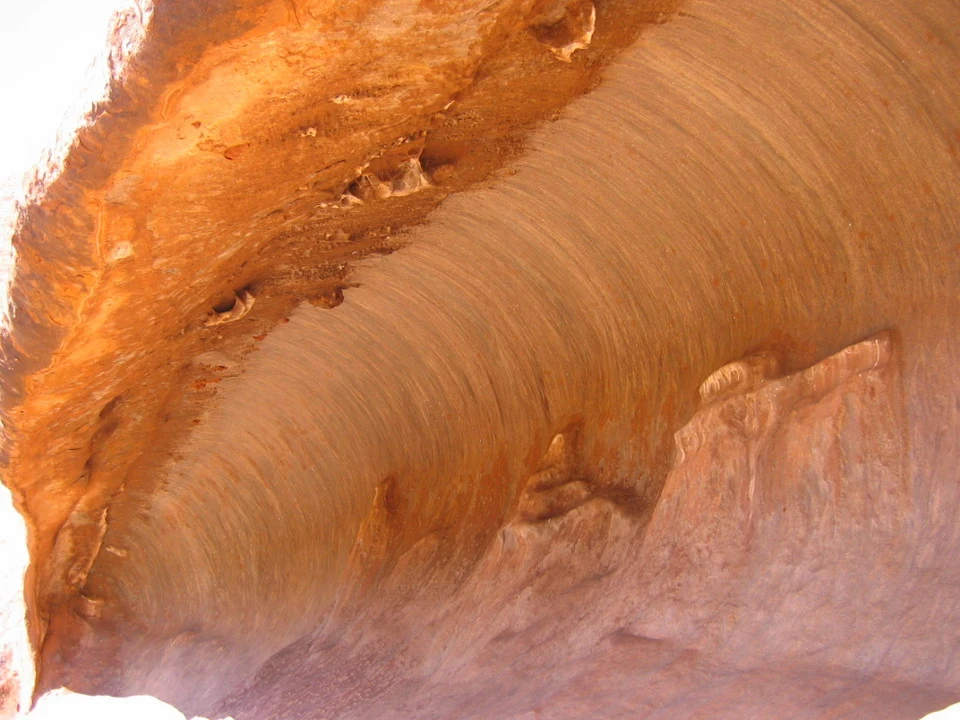
We get our bearings. towards the Olgas (Kata-Tjuta in Aboriginal) to hike the 7.4 km trail of Valley of Winds and then the Walpa Gorge (2 km round trip), where you can find a striking rock formation and a pool between the rocks. These rock formations, although less imposing, are even more interesting than Ayers Rock. Because there is not much foot traffic, we can better appreciate the silence emanating from the rocks. In general, we find a very quiet and smaller crowd compared to what one might expect from the fame of these places. The daytime temperature remains warm but breezy, which is very pleasant and tempered in the shade. The main attraction of the Olgas is in the rock, which seems to be like hazelnut chocolate. The rock was formed during erosion by magma that had incorporated stones of various sizes. Everything has since been skillfully smoothed by the passage of time. The walls are taller than Uluru, while at several points there are Waterholes, small ponds created by drainage water and held back by the rocky bottom. We continue to Sunset Point for a quick picnic with some cheddar cheese we brought from Adelaide, which is perfectly preserved. Along the way to and from the Olgas, we stop at various places to photograph plants. flowers, low bushes that grow in the sand. Sand similar to that used on tennis courts. The contrast between the green or yellow of the bushes against the red background creates noteworthy views. Since we still have some time available, we take advantage of it to make another drive around Ayers Rock, this time counterclockwise, going to see the rock up close. Unlike Uluru, its uniformity is noticeable. There are indeed small groves, but otherwise it's a monolithic rock. We do the Mala Walk, passing through several very interesting places: Mala Puta, which is not a translation from Spanish, but rather a sacred area for women where taking photos is absolutely forbidden, even though there is no particular reason to do so. The risk is a fine of up to $5,000. There are also other walls of the monolith that contain rock paintings, as well as areas where it seems almost like an excavation has been made. stone wave at the foot of the mountain. The spot where we park is also the starting point of the climbing to Rock, where the signs literally promote terrorism by discouraging non-religious indigenous people from entering, threatening a series of health problems. They are filled with recommendations that occupy square meters of signage. We believe that under current conditions, climbing is not exceptional, but we adhere to what the indigenous people require in terms of religious matters and remain at the base. We respect the sanctity of the place even more than the intimidation from the park authority. We return on the Lasseter Hwy, go north on the Luritja Rd and after 300 km we reach the King's Canyon Resort just in time to to watch the sunset Along the road, the vegetation is taller and less desert-like. It's important to remember that we are at the peak of flowering season, and what we are seeing represents reality only for a few months of the year. There are informative panels that show how seeds can survive up to ten years in dry soil before sprouting with the first rains and developing their entire life cycle in just one month, allowing the seeds to return to the ground, ready to wait for new rainfall when they arrive. This is a demonstration of how nature knows how to perform miracles in complete silence. A dingo roams around the lodge rooms, as indicated by the sign at the reception that strongly encouraged tourists not to feed them. These wild dogs become more aggressive if accustomed to being fed by humans, and during difficult periods, they can even kill children, as has already happened.
We enjoy a kangaroo fillet grilled in the resort restaurant. Rustic atmosphere, country-style setting, and it doesn't seem like we're anywhere but in the Red Centre of Australia! To digest, we take a walk to observe the panels explaining the history of the canyon's discovery. Indeed, Giles only came here in 1872, and even in 1960, the Cutterhill family arrived in the area under pioneering conditions, establishing a station and building the first roads. These paved roads came later. So, in several areas, this region is still very underdeveloped from a tourism perspective, and we say this with a positive attitude. The resort blends well, minimizing its environmental impact. In the bar next to the restaurant, there are some photos that demonstrate how heavy rainfall can cause significant damage. All the floodways were overflowing, and even the off-road vehicles could barely cross them.


