

Day 19
Sydney II
Sydney: one of the most pleasant cities in the New World – Farewell to a New World
Evening in St
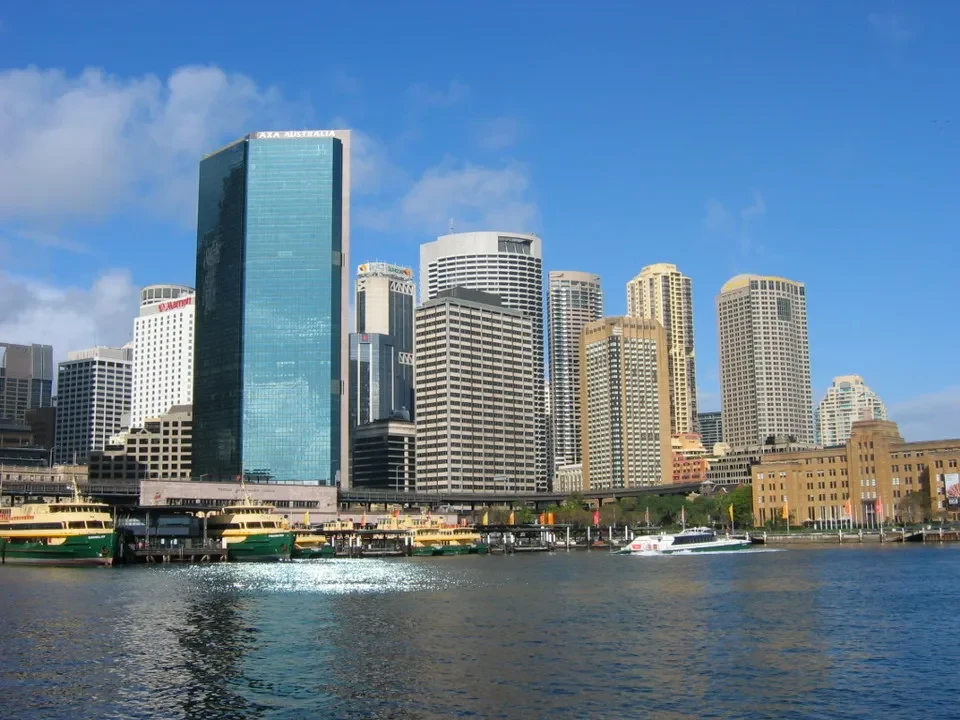
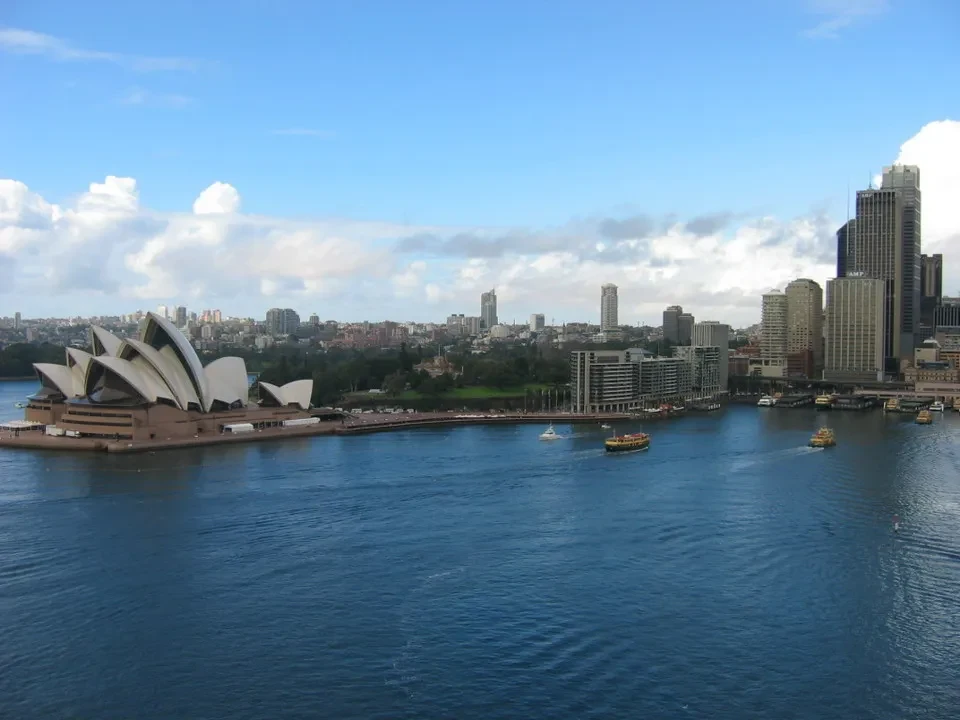
Relieved that there had been no attacks during the night, we set off shortly after 7 am to revisit some of the places we saw last night with the nighttime lights and complete our downtown tour. The weather is extremely variable, but there are more periods of good weather. Reaching the ferry dock proves to be a difficult task even on foot, due to the barriers. But with some clever maneuvering, we manage to get through. We see the St. Mary's Cathedral, the venue for Pope's upcoming meeting with young people in 2008, we take a Harbour Bridge tour for a better view of the Opera House and of Skyline.
Arrival in St
We head towards Darling Harbour... a large recreational area near the port where an exhibition of a series of artistic photographs takes place, featuring around thirty of the most beautiful places on Earth. Each photograph is linked to an environmental theme, providing information on various environmental risks. We take a walk through the famous market in Chinatown and retrieve our parked car from the covered parking lot. Sydney with our speakers, we are heading to Marubra to see the delicious beaches, almost like a farewell to Australia. We continue down to La Perouse, where you can admire beautiful seabed decorated with rugged coastlines. And it's time for the final leg of our journey to the airport, where we leave the car and board for Dubai via Bangkok.
The Australians seem quite blunt in the outback, although never impolite, while along the coast they become more calm and relaxed; stress doesn't really exist here. A positive aspect of this character is fair play on the roads. We didn't see any arrogant traffic situations, and we were surprised by how rarely we heard car horns. However, the great civility of the people is immediately apparent, especially for those coming from Italy.
The connection with Great Britain has so far represented a useful support for a nation that had struggled to develop due to the large distances and low population density. It seems that the country is evolving, although from our European perspective, this is happening slowly. For example, we were amazed to see how the major cities are still connected by state highways that pass through small towns, and that motorways are only now being built. This is just one example of a country with enormous potential and undergoing development. But for development, it requires character, not subservience. Some cities are simply copies of their American counterparts, and at the political level, there is a flattening of positions towards those of America. While this has brought some benefits, it also risks leading to a loss of national pride.
It seems I understand that the real problem with Australia is its geographical isolation, even before its relatively young history. An island far from everything. The New Zealand cousins are about 3 hours by plane from the nearest airport, while to reach a more economically viable destination you have to fly to East Asia, which is at least 4000 km away. This is confirmed by the Sydney airport, where there are relatively few international flights, especially compared to the reputation of this metropolis. Recently, television showed a smiling Australian president shaking hands with his Chinese counterpart to reach an agreement that involves selling who knows how many tons of minerals to China. Selling raw materials is a job for countries that cannot use them to produce goods and therefore develop. With China aiming to be increasingly dominant in the Pacific region, or even the entire world, this should encourage Australian leaders to consider how to avoid becoming the garden of Asian giants. The good life, surfing, and barbecues are part of the friendly character of the population, but without strong development there is a risk that some ingredients will be missing for Sunday barbecues.
Risks
There are a number of specific risks in nature that one needs to be aware of and protect against. Some are highlighted and perhaps precisely for this reason do not represent the major causes of real danger: among these are crocodiles, which are common at the mouths of rivers in the north, but are avoided with caution, and there are approximately 5-10 people per year who end up as food for these reptiles. Snakes, even though Australia has some of the most venomous snakes in the world, do not seem to be a particularly serious source of mortality. They are mostly found in areas rarely visited by humans and tend to flee when they hear noises. The situation is different with jellyfish and spiders. The former represent a real tourist disaster. They prevent swimming along the beautiful Pacific coast for much of the summer season. It seems almost absurd, but despite unique beaches and crystal-clear water, tourists are often forced to swim in the hotel pool. In some places, containment nets are used outside. The most dangerous are the cubomeduses, whose bite is fatal within a few minutes.
The metro of St.
Another source of accidents are spiders, which are often found in the grass and can jump up to a meter long. They are very common around Sydney, and their bite is not easily treatable unless immediate action is taken.
Geology
Over the last 90 million years, from a geological perspective, Australia has remained relatively inactive. It is too flat, hot, and dry to allow for the formation of glaciers, and its crust is too old and thick to be penetrated by volcanoes or folded into mountains. Uluru and Kata Tjuta are the remnants of mountains that were as high as the Andes 350 million years ago, but have since become tiny protrusions.
Australia remained isolated from the other continents for a very long period, at least 45 million years. The other continents have been able to exchange species several times, because in various moments of the past they were connected by land bridges. Problem of soil salinization: in many areas, there are between 70 and 12 kg of salt per square meter of soil, and desertification has caused water to penetrate more deeply into the soil, dissolving the salt crystals and bringing them to the surface. The water provided through irrigation penetrates the sediments of a soil that was once an underwater seabed and now the salt appears in water collection basins and fields.
Pets
Local wildlife
Particularities: Mammals such as the platypus and echidna lay eggs. Eucalyptus trees change their bark instead of their leaves. There are practically no trees that lose their leaves, and there are no animals that hibernate. Birds with a breeding season are relatively rare, and even less so those that migrate; conversely, birds reproduce when it rains, and a large percentage of them are nomadic and follow the rainfall by moving across the continent. Various bird species rely on "nest helpers," adult birds from previous broods stay with their parents to help raise the new chicks. The efficiency also applies to animals that jump. Jumping is the most efficient way to move at an average speed. The energy of a jump is stored in the tendons of the legs (like in spring-loaded trampolines), while the intestines go up and down like a piston, so the lungs fill and empty without having to activate the muscles of the chest. When traveling long distances to find food, efficiency becomes essential. Marsupials are so efficient that they can eat up to one fifth less food than placental mammals of the same size. Koalas are the only living beings with a brain much smaller than their skull; in practice, their brain is a small, wrinkled nut floating in a skull filled with fluid. It is believed that they sacrificed the brain in favor of energy efficiency. Koalas eat eucalyptus leaves, which are so toxic that they must use 20% of their energy to make them edible. This leaves little energy for the brain, and since they live on the branches of trees, where there are very few predators, these animals can get by even without being very intelligent. In Australia, there are 10 of the 15 most venomous snakes in the world, but they are not considered a major danger because they live in very remote areas and usually tend to flee.
Indigenous people
Traditional religious beliefs of the Aboriginal people are based on the existence of spiritual beings that lived on Earth during the time of creation. "Dreamtime" (the time of dreams) before the arrival of humans. These beings created every aspect of the natural world and were the ancestors of all forms of life. Although they took different forms, they behaved like humans and, as they moved, left marks to indicate where they had been. Although these ancestors were supernatural entities, they aged and eventually returned to the sleep from which they had awakened at the dawn of time. Their spirits continue to exist in the form of eternal forces that breathe life into newborns and influence natural events. The spiritual energy of each ancestor still flows along the path he traveled during the Dreamtime, and it is strongest in the places where he left physical marks of his activity, such as trees, hills, or depressions in the ground.
The indigenous people believe that every person, animal, and plant has two souls: one mortal and one immortal. The immortal soul is part of a specific spiritual ancestor, and after death, it returns to the sacred places of this ancestor, while the mortal soul simply fades into oblivion.


