

Day 14
Atherton Tableland
Atherton Tableland, with extensive mixed farmland and a rich tropical forest area full of lakes and waterfalls. "Encounter" with crocodiles.
Morning in Atherton Tableland
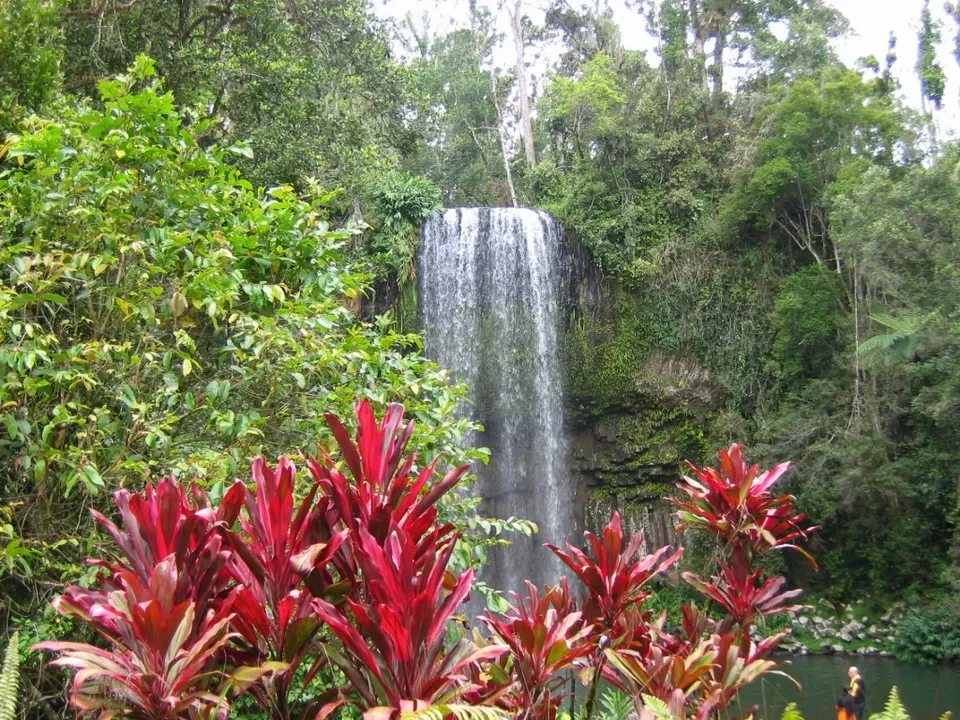
Finally, it was great to wake up early again and maintain my healthy habits. We drove up to almost Mossmann to take the 44 Developmental Road. With a winding road uphill, we arrived at Lion’s lookout, then descended slightly to reach the ATHERTON TABLELAND, located at around 500 meters above sea level, characterized by wooded areas, and then back into sugarcane plantations. We then passed through areas that seemed uncultivated; in reality, they were sparse pastures for cattle grazing. The termite mounds, which were even over a meter high, initially confused us, as we thought they were isolated stones similar to menhirs. The sky is clear, but it's still early, while some kangaroos are watching us pass by from the side of the road. The first farms begin to appear. Along the plateau, we see a series of banana, mango and avocado plantations: for a long time, we have been eating these fruits or berries, and for the first time, we are harvesting them in their countries of origin. Otherwise, there are potato and greenhouse vegetable crops. We were surprised to find coffee cultivation, which was unfamiliar to us. We stopped the car and asked some workers who were installing irrigation pipes for information. They told us that it was a coffee plantation, which also invited us to witness the beginning of the harvest tomorrow and asked us where we came from. When we told them we were Italian, their eyes lit up, and they informed us that he was originally from Calabria. Despite this, we had to continue the conversation in English, as it was the only language we both understood. Perhaps he still knows some dialect, but we could not understand each other anyway. We passed through Atherton and we arrive in Yungaburra, presented as a typical nineteenth-century village, an essential stop for all organized tours that usually spend lunch here. In reality, we see some original Queensland-style buildings, but not a real town with the atmosphere of yesteryear. However, it should be noted that everything is well-organized and welcoming. The large number of restaurants, bars, and accommodation options are clear evidence that tourism brings prosperity. The weather has meanwhile become cloudy, and the surrounding greenery takes on less vibrant colors. Curtain Fig with an interesting walk in the rainforest, a huge fig tree that had fallen on another tree and remained leaning. Along the trunk, roots had sprouted, reaching the ground and making it look like a harp. We continue to Lake Eacham, unfortunately with overcast skies, which doesn't show its full splendor. It would be the ideal stop for a picnic on sunny days. We see some wild turkeys with a red head. Finally, we go to the Red Cedar Tree, which is somewhat disappointing as the walk in the forest is very beautiful. After a long drive on unpaved roads and approaching on foot, we find ourselves facing nothing: the tree was felled by a tornado that hit this area last year after a life of over five hundred years. The trunk, about two meters high, is all that remains of the historic cedar. Here too, the fig trees have a very particular base; it seems to be made up of separating walls, which are useful as reinforcement against frequent typhoons. We go to Millaa Millaa, which has become a ghost town, and we walk the Waterfall Circuit, starting with the spectacular Millaa Millaa Falls, which were even more beautiful with a ray of sunshine that appeared just as we arrived, followed by the Zillie Waterfalls and Ellinjaa Waterfalls, less imposing but still beautiful. The landscape is hilly with fenced pastures, where cows graze peacefully under the changing sky. This area is very rich in kangaroos because there are no predators like the dingo and it is rich in water sources for sheep. We briefly pass by the Mungalli Falls, but only after having tasted a Cheese Pie at Diary Farm, where biodynamic cheeses are produced. A great place to eat, if we hadn't had a very heavy and indigestible breakfast in a bar in Atherton. The pancake with maple syrup was like a stone weighing down our stomachs. We bypass a couple of waterfalls, judging that we have seen enough for today, and start on a trail in the Palmerstone Wooroonooran National Park, descending more than 1.5 km into a lush tropical forest. The forest then gives way to banana plantations (with fruits hanging from the trees) and sugarcane as we descend south-east towards Innisfail. It is a green and fertile area, where rainfall reaches 3500 mm per year, which makes it less attractive from a tourist perspective but much more so from an agricultural one. Visit to a crocodile farm to Johnstone Crocodile Farm, which is home to the largest number of such reptiles in Northern Queensland.
Along the Bruce Highway
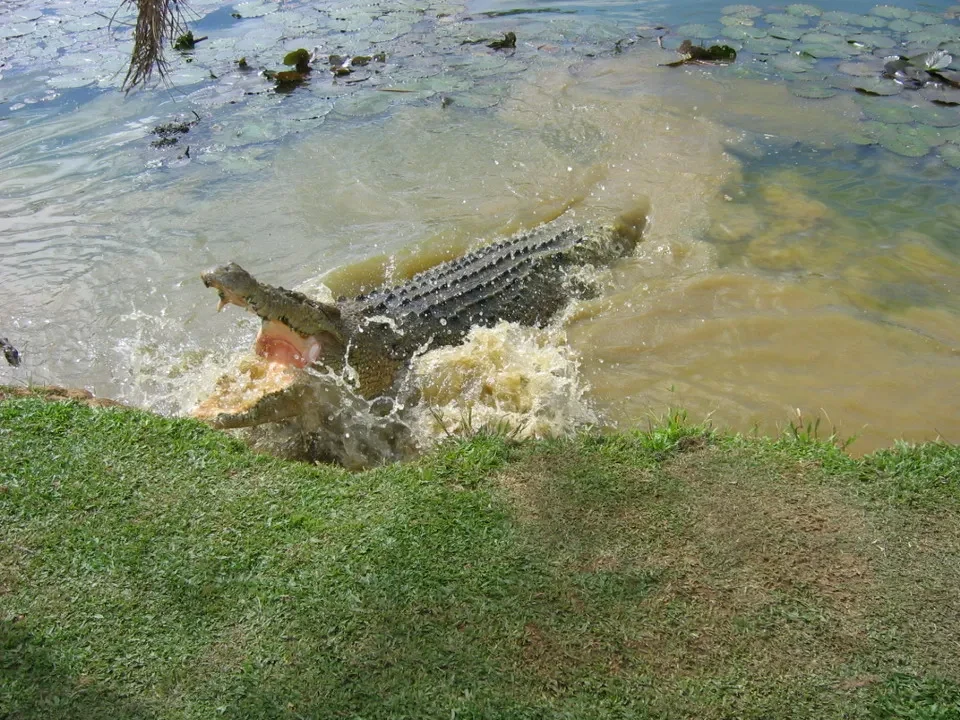
Let's first look at the alligators in their respective enclosures with an eclectic handler who offers us a lecture on the aggressiveness of reptiles. trying to harass them I used a shovel and was repeatedly attacked. Only experience prevents them from ending up on today's menu of one of these. Some bad experiences must have happened, given the scars I see on their limbs. At 3:00 PM it is lunchtime and they are fed with chicken. We are told how crocodiles are raised to obtain edible meat and leather for producing bags, wallets, etc. The largest ones have no value as skin or meat and are kept for display to tourists; one reaches a length of 6 meters. It's interesting to note how the tongue comes into contact with the palate when the mouth is open underwater, preventing the animal from swallowing water, unless it opens its mouth to pass food without being chewed. They confirm that they can spend hours underwater without breathing. They can also survive for months without food, so 6-8 pieces of chicken may be enough to feed them for a year, while they give them about sixty. They can live up to 50/60 years. Many are still with their mouths open to warm themselves: they need a temperature around 30/32°, 28° is the minimum limit. By keeping their mouths open, they "ingest" heat that their thick scales cannot pass through. They can change their teeth up to 46 times, essentially falling out and growing back continuously, and when they get old they lose them completely. Nevertheless, they can be dangerous: I see an old animal close its mouth with so much force that it breaks any object caught between its gums. In this case, the chicken literally disappears in its jaws. To kill young crocodiles for meat, they are first stunned with an electronic device placed behind their heads, then turned over and skinned to obtain meat and skin. We also see some kangaroos,wallabies, cassowaries, snakes to take pictures with, American alligators and a small dingo. The river crocodiles are easily recognizable by their smaller bodies and rows of more uniform teeth; it is said that they are not dangerous for humans, of course seeing one nearby is not a pleasant experience even without asking which race it belongs to. It's now 4:30 PM and we start the first descent south on Bruce Hwy nr. 1, first towards Ingham then towards Townsville. The sky has cleared despite passing through Tully, which is the wettest city in Australia with an average of 4000 mm of annual rainfall. This is confirmed by the lush greenery surrounding us. Not finding accommodation before Townsville, we reach the capital of North Queensland, with a population of 150,000, a true metropolis for this region. We go to dinner around 8 PM on Palmer Street, the street of restaurants, where we find a Mexican-style grill that suits us and we fill up on steak and tortillas with shrimp. An interesting fact is about the beer glasses or other drinks: they are kept in the refrigerator before being served to customers. The same applies to the hotel minibars, which also contain empty glasses. A walk through the center, which has a very particular appearance. The Mall, like all city centers, is a CBD (central business district) with professional offices and shops. Despite being Sunday evening, many bars and restaurants are closed while others are crowded with people shouting, probably there are ongoing Australian football matches that activate the enthusiastic supporters as well as drinkers. There is little local foot traffic and it seems we are the only tourists who have ventured this far.


