

Day 8
Tarangire National Park
The first collection of animals in the savanna is taking place. A live documentary.
Towards the Tarangire National Park
Endless golden savannah surrounding the Tarangire River. The river flows throughout the year and is a vital source of water for the animals in the region during the dry season. Lined with acacia and baobab trees, the river is regularly visited by the large elephant population of the park and other herbivores such as zebras and antelopes.
Meeting at 8:30 am, but a quarter of an hour before the safari driver is already in the hotel parking lot. We are also ready after a good and plentiful breakfast at the buffet. Relaxed and ready for this new adventure, we meet Modi, who is friendly and competent, having just arrived from Moshi with all the necessary equipment for the week-long camping trip, as well as our diplomas, which he had left behind in Moshi the previous day. We will meet the cook tonight, as he is already at the destination. The off-road vehicle is an old Land Rover, which shows its age but doesn't falter when shifting to lower gears; unlike more recent models packed with electronics, ours will need occasional soldering due to the incredible bumps, but it will proceed without any problems throughout the journey. To improve visibility, the roof opens completely, rising by about thirty centimeters; views and safety are thus ensured. Before leaving Arusha and its dusty chaos We stop at a shopping center dedicated to tourists, where all sorts of handicrafts are sold in a very intimate setting, perhaps a bit naive, but certainly effective and at exorbitant prices. The shops located outside the main building have the shape of Masai huts, and the surrounding fields are dotted with animals from the savanna, well-made from metal. Not far away is the handicraft museum, but we have other plans; today we're heading straight to one of the parks that will prove to be most interesting: Tarangire National Park (meaning "river of antelopes"). Along the road, beautiful agaves grow. Let's see the first Maasai. with the typical round-shaped huts, while with the tunics in vibrant pastel colors they watch over thin herds of sheep or goats. Often, these are children who wield a stick made from a branch and try to get the animals grazing in the sparse pasture to listen to them, preventing them from encroaching on the road. We also pass by a compound filled with residential blocks; we are told that it is a military training center, perhaps for aviation, as there is a small airport nearby. The traffic consists mainly of safari jeeps and trucks heading towards the center of the country, especially to Dodoma, which is its capital; everyone is very attentive to the frequent police checks.
Inside the Tarangire, between the savanna and elephants.
The flow of people in the park is completely different from what we experienced during the trekking, and we start to miss last week. Stylish people and spoiled children are clearly visible at the gate where Modi went to complete the formalities. We take note of our surroundings: the dry season leaves little room for variety of colors The landscape is dry, arid and yellow; only the tall trees, and not all of them, and some bushes have green leaves. The rest is a stark reminder of nature waiting for the expected rains in about a month and a half.
Some interesting facts we learned during the safari:
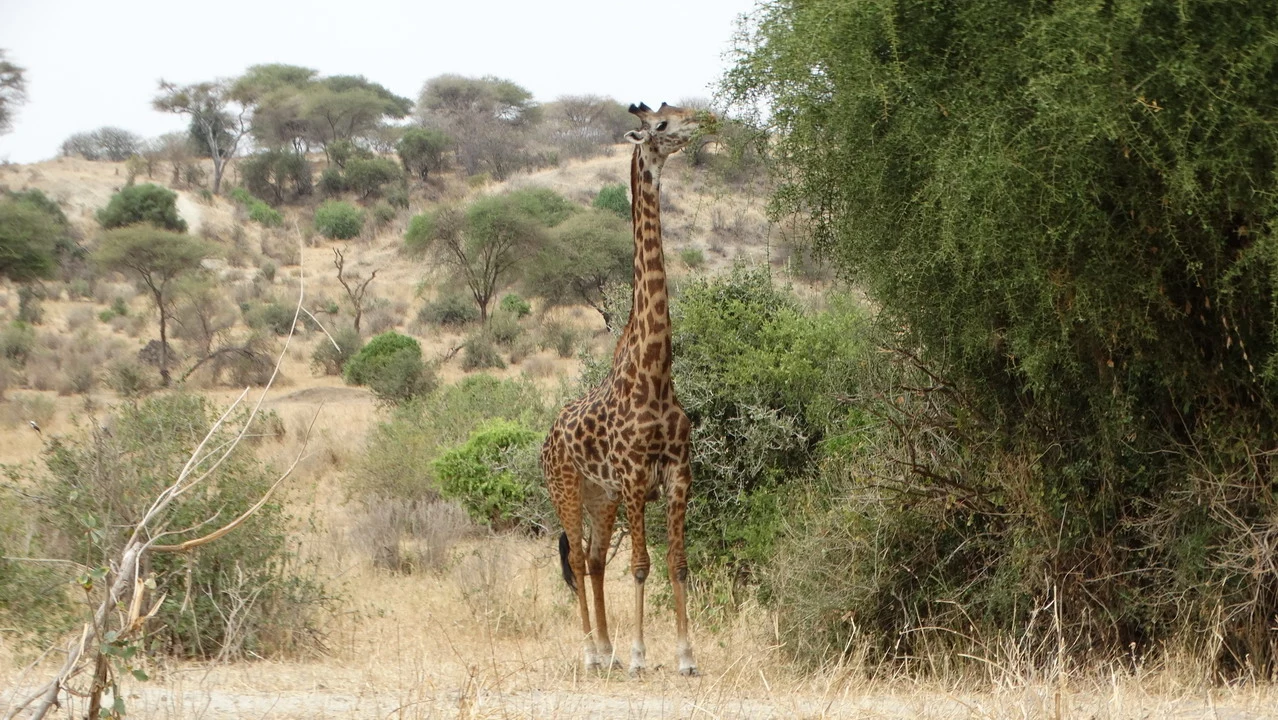
The men from the giraffe They don't have hair on their horns and necks because they eat it by fighting with others.
Rhino fair-skinned, with less pronounced lips and a larger build.
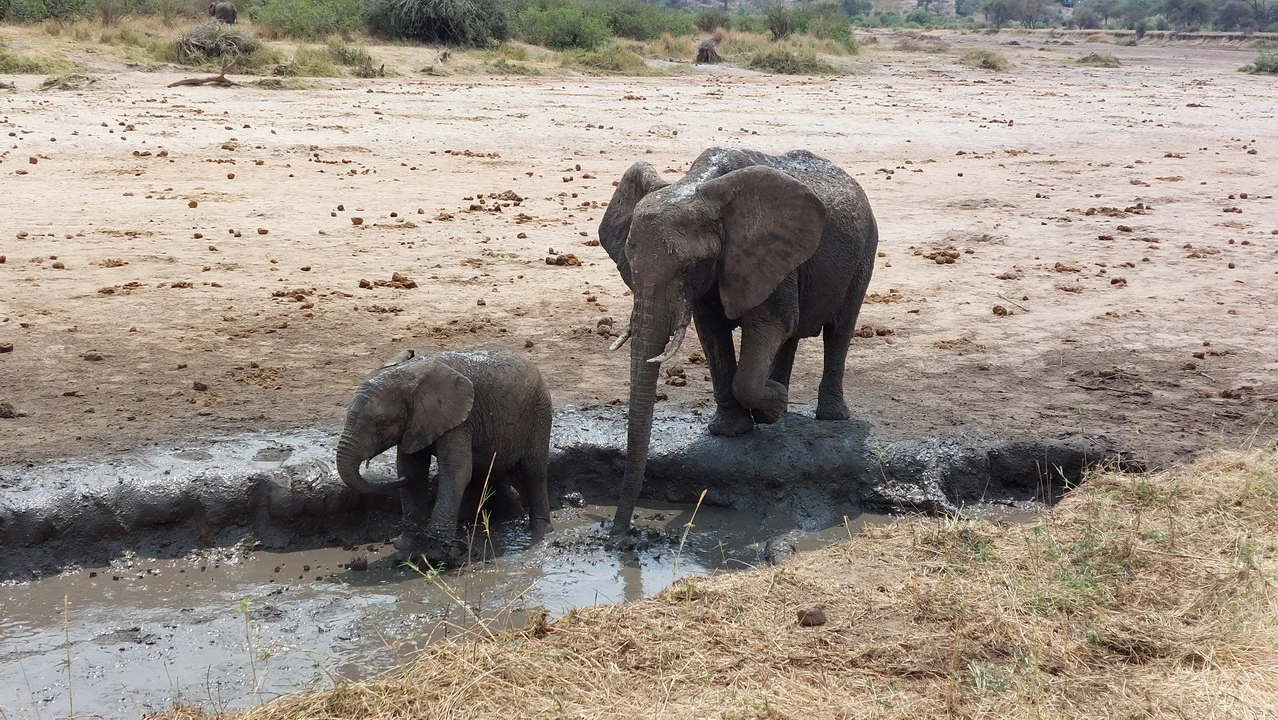
Elephants: it is said that they go to die in certain areas; this is not entirely true. When they no longer have teeth, they go looking for grass to eat, but this does not have sufficient nutritional properties and consequently the animals end up dying in certain places. Which has nothing to do with the mystical and spiritual aspects attributed to elephants. They drink about 200 liters of water per day. They do not migrate: they move around in search of food always in the same area.
If the baby dies, the mother will care for it for seven days.
The ostrich The female is grey, while the male is black and larger. Both incubate the eggs: the female during the day and the male at night, because the dark color helps to conceal them better. Despite their seemingly unathletic appearance, they can reach speeds of up to 70 km/h.
I buffaloes They have a system of solidarity among themselves, such that if one is left behind due to an attack by lions, the others stop and return to help the unfortunate individual. If they are old, they are abandoned by the group and become very aggressive because they know that they must rely solely on their remaining strength and always consider themselves under attack.
The Secret Messenger bring this name because when it bites, especially snakes, it does so with movements that resemble the sound of a machine operating. Furthermore, the white collar and feather boots make it look like an office worker.
The coloring of the zebras It seems to be linked to the fact of deceiving the felines when hunting them. The lions aim at an animal but are confused by the movement and coloration, losing their reference point. Furthermore, these animals have the habit of standing upright parallel, looking in opposite directions to have a complete view of their surroundings. It also happens that they sleep standing up for a quicker reaction.
The blue coloring of the testicles of certain monkeys It's a signal to indicate that they are ready for mating.
There is a bird that builds nests with multiple rooms, and these can weigh up to 50 kg.
I pythonsAfter eating a dik-dik or another animal, they rest in the trees, which is quite unsettling for anyone passing underneath.
ImpalaThe male has horns, while the female does not. Only one male dominates a group of females; those seen alone are the losers.
I dik dik They are usually seen in pairs because they are monogamous.
Gnu and zebras They are usually seen grazing together. The zebra eats the upper part of the grass while the gnus eat the lower part; this is why the two species often share the same pastures.
As we ventured into the park, it was amazing to see some water pools Amidst all this aridity, due to the impermeable soil and the emergence of springs in some areas, there is a concentration and variety of animals that we will only surpass in that paradise, Ngorongoro. As the first ones we see on this Tanzanian experience, we are amazed by observing zebras, giraffes, elephants, antelopes, facoceri, water antelopes, mongooses, monkeys, dik-diks, ostriches, buffaloes, secretary birds and pharaoh. By stopping, we can get a glimpse into their daily lives and physical characteristics in a real-life setting that is always difficult to detach from. But sometimes you have to tell the driver to continue searching for something else. At some point, the off-road vehicles concentrate (a rather unpleasant sight) in order to see... image of a cheetah The animal is sitting some distance away, easily recognizable only with binoculars or the maximum zoom of a camera. We stay there for a while, observing its movements, but there isn't much to see, except for the excitement of seeing the first cat. Lunch is served in an area dedicated to stopping, protected from wild animals, and perfectly prepared with hot food taken from a box worthy of the best picnics. We continue our search, approaching the Tarangire River, which we can recognize thanks to the presence of its banks. Inside the riverbed, we find a large herd of elephants. a trunk planted in the sand: we will discover that the water flows underground and they intercept it in this way. Some take a bath in the rare puddles created by the emergence, while others shower themselves by throwing muddy water on themselves, which is even more useful for protecting their skin from the sun. The children imitate their parents. a bit awkwardly, but precisely because of this they are charming. Being an animal with a matriarchal structure, when the leader indicates that recreation is over, they head in the opposite direction to where we are, returning to the savanna. Regardless of the ethological aspect, even the The landscape is fascinating. Thanks to the plateau from which, at certain points, the view opens out in the distance. Although we would never stop observing the movements of the wild animals before us, when it is 16:00, we must return, as we still have a stretch of road to take us to Mto wa Mbu. 191 (meaning "mosquito river") to stay at the lodge kindly offered by Kessy near the Migombani camp. Here we get acquainted with Lamek, the cook, and enjoy his delicious food from tonight. In fact, the lodge offers different levels of service: bungalows with a restaurant service in the premium version, standard rooms with a kitchen and shared dining area under a concrete awning, camping for tents and campers. It is located in town and well protected from intrusions; however, the atmosphere remains peaceful. After dinner, we take a walk, even though the tree-lined courtyard is not particularly illuminated, perhaps also because our eyes are gradually becoming less sensitive.


