Day 4
Kilimanjaro 3: from Shira Camp to Barranco Camp
Lava Tower, descent to 4,600 meters and beautiful natural gardens. A useful acclimatization.
Towards the Lava Tower
Habitat: Semiarid region
From Shira Camp to the Lava Tower
From the Shira plateau, we continue east along a ridge, passing the junction for the Kibo summit. Further on, the direction changes to southeast towards the Lava Tower, also known as "shark's tooth," where we reach an altitude of 4,630 meters. This is the most challenging day of acclimatization. Usually, it's here that people start experiencing shortness of breath, irritability, and headaches for the first time. Shortly after the tower, we encounter the second junction, which leads to the Arrow Glacier at 4,880 meters. We then descend by almost 680 meters to Barranco Camp. After reaching 4,600 meters at the Lava Tower, the benefits of this day in terms of acclimatization become very clear. The descent to Barranco Camp, at an altitude of 3,962 meters, takes about two hours and offers stunning views of the Breach and the Great Barranco Wall. The camp is located in a valley below these walls, in a position that often provides a memorable sunset before dinner. Although the day ends at the same altitude as our starting point, it remains a crucial step in preparing the body for summit day.
Acclimatization climb to the Lava Tower
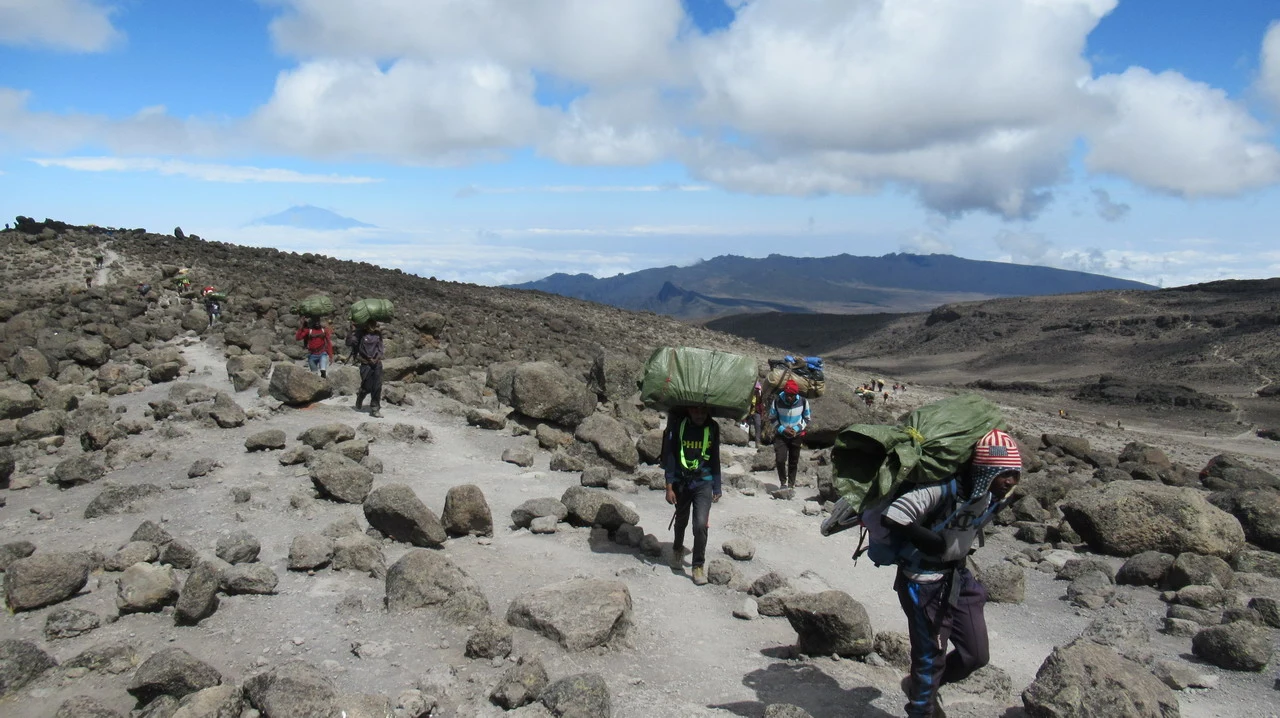
After a night where the tent was swaying in the wind, but we still managed to rest, breakfast arrives at 7 with always different and energizing products. We leave at 8 with Jackson, as Joseph remains at the camp to coordinate the porters and ensure they take all the necessary equipment. This sixty-three-year-old mountaineer's pace is remarkable: he slowly but steadily ascends without us noticing that we are covering hundreds of meters of altitude gain. We are doing well, and when Joseph reaches us, we are not far from the Lava Tower, immediately after meeting the Lemosho Route coming from Shira 2 Camp. The path quickly splits into: the carriers They will use a route that leads more directly and easily to Barranco, without having to climb to the highest point that we will reach. This is specifically for acclimatization, following the "walk high, sleep low" principle. The ascent to Lava Tower It's not particularly steep, and despite reaching an altitude of 4,600 meters, we didn't experience any particular discomfort. Always aiming to breathe as much thin air as possible, we have lunch at the highest point, where there is a tent city that wasn't expected as a campsite. After finishing our packed lunch, in the cold, partly due to a non-dense but pungent fog, we descend to the opposite, steeper side, crossing over a couple of streams originating from glaciers below the peak.
Descent to Barranco Camp
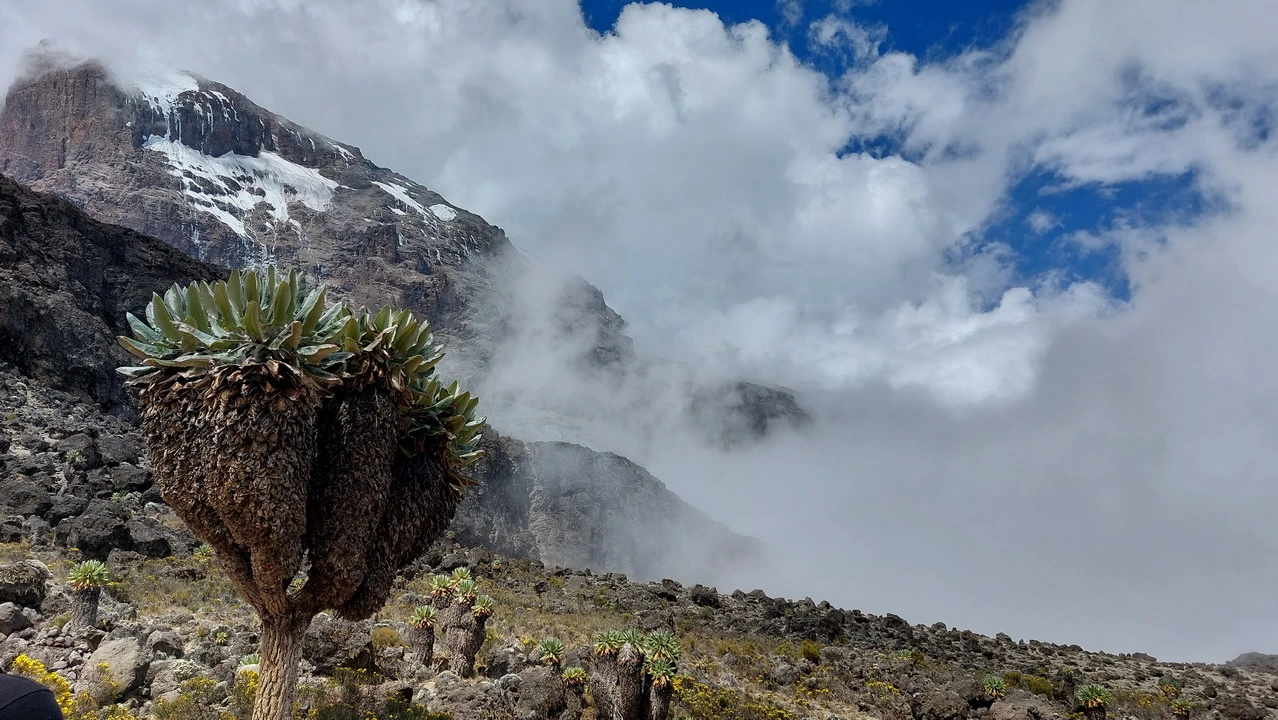
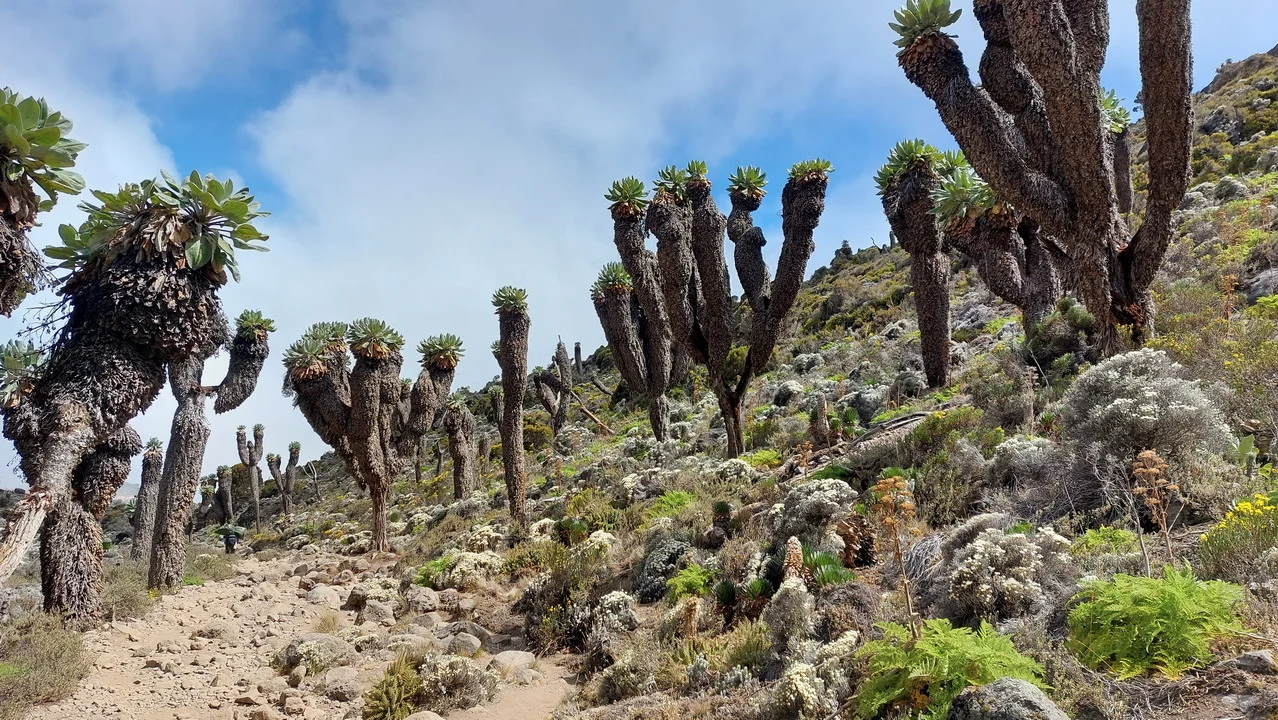
The vegetation here, things really start to take shape: plants I haven't seen before They appear before us with colors that sharply contrast against the barren and dark terrain. We are practically in a garden, with the lobelias and their beautiful blue flowers hidden among the foliage, and the dendrosenecio kilimanjari, a native plant that resembles a palm tree, has yellow flowers and lives for about thirty years before it withers and dies. The bright flowers make a wonderful foreground against the remnants of glaciers in Barranco, while other bushes similar to white hearts, very flowered, complete the scene among small streams flowing down from Kilimanjaro, crystal-clear and fast water. We see the Western Breach, which can only be accessed by signing a liability waiver, because the risk of falling rocks due to glacier melting has increased significantly in recent years; this is particularly critical for the Lava Tower, where climbing is prohibited. The descent path is constant and steep until reaching the camp at an altitude of 3,900 meters, where Jackson's whistles indicate the porters who have already set up their tents, positioned away from the rest of the camp to ensure we have at least a minimum of privacy. We are located on a panoramic terrace: below us, the mists; above, a clear space between the clouds and the peak ridge. Just beyond our heads rises the Barranco Wall, which will serve as our alarm clock for tomorrow; probably the point where our guides realize they are dealing with climbers rather than tourists seeking easy thrills. These thoughts occupy our minds: it's difficult to think of anything other than reaching the summit, the only and perhaps foolish reason for being here. In this busy town, a hub for trekkers from both the Machame and Lemosho routes, the atmosphere is relaxed. The voices of the porters alternate with those of the climbers, but we have never heard anyone speak Italian during these days, in a classic pre-challenge optimism. The first group sees Barafu as their next goal, from which they will descend to Mweka; the second group looks towards the summit, which is getting closer. Everyone knows that the hardest part is yet to come and that the fatigue has just begun. From here on out, our legs will become secondary compared to our mindset, an essential element for achieving any goal, but even more so. The sun sets early and the temperature quickly drops. I head towards the "telephone booth," where the signal is strongest, to communicate our status and emotions of the day. Then we prepare our equipment for the next day, the final approach to the summit. We enjoy a drink with popcorn and warm pistachios; the surrounding landscape is wonderful, with the remaining glaciers peeking out and the Barranco Wall in excellent condition, appearing and disappearing in the mists. We suggest taking a group photo, which is enthusiastically accepted. A quiet dinner and reading about Bonatti's latest adventure restore our mental energy; our physical energy is already well-spent, and this is a good sign, even if it's not enough on its own. Getting out of the sleeping bag to go to the bathroom requires some mental effort: simply getting out of the sleeping bag and sleeping bag requires a certain amount of attention, before re-entering without negative consequences for the joints. The cold outside is certainly not the ideal temperature, as sitting on the high toilet (only about 20 centimeters) requires a good deal of squatting ability. When we return to our tents, we are perfectly awake, but it's easy to fall back asleep quickly, thanks to the combination of altitude and fatigue. In other situations, the altitude has had the opposite effect, creating a kind of insomnia that can turn into morning energy, enough to not feel tired until we return. This time, we will not suffer from sleep; instead, we will take advantage of it by sleeping more, since there is little else to do when it gets dark, except to read some pages of Bonatti's book by the light of our headlamp. This is a real boost of energy for the next day. Just as the body needs carbohydrates at this moment, the mind needs adrenaline, positive sensations, even exaltation, to help us reach and surpass that goal of 5,895 meters.