

Day 5
Kilimanjaro 4: from Barranco Camp to Barafu Camp
Field 4, the last one uphill. We're almost there, the anticipation for the Moment is growing stronger.
The Barranco Wall and the Karanga pass.
Location: Alpine Desert
From Barranco Camp to Karanga
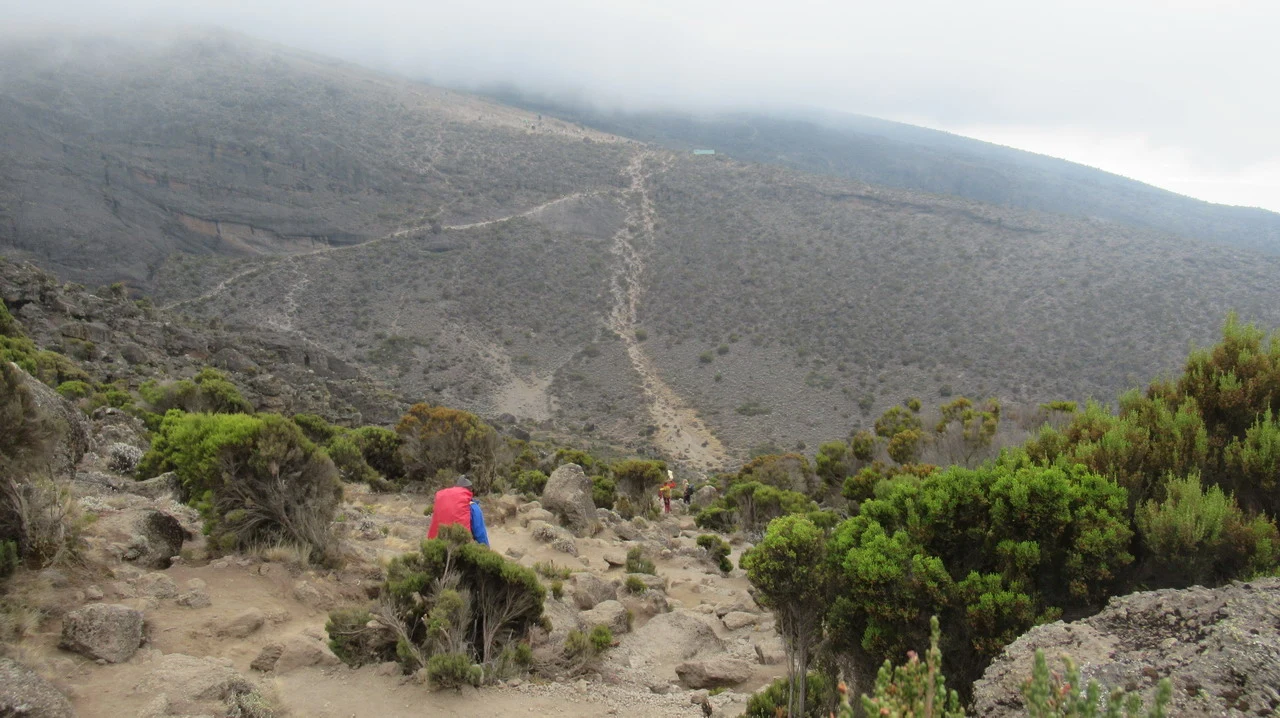
After breakfast, we leave Barranco and continue along a steep ridge passing through the Barranco Wall. Just below the Heim glacier, we can appreciate how beautiful Mount Kilimanjaro is. The path then descends through the Karanga Valley, crossing ridges and intermediate valleys. Then we leave Karanga and reach the junction that connects to the Mweka Trail. This is the preferred route for descending from the summit. We turn left onto the ridge and after about an hour, we arrive at the Barafu Hut. The last water stop on the route is in the Karanga Valley, as there is no water at the Barafu camp. From this location, you can see the two peaks of Mawenzi and Kibo. At this point, we have completed the Southern Circuit, which offers a view of the summit from different angles.
Towards Barafu Camp
Barafu, a Swahili word meaning "ice", is a desolate and inhospitable camping area where part of the night is spent. Completely exposed to storms, the campsite has tents pitched on a narrow, rocky, and rather uncomfortable ridge. The summit is 1,345 meters higher, and the final ascent will take place during the same night.
Yesterday, while we were descending to reach the camp, we saw a steep path winding along the rocky wall of Barranco Wall. Almost unbelievable at first glance, but obvious and therefore logical for exiting the valley where the campsite is located. Of course, after waking up and having breakfast, it doesn't represent the morning start that one would hope for. The guides rush us because it's best to tackle it before the crowds arrive; unfortunately, everyone thinks so. The wall doesn't require particular climbing skills, but you need to use your hands in several places. Here, we are able to demonstrate our habit of living in the mountains beyond hiking trails, easily overcoming the awkward companions from non-alpine areas. Our guides will call us "spiders," and we feel proud and grateful to the Alps, which have been a source of physical, mental, and spiritual training for us to be here and at this moment. Climbing on easy rocks at 4,000 meters still requires caution not to run out of oxygen, but the body responds perfectly to the demands of the terrain. For fairness let's allow the porters to pass, who dismantled the tents and quickly moved forward to have them ready for the next destination. Our admiration for them is boundless: we would want to erect a monument to each of those young men. Unfortunately, one of ours, at the Karanga camp, had to stop and descend rapidly due to altitude sickness: a severe headache struck him, and although wrapped in the clothes of his companions, he shivered and showed symptoms that were not encouraging. We gave him some Moment tablets, but when he reached the ranger station, he collapsed. They insisted that he immediately begin descending with two other porters, so we lost three of our men in one fell swoop. Karanga is a transit field.... where several trekkers stop for the night to acclimatize, and from here also a downhill path starts, used to take out the waste. The suffering porter leaves us stunned, and even if there are logistical difficulties ahead, that won't be the problem: what's important is that he gets down and recovers. We can't understand if it was the same person who had a crisis on the first day, but was then helped by colleagues who had already reached the Machame Camp. Certainly, he had been encouraged by our guide in the approach to Karanga, who also helped him by carrying a bag. As we are told, he hadn't practiced his profession for some time and had lost the habit of being at that altitude; with those weights on his back, there is no excuse.
From Karanga to Barafu Camp
As for us, we arrive at the top of the Barranco Wall without any problems and continue on to a I descend from the lunar landscape. until the Karanga camp. In the valley before the camp, a stream flows, which is the last source of water from here on; a few hundred meters away, we can see porters carrying buckets of plastic on their heads, carefully avoiding sudden movements so they don't spill some of the load. At Karanga, we have lunch and feel like parasites, because despite our wishes, tent refectories and toilets are still set up. Unfortunately, the guides are used to having less rustic guests, and this disappoints us; it should also be noted that Joseph doesn't want to leave anything to chance and doesn't want us to get cold during lunch. The sky is covered with low clouds., according to the budget, and there is wind; but it's not cold and we are doing reasonably well. We are aware that we need to pay attention to every detail: even just eating something too much can lead to stomach problems, while eating too little means not having enough energy. And the stakes are high: reaching the summit, now or never. The lunch was a superb creation by Musa: strips of potatoes, possibly boiled and then fried, but still crispy, with chicken, tomatoes, onions, and some bell peppers. The clever addition of spices makes the dish exceptional, the kind of lunch we would have appreciated in any restaurant.
Sunset at Barafu and waiting for the summit.
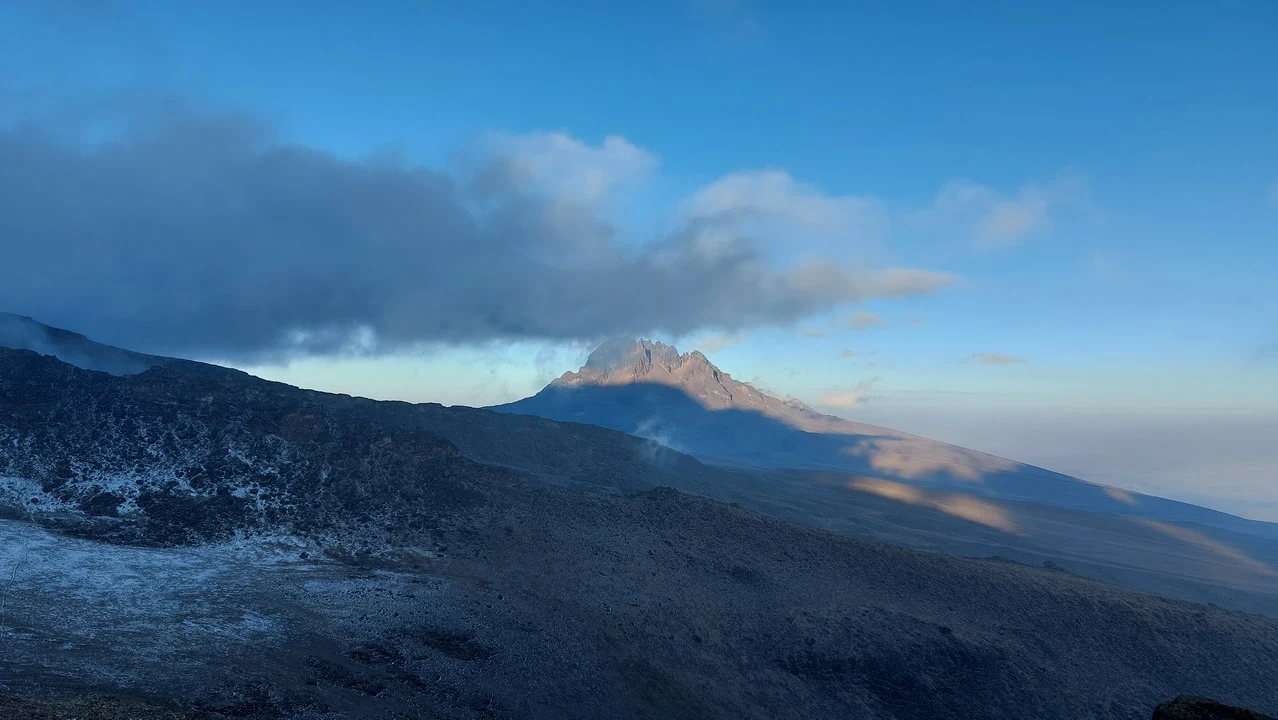
While Joseph oversees the dismantling of the tents, we follow Jackson with his graceful stride. The slope is not steep, so by proceeding slowly, there's no great effort required. The only problem is the clouds: once inside, we are enveloped in a storm of fine, powdery snow. We stop to put on our backpacks and, in a dimly lit area, we reach the Barafu Camp when a light layer begins to settle. For the reasons previously mentioned, the tent is not yet ready, but it's not a problem to wait for everything to be set up; finally, we have our base camp ready for the fourth and final climbing area. Now the cold is definitely biting, but the snowfall stops, leaving space for a nearly paradisiacal view that extends from Mawenzi On Mount Meru, passing from our own mountain still shrouded in mist. The tents have been set up on the upper part of the camp, on a panoramic terrace where we are literally perched above a sea of clouds. Behind us is Kilimanjaro, with the path leading to the edge of the crater; to the right... Mount Meru stands tall. with the peak emerging from the clouds; to the left, in a wide valley covered with the glistening layer of fresh snow, Mount Mawenzi glows beautifully at sunset. Here too, the campsite is dotted with colorful tents that slope downwards towards the valley: the atmosphere is one of anticipation, and anyone you meet during the evening walk expresses emotions and expectations about the upcoming summit attempt. We are all excited, and we are all asking ourselves the same question: will I succeed? After dinner, we climb over some rocks above the campsite to watch a sunset that is worth all the effort I've made it this far. Right now, I don't feel any particular excitement, nor fear or apprehension. I experience the wait almost with detachment, fully aware that detachment isn't really possible. We've accomplished everything we could in terms of training and preparation. The dinner was as good as it was plentiful, although we are at 4,660 meters and it wouldn't be wise to overfill our stomachs. It's cold, and when the sun sets behind the western slopes of Kilimanjaro, it becomes even colder. All that remains is to lie down and wait for a wake-up call before this day ends.


