

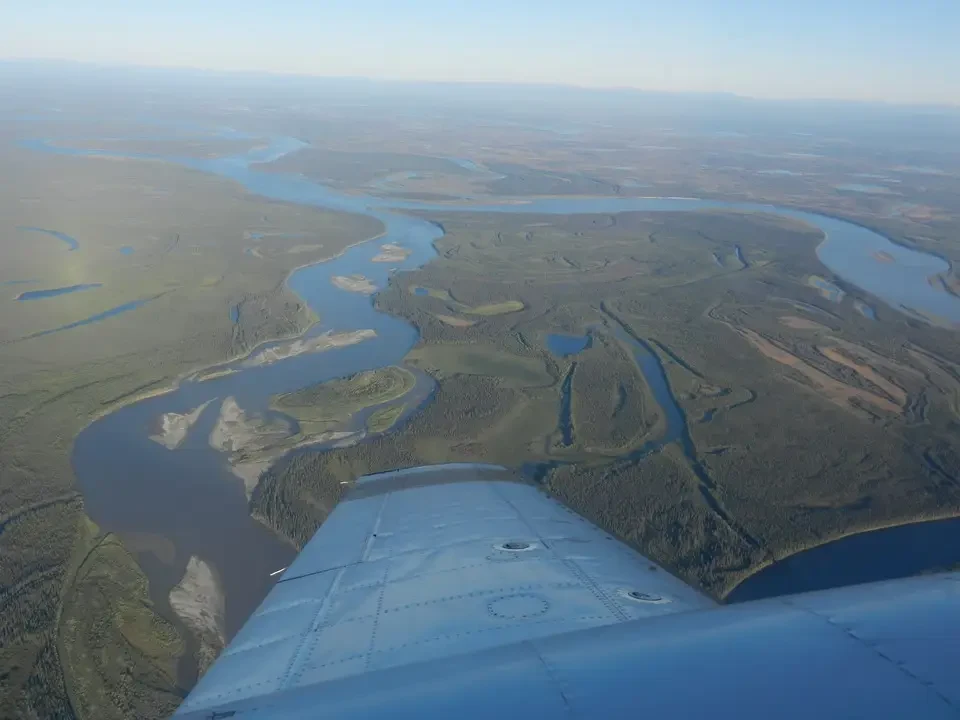
Day 7
Yukon
Dawson City, the city that embodies the gold rush era. Top of the World, the road leading to Alaska.
Along the Dempster Highway
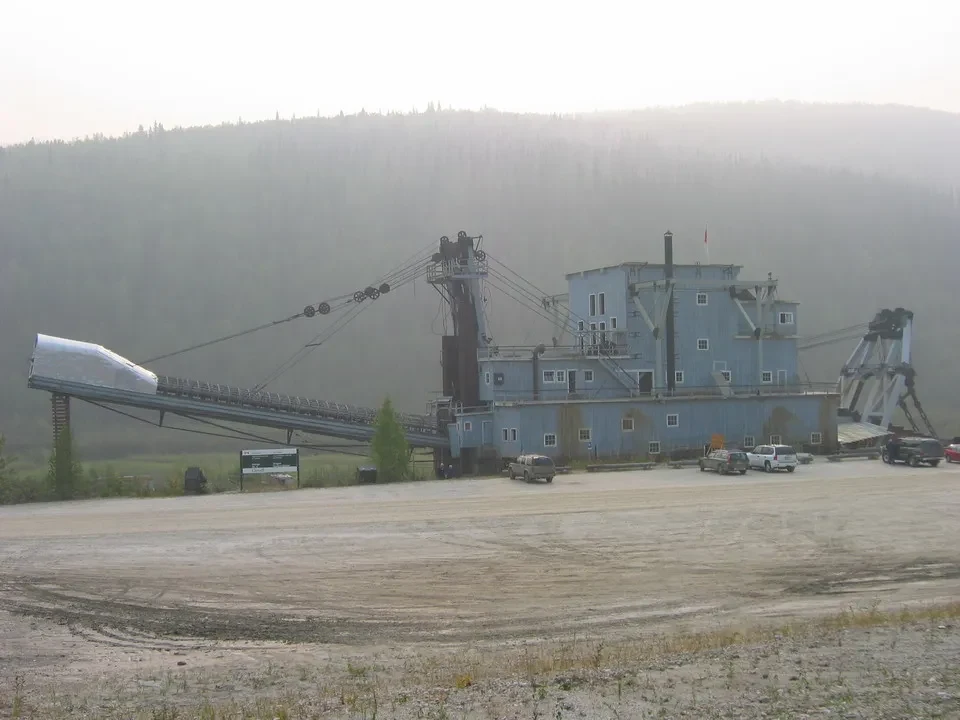
The thermal excursion remains relevant. Yesterday evening, the temperature was just under 30°C while this morning it dropped to 8°C, with a fog so dense that it made the landscape particularly evocative. A short distance south of Dawson, we encounter the Klondike River and shortly thereafter, the Dempster Hwy branches off from the Klondike Hwy, which takes us to Inuvik in about 750 km, well beyond the Arctic Circle. It is almost entirely unpaved and lacking services but with virtually untouched nature, which today still represents the true frontier. Perhaps a challenge for a future opportunity… 18 Km south of Dawson, we turn left to follow a dirt road that leads to Bonanza Creek with the Discovery Claim, the site of Carmack's original gold discovery. There is only a marker commemorating the event. Just before, there is a large Dragon number 4, now inactive, but carefully preserved. It was built on-site and was used to dredge the land in search of gold. The entire area has been so ploughed that it looks like an endless stone deposit. A disaster that lasted until the 1960s, but which proved very beneficial.
Building on permafrost
Today, in the Klondike, we still find approximately 2 tons of gold per year, but the extraction processes have changed. We drive up to the Midnight Dome, the mountain overlooking Dawson City, although unfortunately, the fog almost completely obscures the view of the city. Shortly after, we discover that it is smoke, odorless and coming from numerous fires originating from far away in Alaska. These fires have grown to a huge size, originating from as far away as Alaska.
Dawson City, was once considered one of the world's capitals for gold prospectors. Let's take a short tour through the old buildings on the completely unpaved streets with wooden houses and old saloons. The atmosphere makes it seem possible to meet writers like Jack London or the tireless old prospectors. Founded at the confluence of the Yukon and Klondike rivers, between 1898 and 1900, during the height of the Gold Rush, it once had a population of up to 30,000 people. A city that has managed to maintain its charm from the past without succumbing too much to commercial attractions. During our tour of the city, we see the Jack London's cottage and Robert Service, who were transported from a small village nearby. The houses that have not been renovated, they offer clearly visible signs of permafrost, sinking dramatically where the ground has collapsed. It is impossible to build with concrete in these areas; everything must be made of wood, and the foundations must account for the problems caused by thawing. The temperature is around 20°C. At the visitor center in Dawson, we can see the antlers of two moose, which were found stuck together. This happens because during mating season, moose fight, and sometimes they get trapped with their antlers intertwined. The weaker of the two dies, while the other, unable to free itself, becomes an easy target for animals that capture it. We book a train from Skagway and board a ferry (just slightly larger than a small boat, but capable of carrying buses and trucks) to the north shore of the Yukon River. From here begins the spectacular journey of the " Top of The World Highway", accompanied by radio programs that broadcast beautiful country music: it feels like living in another time. A fox crosses the road and doesn't seem alarmed by the arrival of the car. There are frequent stretches of unpaved roads, and it's a truly scenic drive along the gentle slopes towards the west. We maintain an average speed of around 80 km/h while the altitude varies between 800-900 meters. There are several areas, especially to the north, where the vegetation is reduced to small birch trees and shrubs, and we can already see the beginning of autumn with a colorful undergrowth. The fog has an acrid smell and impairs visibility. We sense that the views are still noteworthy. We arrive at the border with Alaska, the northernmost US border, where a friendly border guard issues us entry permits for the United States, which we will return once we definitively leave the USA, i.e., to Skagway. The fee is 6 USD per person. We cross Boundary it seems like a village of the desperate. We continue for several tens of miles on a rough and poorly maintained road until we reach Chicken, another Indian village that doesn't exude wealth. The road improves but the surrounding forests are completely burned. The soft hills Near the Taylor Hwy., you can find standing pine trees that remain untouched until they are finally damaged by the wind. In the meantime, some vegetation begins to grow in areas where the fire occurred at least 4-5 years ago. Nature takes its time, and its rhythms are less hectic than those of humans. The scene before us is still eerie, and it doesn't stimulate the senses as much as seeing the extensive green areas from previous days. At Tetlin Junction, we take the Alaska Hwy in a southeast direction. It is in worse condition than the section we traveled yesterday, and even the part in Yukon won't be better. The landscape returns to being dominated by pine and birch trees, with the Tanana River on our right. The temperature is 29°C. The rooms are decent, while the owner is overly rustic. We have dinner with a typical steak in an extremely rural setting. The restaurant displays all kinds of local animals preserved in jars. We meet a friendly construction worker from a building company who has married a German woman. He comes from Whitehorse but is working on the Alaska Hwy nearby. It's needed here, as the winter has made this area quite inaccessible. He is amazed at how Europeans can live so closely together in small spaces. In Canada, the problem doesn't exist; it's the city where he lives, with its twenty thousand inhabitants and a few traffic lights, which sometimes feels suffocating to him. The sun is about to set when we go for a walk through the parked trucks, the symbol of America on the road.


