

Day 2
Pueblos Blancos and Granada
From the Arab triumph of Alhambra to their exile in the Pueblos Blancos.
The Alpujarras and the white villages
Actually, we won't particularly enjoy the prime location – it's not the right season and wasn't even part of our plans. We wanted to stay outside Málaga for reasons of peace and quiet, and be already on the right track to head towards the Alpujarras. These are a few small villages nestled along the southern slopes of the Sierra Nevada, the so-called white villages that we will also encounter in the last days of our trip further west. In this case, the origin of these clusters is due to the concession granted by the Catholic Kings to the Muslims to flee without consequences from a recently reconquered Granada, founding towns in a classic Moorish style with flat roofs and narrow alleys forming intricate labyrinths. We leave the car in the designated parking areas at the beginning of each village to wander aimlessly along streets that are not dissimilar to those we normally see in Liguria, of course, on slopes that can be quite steep and under the spell of the white plaster that covers every part of the buildings.
We have breakfast shortly after 7:30 am – it's already 12°C – in a café not far from the hotel with sea views, before sunrise. It's Saturday, and there are only a few people around; those who want to can still sleep in. This is our first experience of the Andalusian accent, where… s It is pronounced with the tongue resting on the upper incisors, making it difficult to understand – also due to the masks. Regarding Covid restrictions, the rules are essentially the same as those in effect in Italy. We thus begin a long series of morning coffees with milk in the classic Spanish version: in a deep glass, usually without foam. On rare occasions, when ordering the same drink in different days and bars, we will be served a cappuccino – but the traditional one is without foam, served in the cup.
We take the highway – a sort of two-lane, toll-free road – that leads to Motril, passing through mango plantations with seemingly barren land and beautiful white oleander bushes; there are also olive trees, but not many. As we approach the heights of the Alpujarras, we encounter increasingly cloudy conditions – more like fog at higher altitudes – from which occasional rays of sunlight peek through. We stop for a moment to Órgiva but it doesn't seem like anything special, except for the characteristic of appearing as a large patch of white that stretches along the slopes of the Sierra. Pampaneira It's actually a lovely village that deserves a stroll through the center – it’s 10 am and the streets are starting to come alive. Berber carpets for sale, very well displayed, a legacy of North African culture that is still deeply rooted. In a shop where countless classic local ham — the dry wind makes it a typical place for aging — we buy some local ham with goat cheese and bread for lunch. Several shops display wooden barrels of sweet wine for sale by the glass or in bottles. Lanjarón also tells us little, and we quickly see it passing by in our car: thermal baths and hotels appear to be in a state of disrepair, or at best require major renovations. The temperature is definitely lower – around 6°C, and the altitude varies between 700 and 1,000 meters – the vegetation is now that of the mountains, with some flowering but a clear predominance of bare branches still in their winter attire. Between one village and another, we encounter the first expanses of olive groves, the main source of income alongside tourism. In the coming days, we will find the name Lanjarón on bottles of mineral water served at restaurant tables. Despite having slightly different urban planning, the white villages have essentially the same characteristics. Located along wide hillsides, the settlements are concentrated in a small area, with narrow streets where a car cannot always pass. Most resemble a cone, with its peak at the top represented by the church and/or castle, from which the houses descend like a milky waterfall – strictly of white color. Reasons related to climate – to allow ventilation and contain summer heat – and defensive reasons – to prevent mass attacks – have required the construction of narrow streets, thus creating this characteristic shape that makes them today highly sought-after tourist destinations.
Granada and the Alhambra
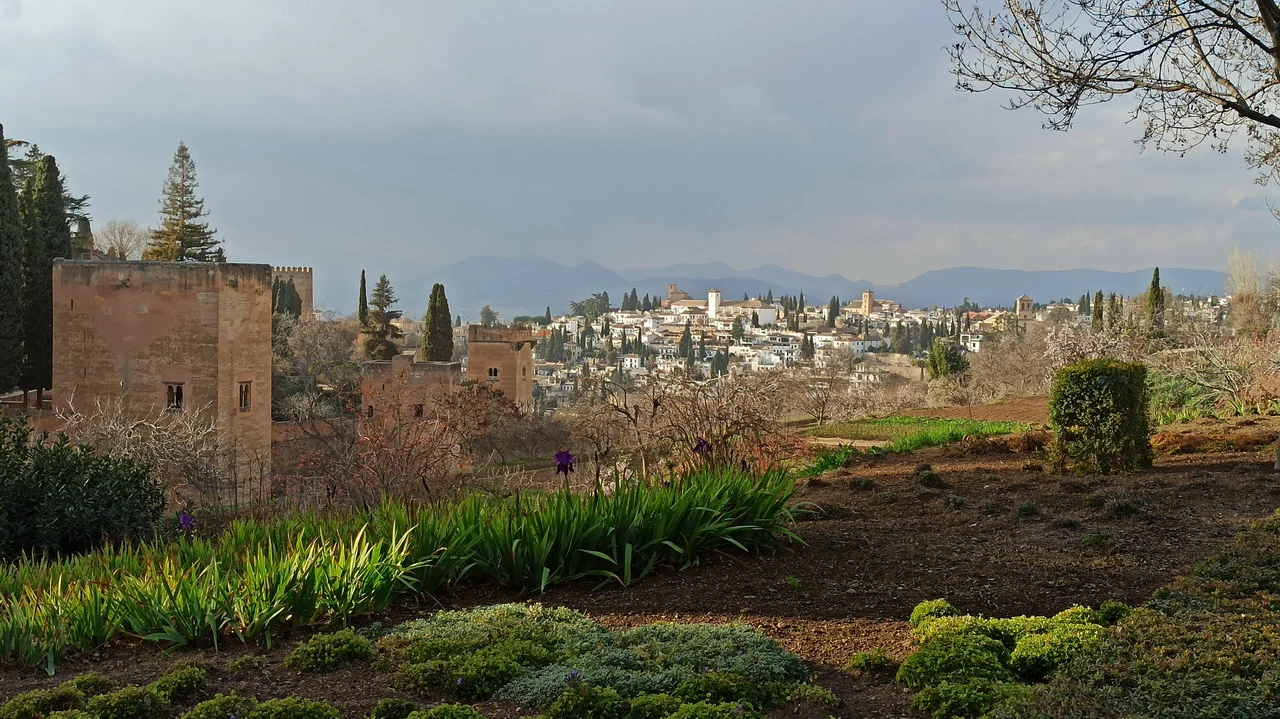
About forty kilometers away, we reach Granada: We leave the car in the parking lot of the Alhambra, which is located just above the famous monument. Having previously booked our tickets online – to ensure we could enter given the huge crowds and COVID restrictions – we head straight there. at the Alcazaba... which could be considered the military heart of the citadel. For safety, we had booked access to the interior for 3:30 PM, giving us time to have lunch and enjoy some delicious ham while sitting on a bench in the very center of the Alhambra. Afterwards, we went down to visit the city center: Plaza Nueva, the Isabel the Catholic Square, the Cathedral with the Royal Cemetery of the Catholic Kings in the Royal Chapel – where the monarchs who spearheaded the Reconquista are buried – the Basilica of Saint John of God and the Jewish quarter of Realejo. The day is quite sunny, with a temperature of 18°C; We head towards the Alhambra. to visit the Palace of Charles V — unique in its kind, with a square-based outer perimeter and a round inner courtyard — and the Palacios Nazaríes. These are a real treat for the eyes: an abundance of architectures and decorations Arabic-style harps that you wouldn't want to leave. The inlaid work — both in stone and wood — on the horseshoe arches is the work of patient and skilled craftsmen. The Arabic style has also favored the presence of numerous patios, which are regularly refreshed by fountains and water channels running through grooves, creating a refreshing image of tranquility. It is clear that Granada is one of the few Andalusian cities with abundant water, thanks to the Sierra Nevada mountains, which can be seen in the distance. Occasionally, windows open up with stunning views of the adjacent hill, where the Albayzín neighborhood — where we will spend the night tonight — and the famous Mirador San Nicolás are located. In reality, it is only "Muslim" in terms of origin and urban structure: the Arabs fled or were forcibly converted more than half a millennium ago.
Regarding this, it's worth noting the Arab-Christian history that characterized the first half of the last millennium. After the Muslim conquest of much of Spain in the following century after Muhammad’s preaching, the so-called Reconquista began, which ended precisely in the year Christopher Columbus landed in America for the first time – 1492 – with the conquest of Granada and an agreement for a Muslim enclave right in the Alpujarras we just visited. Both Granada and Málaga were the last cities to return under Spanish rule; by around 1250, Seville, Córdoba, and the western region of Andalusia had already been retaken. However, the Arab (or Moroccan Berber) character remained both in the DNA and in the style, expanding into other cities with Mudéjar architecture, thanks to its sublime finishes.
Since we're already talking about it, it's worth mentioning the Genoese navigator: there are countless streets named after Cristóbal Colón, who is considered a true son of Spain – which may be true, as aside from his birth, the Genoese navigator seems to have shared very little with his native land, dying poor in Valladolid and being buried in the Cathedral that we will see in Seville in the coming days.
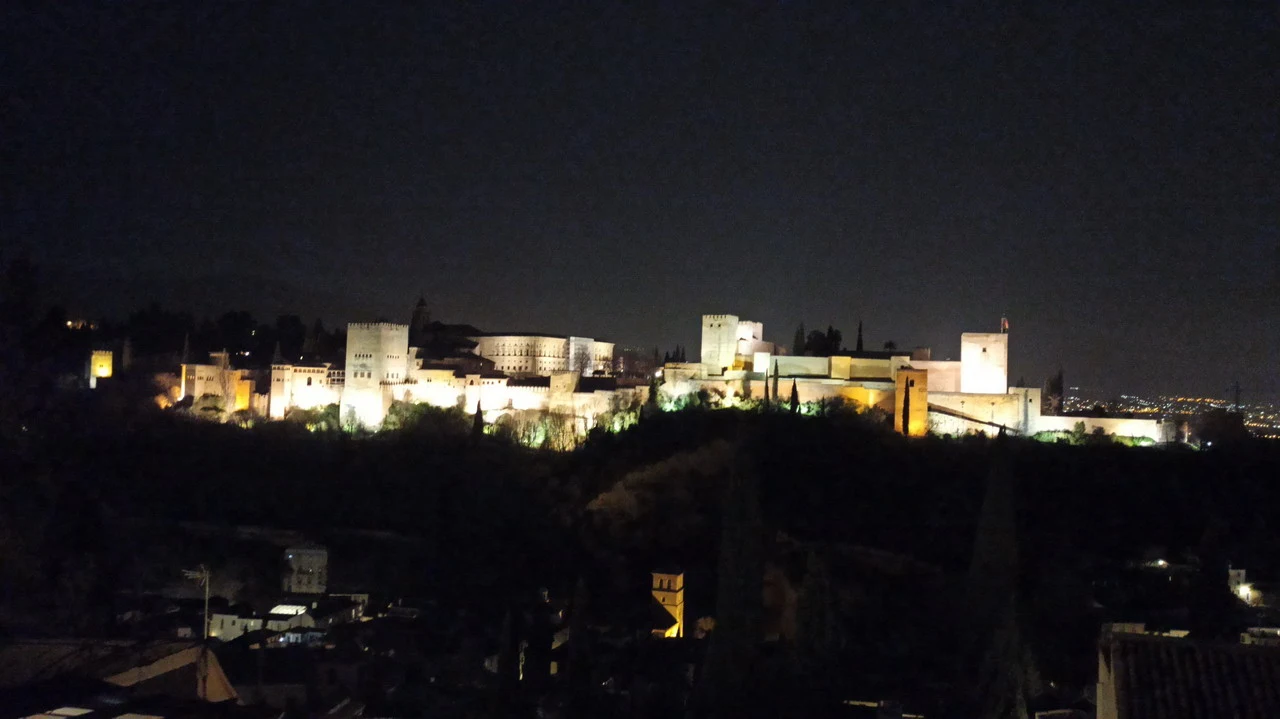
The Albayzin neighborhood at night and the Mirador San Nicolás.
We conclude our visit with a walk through the beautiful gardens of Generalife, which will be even better in a couple of months when all the plants have reached their peak bloom. Another lovely walk; so much so that, despite having eyes full of architectural and natural wonders, it's perfectly fine to sit in the car. With a long drive around the city to reach the Albayzín — walking across the valley that separates it would not have taken any more time — we arrive at the hostel booked in the heart of the neighborhood to experience its beauty fully. Near the parking lot is the San Cristobal Viewpoint... during the magical moment of sunset. The views from above allow you to admire the layout of the houses, with the courtyard in the center ensuring a minimum of coolness on the hottest days. Fate has it that just as we go out for dinner, a heavy downpour forces us to open our umbrella, paying close attention to the treacherous surface of the smooth stones, where one could easily slip even when dry. By focusing on each step through the narrow alleys between the walls, which might tell countless stories, we find an interesting Moroccan restaurant and declare it the place for dinner. The result will be positive: well-spiced kebabs, lamb chops, and stuffed eggplant. Everything is very enjoyable – and with this, we begin to feel transported to a world that is older and further away than the simple geographical distance from Spain suggests. In Granada, cold weather is not uncommon, given its proximity to the mountains; it has even snowed occasionally, but these are rare occurrences. Another walk through the center, made damp by the brief rain – despite the late hour, which is lively and illuminated. The area around the Cathedral does not have any particular features; quite different from Mirador San Nicolás, from which you can enjoy a amazing night view on the profile of the Alhambra, which stands out on the crest of the hill opposite, beautifully illuminated and glowing in the Andalusian night. We end the evening with a hot chocolate at a coffee shop, a bar with an Arab-inspired atmosphere, where shisha pipes are plentiful.
With its 230,000 inhabitants, Granada is not a particularly large city, while the accommodation options are scarce compared to the visitors who — especially on weekends — tend to flock there to visit the Alhambra, a jewel of rare beauty and one of the most fascinating defensive residential complexes in all of Europe. As we will see even more clearly in Córdoba, where there were Islamic buildings — particularly religious ones — these have been destroyed and converted into churches or government palaces; here, the example of Charles V's palace is significant. In some cases, we witness a transformation through architectural syncretism, whereby an originally Islamic building has gradually been transformed into a Christian one. Today, we must truly be grateful that not everything has been lost, and that the ancient reconquerors were captivated by such beauty without destroying it entirely.


