Day 6
Algarve
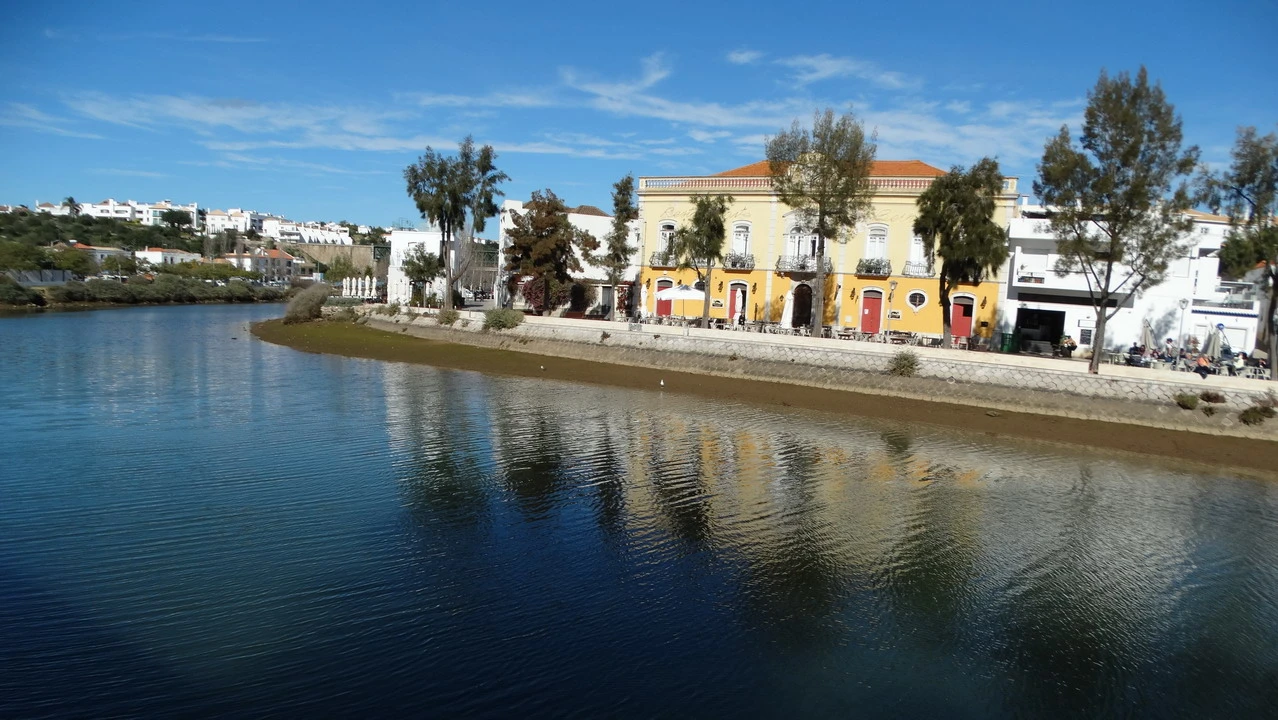
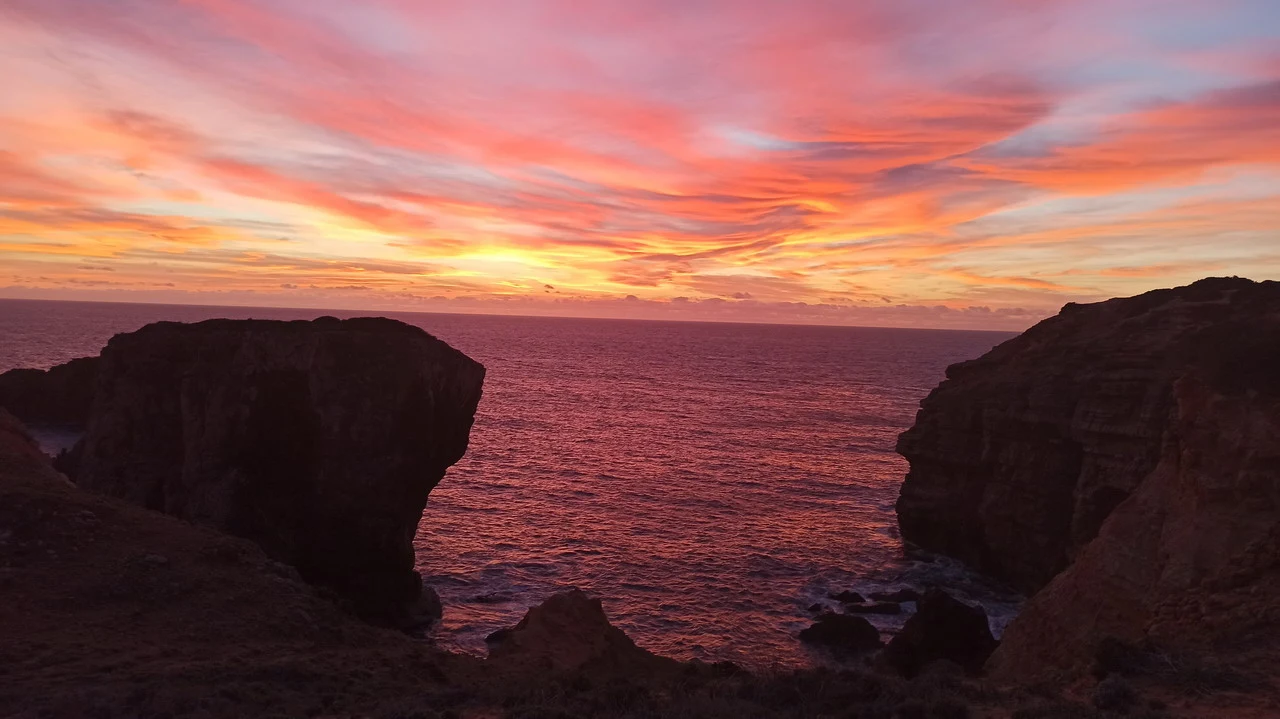
Colors: The yellow and blue tones shift to even warmer shades at sunset over the Atlantic.
From Seville to the Algarve: Huelva, Cacela Velha and Tavira
As every morning, we leave the accommodation early – according to local customs – and have breakfast at a café before heading to the parking lot to pick up our car. The only difference is that today our destination is nearby Portugal. On the way, we make a brief stop to see Huelva, mainly to cover the long iron pier of the mining company Rio Tinto, built at the end of the nineteenth century – now a historical monument – from which copper extracted just a few dozen kilometers north was loaded onto ships, while the sea stretches almost as far as the eye can see. Huelva surprises us with its green and orderly waterfront, dotted with picnic areas equipped with well-maintained and clean umbrellas, where groups of people are attending outdoor fitness classes. We had imagined it as a decaying and boring city – instead, it turns out to be welcoming and modern, human-sized, with recent and well-kept buildings, wide and shaded avenues, a relaxed and vibrant atmosphere.
There are several roads that cross the land, creating an environment rich in lagoons and wetlands, ideal for the proliferation of aquatic birds. We continue on the highway, passing through orange groves and strawberry fields in bloom – this area produces 90% of the strawberries consumed in Spain – along with fruit trees already in blossom; where the cultivated fields end, pine forests begin overlooking the sea, and we enter Portugal by crossing the modern bridge over the Guadiana. We stop to check that the automatic payment system for highways is functioning correctly: in recent days, we have linked the vehicle license plate number to a credit card on the Portuguese highway website, and the charges are automatically loaded. Once confirmed, we continue our two-day trip through Portugal. We have now arrived in the Algarve: the eastern part is more relaxed and quiet, the central part – with Vilamoura and Albufeira – is more bustling, while the western Algarve, with Lagos, Portimão and Sagres, is the historical and cultural side of the region. Our first stop is Cacela Velha, a beautiful village where the center features the church with its attached cemetery; the walls are obviously painted white and the windows have classic blue frames, typical of the Algarve. We descend the staircase to greeting the waters of the Atlantic and the shore seems like a natural botanical garden with succulents, figs, agaves and white gorse plants. Then we move on to Tavira, a beautiful town built along the calm waters of the Gilão River: let's see the castle, the historic center and the Roman bridge, which seem frozen in time, while the ferries cross the salt lagoons and reach the beautiful beaches. At this moment there is little activity, but everything suggests that in summer here there will be chaos. A quick visit to the charming covered market to buy local cured meats and take them to Ilha de Tavira, where there is silence during this season, and while the gums work, the eyes enjoy looking in every direction. We get back on the highway, discovering that the automatic payment system with license plate recognition is active between exits — we are charged a few tens of cents every few kilometers. Strangely, fuel costs almost as much as in Italy, while in Spain it was about 30 cents less.
After crossing the border, we immediately notice how much poorer Portugal is compared to Spain, both in terms of infrastructure and private buildings – simpler and more basic, if I may say so. We are facing the sea, and spring has already arrived, to the point that the trees have stopped blooming and the tender green of the leaves is starting to appear.
The first impression of the Algarve coast is wonderful and will only get better over the next two days. Cliffs and rock formations alternate in a pattern that doesn't bore the eye, and the ocean seems like those from tropical postcards, in an ensemble of rare beauty. High cliffs made of red sandstone, occasionally interrupted by small beaches, idyllic coves, and some caves, create the landscape that marks the boundary between land and sea.
Benagil, Cabo Carvoeiro and sunset at Sagres
At Praia do Carvalho, there is a staircase to reach the reddish beach along whose semicircular perimeter stand tall rocks. This is the southern Atlantic coast, made even more varied by the presence of arches, caves and enormous holes in the limestone. The contrast between the color of the beach, tending towards red, of the sea in its blue and light-blue tones, and the sparkling green of the trees in springtime, offers simply unforgettable views – far beyond catalogue images. We are quite surprised when we go to Benagil and discover that during this season, short tours do not exist and it is necessary to spend 30 euros for a longer tour which would also include the time lost bathing in the cold waters of the Atlantic. Therefore, we choose the path that allows us to see the famous cave through the large opening present in its "ceiling"; however, the sun begins to set and the view from below would already be in shadow. The fact remains that the cave is unique, even when viewed from the least scenic point – it is one of the most beautiful and photographed places in Portugal, with a natural arch that hides a sunny beach inside through an opening in the ceiling. We walk along the paths following the edge of the cliff, being careful not to overextend ourselves: the ground is fragile and falling would be fatal. Cabo Carvoeiro another wonderful view surprises us at the height of a huge arch, where the sea enjoys slowly eroding millimeter by millimeter with the patience of someone who has plenty of time. A characteristic that we unfortunately lack: it's time to get back on the highway and move definitively west, where we have a meeting with the sun for its evening farewell to Europe. From here, you can witness... end of the day, amidst several layers of clouds consistently ablaze in various warm tones. We decide to drive the 5 kilometers of unpaved road from Praia da Bordeira to Praia do Amado. It's almost 6 PM – Portugal is an hour behind us, but much further west – when the show begins: The Faraglioni cliffs seem to be on fire. and the sea is a huge basin that turns pink. It feels like living a surreal moment, where dreams take over and carry us beyond sunset. The thin layer of clouds It looks like a horizontal tent, suspended and changing as the sun sets, almost disappearing into the ocean. After one last jump of about thirty kilometers, we arrive in Sagres, where a friendly guesthouse owner is waiting for us. He gives us some useful tips on where to have dinner: we end up at a restaurant where they specialize in fish dishes, particularly the famous cod and mackerel, as sardine season runs from May to October. The day was long and the kilometers covered were many – all that's left is to rest, because tomorrow will be just as busy.