

Day 6
Ordesa National Park
Well-preserved history in Ainsa, Benasque, with views of Pico de Aneto and Occitan pride in the Aran Valley.
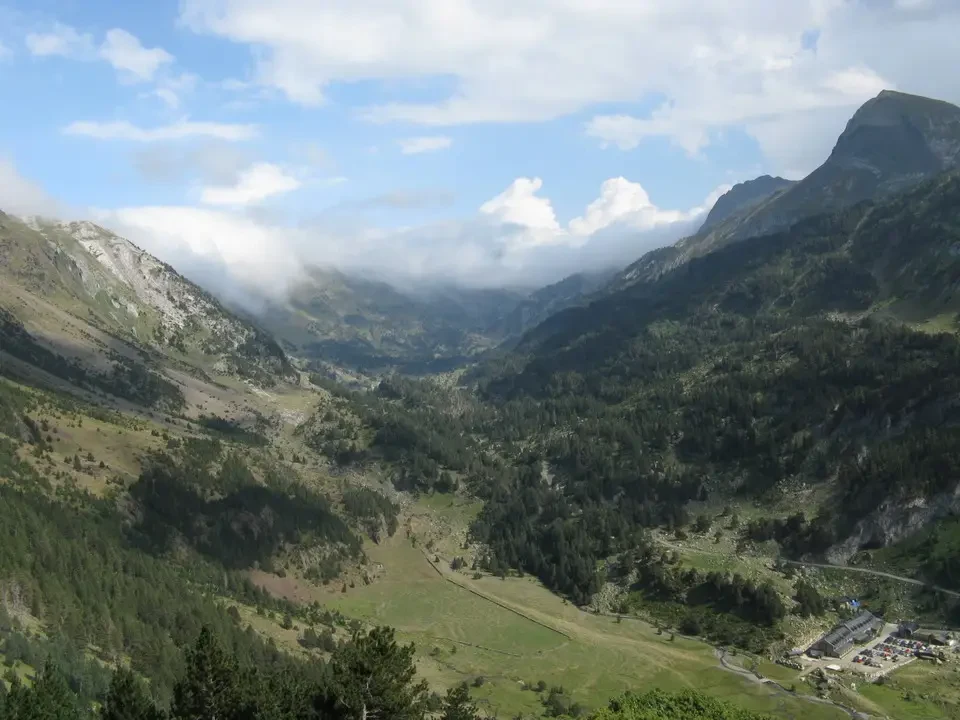
Valley of Pineta and Cinca waterfall
The morning starts again with beautiful weather. We leave around 7:45 am, still without breakfast, heading southwest towards Fanlo. We arrive near Laspuna in about an hour and ten minutes on a winding and unattractive road. We continue towards the upper part of the valley, to Bielsa. Here, the road improves significantly because it borders France to reach Arreau, lower down in Tarbes. We stock up on supplies for lunch right in Bielsa and go to Parador de la Pineta, from which the name of the corresponding circus originates, starting from the large parking lot to go to Cinca waterfall in about fifty minutes. Lunch back at the parking area. While having coffee at the bar, we were advised not to head directly east towards Benasque, as the road is only suitable for a four-wheel drive vehicle.
We head south again until Ainsa, that we visited, and we were very impressed. A town that could be compared to a small village in the Apennine mountains, with a beautifully restored center and charming architectural details. The shops are mainly aimed at tourists, but they are very well integrated into the narrow urban streets.
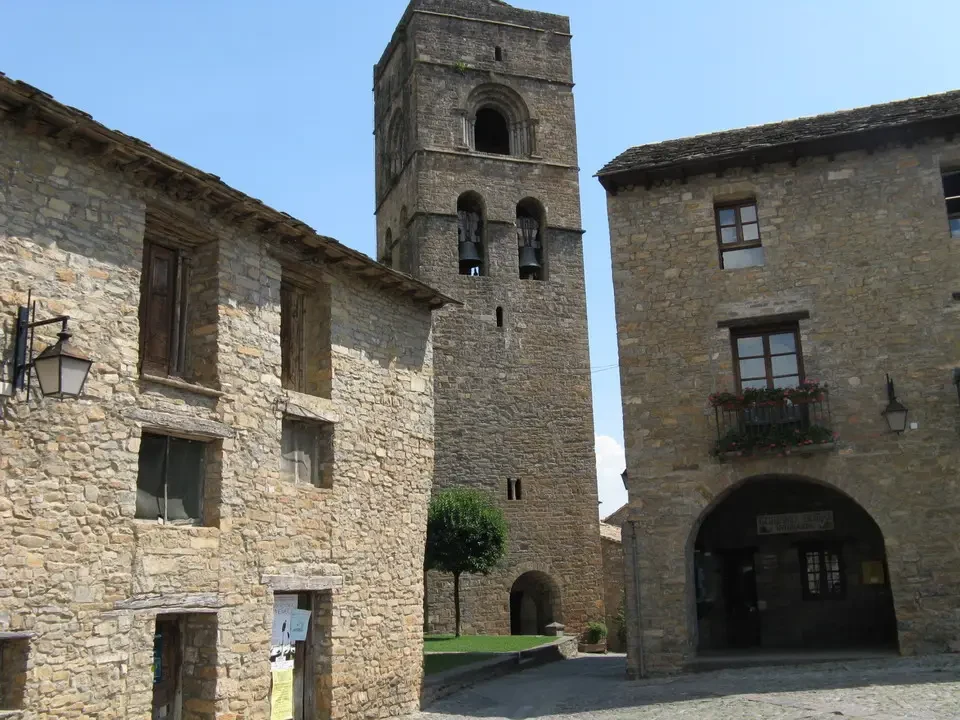
Ainsa and the Aneto-Maladeta group.
Let's see the Ventamillo Gorge, a narrow and high canyon. We finally arrive in Benasque, in an environment more similar to that of the alpine valleys. This area, belonging to the Aneto-Maladeta group, is no longer characterized by the cirques seen in Ordesa, but rather by massive formations that stretch out on the sides. It is a very popular area, not only for thermal treatments, but also for climbing the Pico de Aneto, with its 3404 meters, is the highest peak in the Pyrenees entirely within Spanish territory. In reality, Benasque is the base, but the trails start higher up. For panoramic reasons, we quickly ascend for half an hour on a steep trail on the right-hand side, covering approximately 300 meters of altitude gain, making full use of visibility, which at high altitudes is limited by afternoon clouds. In front of us lies also the wide valley leading beyond the border to the Hospice de France, near Bagneres-de-Luchon.

Val d'Aran, Occitan and evening in Escunhau
We continue along another scenic road heading southeast, connecting two valleys. These are hilly, green areas, but not comparable to those higher up. By car, we reach the highest point in the next valley, where a 5 km tunnel swallows us and we emerge on the other side into Val d'Aran. It is surprising because geographically, we are in France, as this is where the Garonne River flows towards Bordeaux, but politically, we are in Spain. Culturally, neither country: we are in Occitania. The Aran valley is actually the only Spanish valley belonging to this cultural entity.
We reach Vielha, which, in our opinion, has succumbed too much to the allure of tourism and its streets are full of tourists strolling around. The opulence brought by winter sports has taken away its charming mountain village character. We go to the local tourist information office to get a map of accommodation options and head towards quieter areas, after having purchased local cured meats from someone who knows our valleys well, as part of cultural exchange between Occitans. In some way, we feel at home and welcomed. We find a quiet place already in the next town. It's called Escunhau. A friendly elderly woman welcomes us in a rural house and recommends an authentic restaurant, skillfully aged and decorated with handcrafted objects. The sky is covered by low clouds.
Let's chat with the owner and discover how some words are very similar to our local dialect. We try the "olla aranés," a soup that also contains slices of blood sausage, cooked meats, and tuna, the "longaniza," which consists of a small sausage and blood sausage called "builh" here, almost like at home, and grilled rabbit. Upon returning, we have a long conversation with the lady who hosts us, who confirms the enormous amount of snow that fell last winter, while summer was dry. We discover that even here, the mountains don't thrive when not linked to tourism, but there has been less emigration, perhaps because there were no major cities nearby. However, the fact remains that houses are only emptied for natural reasons, although those who buy them are now mostly foreigners, as locals cannot afford the high cost of real estate, which has increased significantly due to tourism. She expresses her regret at seeing that houses that were once inhabited and lively now have closed shutters for most of the year and open only during the fifteen days around Christmas or in summer. Unlike France, where Occitan is no longer used and young people almost feel ashamed of it, in Val d'Aran it is a matter of pride and distinction, to the point that children study Aranés as their first language in elementary school. The second is Catalan, the third is Spanish, then you can choose a "foreign" language between French and English. This is seen positively because it offers young people the opportunity to learn and speak multiple languages simultaneously, increasing their mental flexibility. During the Franco dictatorship, minorities were not only forbidden from teaching local languages in schools, such as Catalan, Basque, etc., but even speaking them at home was prohibited. Given the remoteness of this valley, locals have always been able to communicate with the local language without major difficulties, although in school, Spanish was the only language allowed. This has resulted in uninterrupted pride for Occitan, which has managed to withstand the pressure and censorship of the authoritarian regime. It is interesting to note that in both Catalan and Aranés, "the valley" is masculine.


