Day 5
Vermont
The countryside of Vermont, Lake Champlain, and the autumn foliage in Vermont.
Arrival in Vermont
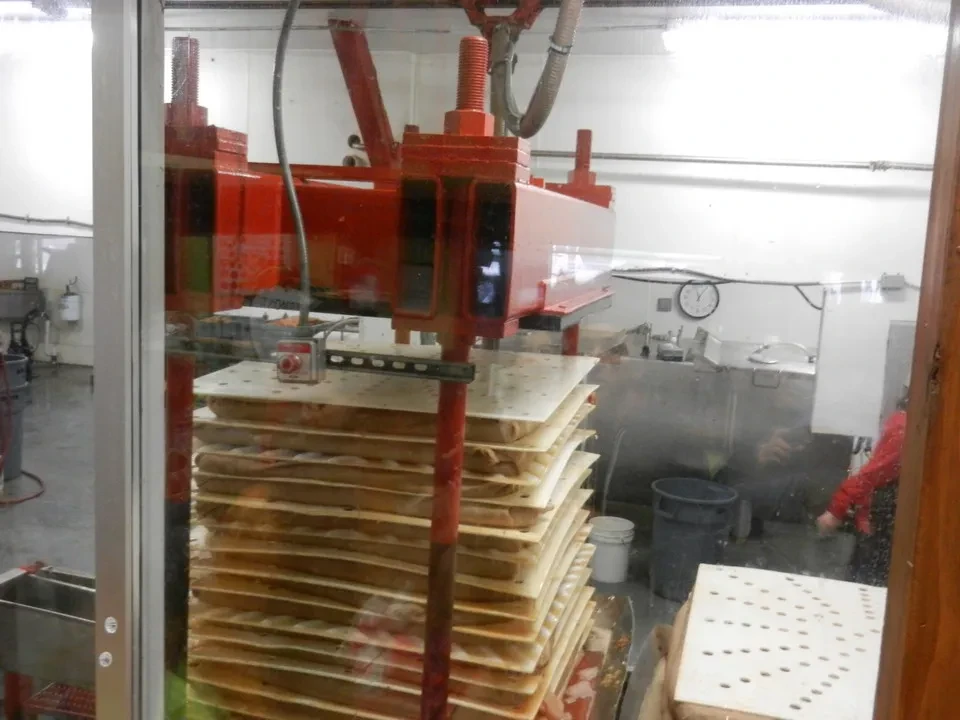
The cool night air gives way to the morning mist that will rise, revealing a light cloud cover. Today's day is situated between the White Mountains of yesterday and the Green Mountains of tomorrow, dedicated to nature and cultural activities. We begin with a visit to... Goodrich Sugarhouse... a small syrup factory. We are shown how this food is extracted and processed, which represents a symbol of the region and that we really enjoy.
It might be useful to spend some words on this, as it is an activity completely unknown in our continent: the ability to extract sap from maple trees was discovered by the Indians and dates back to ancient times. Europeans quickly realized this natural resource and began to exploit it, initially by drilling holes in the tree where they inserted a tube through which the liquid flowed out and was collected in buckets hanging on the trunk. Industrialization replaced the buckets with rubber pipes that converge into a collection center to collect the precious liquid. This system speeds up the harvesting process, avoiding having to go into the woods during a cold season, often still snowy, which nevertheless requires having two vehicles available: tracked vehicles or sleds. In fact, sap is extracted from early March to mid-April, when the temperature difference is high and the warmth of early spring at +8/10°C contrasts with the nights when it is still freezing, causing the sap to rise in the trunk. This is then collected and, if possible, processed on the same day through boiling and evaporation; a process that lasts an average of five days. The yield from sap to syrup is 1:40 liters. Syrup harvested at the beginning of the season will be sweeter and clearer, while that of April will be darker and with a higher level of acidity. Tasting four varieties of syrup one after another, you can clearly feel the differences in taste and texture. Although there are 7 varieties of maple trees, only 4 are typically used for extraction, particularly the "sugar maple". The trees can provide sap up to 50/60 years and are freed from other vegetation so that they can grow abundantly. Extraction does not damage the trees; rather, it is comparable to human blood donation. Everything is regulated by specific legislation. Our contacts are surprised (and we also ask ourselves) as to why this potential is not exploited in Europe, as maple trees are slightly different but would be suitable for extraction. However, it is true that, without a dedicated regulation, there would be a waste of trees; then, probably, specific plantations would need to be created, as in Europe, maple trees are often mixed with other trees in forests, and the resulting areas are consequently much smaller than those in North America. Nevertheless, there is no tradition here, even at the amateur production level.
Smugglers' Notch and Glen Falls
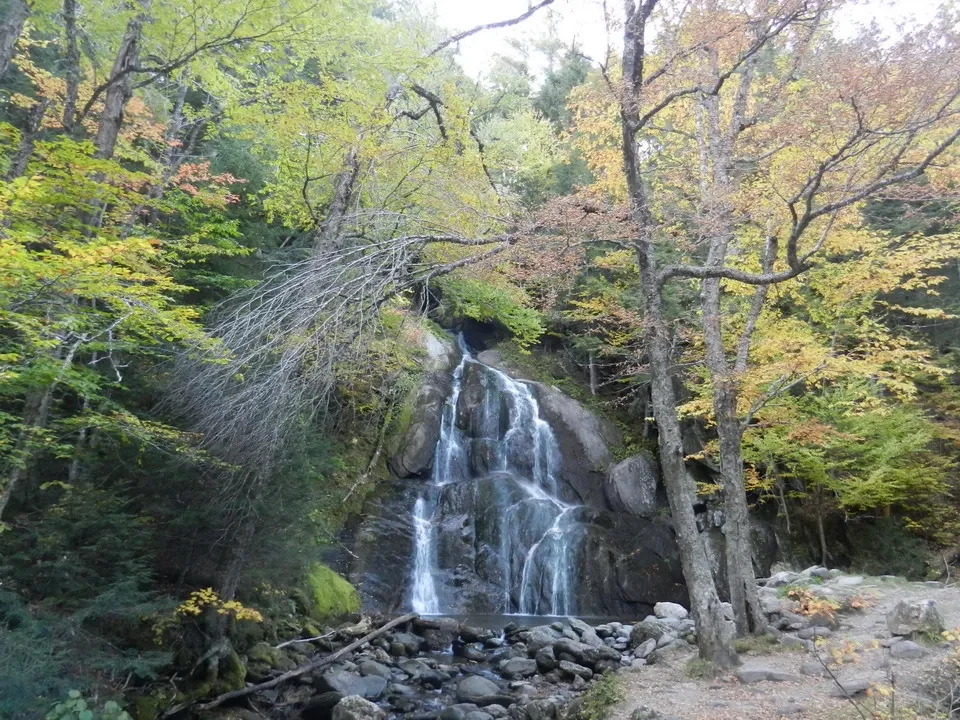
This interesting detour has caused us to fall slightly behind schedule, even today, which is already quite intense: while we are proceeding near Cabot, along a downhill road, we encounter a police car that makes a sudden U-turn and joins our queue. Although it's too late, I release the accelerator and proceed with strict adherence to the speed limits. As soon as the road allows us to pull over, the police car begins flashing its lights almost as if we were in a nightclub; it doesn't take much intuition to understand that it's time to stop, as the situation is already beyond repair. After a couple of minutes, a young officer with a pleasant and courteous appearance gets out and asks me if I have any idea why she was chasing and stopping me: I easily explain that I must have exceeded the speed limits. When she explains that the maximum permitted speed in Vermont is 50 mph while I was going at 63, she takes my documents and returns to her car. In those endless moments, I imagine myself facing a judge, forced to explain my infraction, as well as imagining the amount of the fine and any other possible penalties, which would completely derail our planned itinerary. However, when the police officer gets out, she releases me with a document titled "written warning" in which the infraction is described; I got away with just a warning, but I have been reported to the central station, and on any future infractions, I will be punished. I thank her for only receiving a warning (the officer mentions that we were driving downhill when we encountered each other, making it easier to exceed the limit), and it goes without saying that from this moment forward, my attention to not violating speed limits in this state will be reinforced. On narrow roads, typical of American standards, we arrive at... Smugglers' Notch... a hill located on top of a valley and covered with dense vegetation. As we descend south, we stop to see some beautiful waterfalls (Bingham Falls and Moss). Glen Falls) and arriving in Stowe, which is perhaps comparable to Cortina d'Ampezzo in terms of scale. However, it should be noted that there is a significant difference between the Dolomites and the Appalachian Mountains. Stowe represents the ideal destination for affluent winter tourism: in summer, the meadows of the area transform into sparkling golf courses, attracting New Yorkers, Bostonians, etc., seeking respite. There are also many resorts here, but they seem to be more organized than elsewhere, with a significantly lower environmental impact compared to what is usually seen in these areas. Continuing on, we visit Waterbury and... Cider Mill where there is a chance to see the apple pressing and their transformation into cider, so we go to the Ben & Jerry's Ice Cream Factory, to participate in a guided tour of the most famous ice cream factory: a true icon in the American ice cream landscape. Despite being acquired by the Unilever group several years ago and therefore losing its family-run character, Ben & Jerry emphasizes attention to ingredient selection, both from a quality and social compatibility perspective. In addition to seeing the production process, we are shown how purchases are made while taking environmental concerns into account: agreements with local farmers for milk, and contracts with a "progressive" approach for sourcing raw materials in developing countries. Just a short distance from the factory is a cemetery with many gravestones: on each of them, there are the ice cream flavors that are no longer produced... Who knows if the pleasure of nostalgia has ever caused some to reappear? After all, Halloween is perfectly at home in this region.

The weather never threatened to turn into rain, but for most of the day we were accompanied by a layer of clouds that thinned out, leaving clear skies only when we reached. Burlington, on Lake Champlain (the sixth of the Great Lakes). It is a university town with a youthful atmosphere, contrasting with the lives of some residents; one sees many people wandering aimlessly, a clear sign of social problems.
It's interesting to notice how many place names in this region have a clear French origin. For example, the name of the capital of Vermont (and perhaps the state itself), Montpelier, rather than Lake Champlain: all derived from the time when this area was part of French North America, around the mid-18th century, about which we remember the conflicts narrated in the wonderful film "The Last of the Mohicans." While its neighboring Quebec has maintained its own French pride and autonomy, on this side of the border, the French-speaking population has (or has been) assimilated into the American melting pot, and only the names on maps remain as a reminder of their roots, probably even the surnames of people who preferred or had to Anglicize them.
We return to Waterbury, but only to access the overview US100 heading south and returning to admire the endless stretches of forests, never identical and always stunning. Not satisfied, we drive back on US125 for the evening concert of colors and don't regret having traveled another 80 km. We check into a wonderful Inn in Rochester, similar to an elegant English home, while the adjacent Tavern is definitely American-style and also serves as a meeting point for the village, plus it produces excellent dishes.