Day 8
Punta Arenas
We leave Tierra del Fuego for Chile, crossing the Strait of Magellan.
The urban face of Punta Arenas
RIO GRANDE is a city that feels almost militarized, a legacy of the Falkland War, from which it served as its main base. Huge barracks, murals and monuments reflect its past and some aspects of its present. The city is currently more known for being the capital of Argentina dedicated to trout fishing.
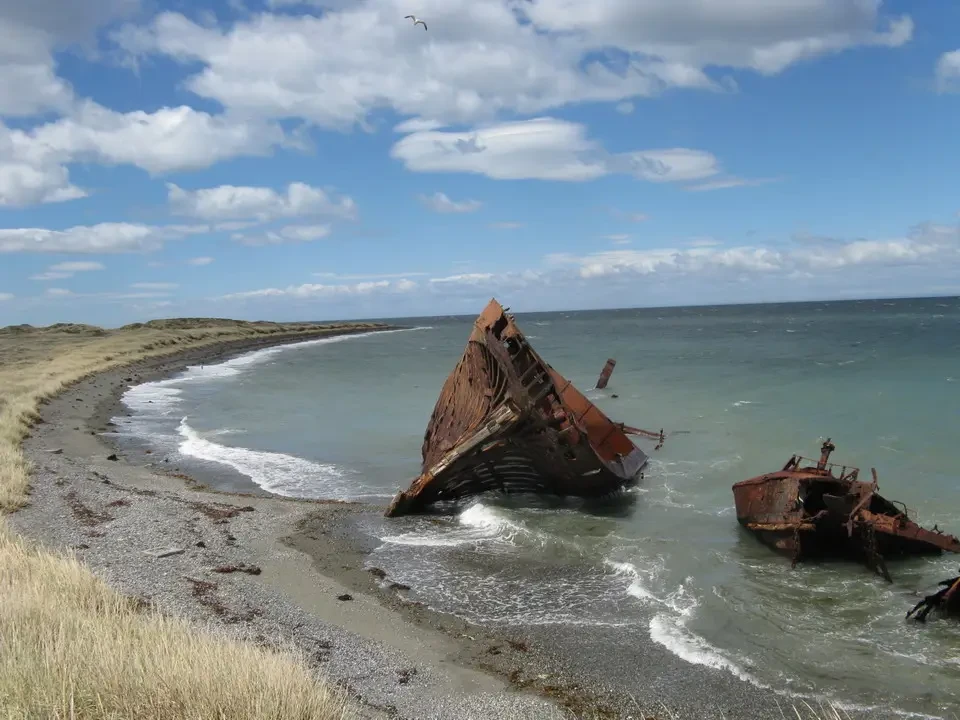
We depart at 8 am and, caught by the wind, we see the monument dedicated to the Falklands War. We fill up with fuel and set off. As we leave the city, we encounter an experience that no one had ever experienced before. It should be noted that in Argentina, there are many checkpoints where officers politely request documents and simply record them. This time, however, after the registration ritual, we receive a bag containing gifts from the police, which consist of: an air freshener, a liter of orange juice, a pen, a nearly expired calendar, and a condom. We thank them and continue happily towards the border of San Sebastian, immediately drawing parallels with our own law enforcement agencies. The operations at the border proceed without any particular problems, and here we are again on the dirt road that we had traveled a few days ago. The experience is no different and provides us with an excellent example of something very close to the concept of eternity. Luckily, the ferry for Punta Delgada is ready to wait for us. The navigation is calm, although the Strait of Magellan is slightly more choppy than it was a few days ago. This time, at the Monte Aymond crossroads, we turn west and head towards Punta Arenas. A short stop at the San Gregorio Ranch... crossed by Route 255 which leads to Rio Gallegos, to take a few photos of two abandoned ships on the shore.

Punta Arenas
The rusty, weathered carcasses of old vehicles are a reminder of the time when a narrow-gauge railway transported goods to Punta Arenas. Actually, there's a small bar hidden inside a container that we're struggling to find. The owner seems surprised to see people and immediately informs us that he doesn't have any food supplies, except for some bars and coffee. Something tells me that today we will be practicing our lunchtime jump. This former large estancia (36,000 hectares) now looks more like a ghost town, maintained by only a few people, and the shearing station is still in operation.
The wind and solitude convince us to leave this desolate land and its humble inhabitants. The steering wheel is still pointed west, amidst a landscape dotted with grazing sheep and the occasional presence of guanacos and foxes. In the province of Santa Cruz, there are almost 4 million sheep, approximately half the number that existed around mid-century. Given the arid terrain, a single sheep needs about 4 hectares to graze. The landscape remains in harmony with the Argentine one, namely, an arid steppe. At the crossroads leading to Puerto Natales north and Punta Arenas south, we turn left towards the latter. In half an hour, we arrive in town and immediately check into the hotel where we had booked, starting our city tour from there.
PUNTA ARENAS. Let's head straight to the central square, Plaza Muñoz Gamero, with some old cypress trees over 150 years old. In the center is the monument to Magellan, with a mermaid and two indigenous people (apparently touching the feet of one brings good luck). It’s clear that this is a city benefiting from significant economic prosperity. This is evident in the numerous branches of European banks. Clearly, this is the hub for oil and mineral extraction activities. We visit the graveyard, one of the most visited places, where the tomb of Menendez stands out, the wool magnate and also a patron of the city. In his memory is also the museum located in the central square. It's interesting to observe how the tombstones recall the origins of much of Europe, with a prevalence of Germans, Scots, and Slavs, who immigrated towards the end of the 19th century.
The tomb of the "unknown Indian" is instead dedicated to the "unknown Indian". The bronze statue represents a young boy with a very sweet face. The Red Cross of Magallanes province commissioned the monument in the place where the last Indians were buried. Hundreds of people come here to touch the left toe of the statue and deposit a coin in its trunk. It is said that it brings good luck. It clearly symbolizes, in some way, the tomb of the indigenous populations, overwhelmed by violence and diseases brought by the colonizers. It is completely covered with votive offerings, crowns and flowers. There are several people praying to it to invoke its favor.
Stop at Punta Arenas
We return to the O'Higgins to visit the recently renovated port, where buildings that would be perfect in Manhattan are located alongside others that are in disrepair. We have dinner at... restaurant La Luna, set up in a fun way. The mussel soup with grated Parmesan, soft bread and cream, all baked in the oven, was delicious. Although it doesn't represent the epitome of light and healthy eating, it remains one of the best dishes I have encountered so far. The beer is produced in Punta Arenas, and is considered to be the southernmost beer in the world. Another walk to the port with the cold wind and a sky just partially covered by clouds on a day that was quite windy but essentially calm. Return with night view on main attractions The view was stunning, with a few more photos of the city and bay facing Porvenir, taken from the natural viewpoint of Mirador Cerro de la Cruz, right next to our hotel. It was almost 11 PM, and daylight had been completely replaced by darkness.
The Oro Fueguino hostel is in a great location, just a few blocks from the center, quiet and right below the Cerro de La Cruz viewpoint hill. Pedro is very helpful and attentive to our needs. You can see this care from the moment you enter, with the furnishings and interior decorations. The fact that we are here during the festivities adds an extra touch of magic to the place. The breakfast area is also extremely well-maintained.